
Monomono’s Maya – Juno-Inspired MPE Synth for Ableton Live & Push 3 Standalone
A lush, expressive Max for Live synth with Juno-style tones, MPE support, and Push 3 standalone compatibility — meet Monomono Maya.
Darren E Cowley (Admin)
Lush Sound Design and Hardware Feel Meet Software Flexibility
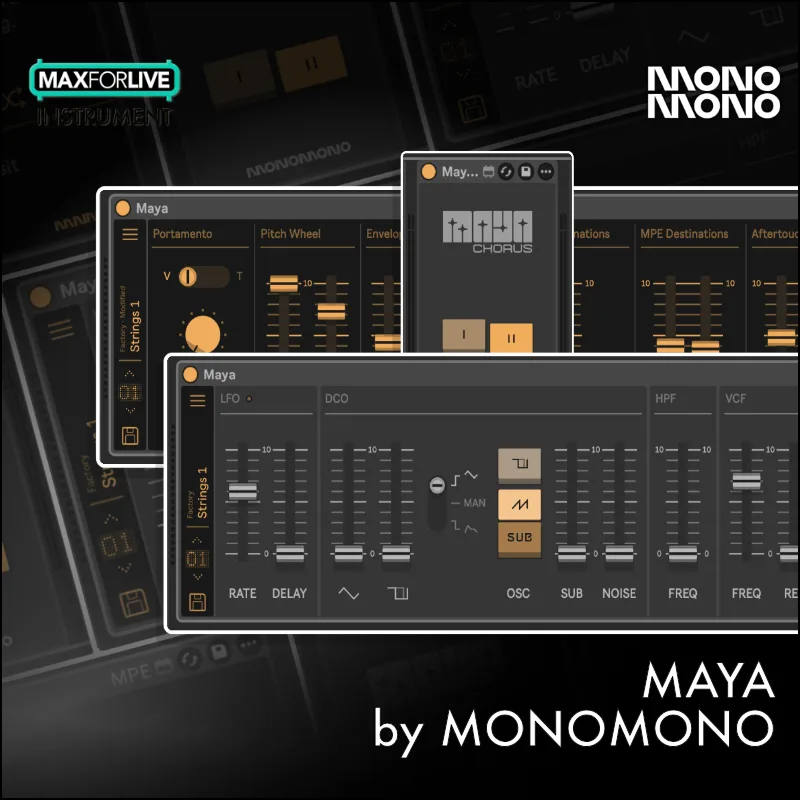
Max for Live gets another heavyweight addition with Monomono Maya — a synth that bridges vintage warmth with modern control. Designed for Ableton Live 11+ or 12 with Max for Live or Suite, this new device brings 6-voice analog-modelled polyphony, full MPE and aftertouch integration, and Push 3 standalone compatibility. Whether you’re in the box or going DAWless, Maya is built to fit both workflows.
MPE-Ready, Push 3-Optimized
Maya responds beautifully to expressive controllers — making full use of MPE and aftertouch. From Push 2 and Push 3 to Linnstrument, Osmose, or the ROLI Seaboard, this synth feels tactile and alive. Even without fancy hardware, its expressive modulation options bring depth to standard MIDI input.
And for those embracing standalone setups, Maya works seamlessly on Push 3 without a computer tether. That’s not just convenient — it opens the door to building an all-in-one live rig.
Classic Juno Vibes, with a Fresh Twist
Visually, Maya takes cues from Roland’s classic panel layouts, but its sound isn’t a one-to-one clone — and that’s a good thing. You’ll find the hallmark Juno elements here (pulse/saw waves, sub oscillator, HPF/LPF filters, and chorus modes I, II, and I+II), but with extra control and character that give it its own sonic fingerprint.
There’s even a bundle-in Chorus standalone device if you just want those lush wide textures in your own chain.
Key Features
- LFO: Rate and delay
- VCO: Frequency modulation and PWM slider
- Oscillator mixer: Pulse, saw, and sub waveforms
- Filters: High-pass + resonant low-pass with envelope, LFO, and key tracking control
- VCA: Envelope or gate modulation, gain control
- ADSR Envelope
- Chorus Modes: I, II, and I+II
- Note Spread: Width and stereo imaging
- Portamento: Constant velocity or time-based
- Pitch wheel mapping: Modulate VCO or VCF — essential for MPE tuning
- Envelope destinations: VCO, RES
- Aftertouch routing: VCF, RES, ENV
There’s even a clever “random string” analog drift function — introducing L/R channel variation for a subtly unpredictable hardware-style vibe.
Maya in Action
Dry, Maya sounds rich and spacious. But once you throw it through Rainbow Circuit’s Petal and the lush shimmer of Manifest Audio’s X-Verb, it becomes cinematic. (Both of those also run standalone — great companions for Push 3 setups.)
You’ll also find the original Roland sound presets included — if you want to channel that unmistakable Juno sweetness straight away.
Why It Matters
Monomono Maya isn’t just another retro synth model. It’s a playable, programmable instrument with genuine soul — perfect for producers who want vintage tone without the limitations. Whether you’re sketching ambient pads, building thick bass layers, or crafting melodic leads, Maya feels responsive and inspiring.
If you’re already in the Max for Live ecosystem — or exploring what Push 3 standalone can really do — this synth is more than worth your time.