
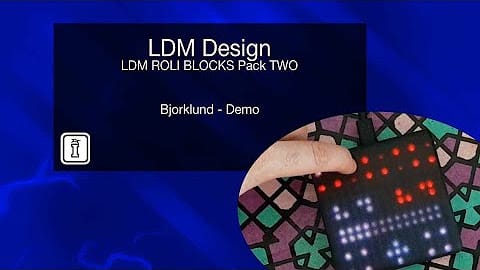
A: LDM ROLI Blocks Pack TWO is a collection of 4 Littlefoot apps for the ROLI Lightpad M hardware controller. The pack includes Bjorklund (6-channel euclidean sequencer using the Bjorklund algorithm to distribute pulses mathematically), Chance (16-step, 6-track probability sequencer with velocity and probability per step plus mute/solo controls), Pentagome (5-pattern transposable sequencer inspired by monome Polygome with pattern holding and on-device editing), and Pressulator (Kaossilator-style continuous controller for fluid scale-based playing). These apps emphasize sophisticated rhythm generation, probability-driven patterns, real-time transposition, and expressive melodic performance.
LDM ROLI Blocks Pack Two
WHAT’S BETTER THAN PART ONE?
MIX & MATCH DEAL: Choose any three or more LDM Design products and get 20% off your entire order – discount applies automatically at checkout.
Four new Littlefoot apps for ROLI Lightpad M emphasizing sophisticated sequencing and expressive performance. Bjorklund generates euclidean rhythms mathematically. Chance creates probability-driven patterns that evolve. Pentagome transposes sequences across the note grid with pattern holding. Pressulator provides Kaossilator-style continuous control for fluid melodic playing.
Inside you’ll find:
- Bjorklund: 6-channel euclidean sequencer – up to 24 steps, mathematically distributed pulses, per-step velocity control, sequence rotation, modulator for pressure/slide, color-coded tracks, polyrhythmic capabilities
- Chance: 16-step, 6-track probability sequencer – velocity and probability per step, mute/solo controls, evolving semi-generative patterns, internal or external clock, on-device tempo control
- Pentagome: 5-pattern transposable sequencer – instant transposition across 20 notes, pattern holding with pressure/slide preservation, on-device pattern editing (2-16 steps with rests), layer up to 5 held patterns
- Pressulator: Kaossilator-style continuous controller – X-axis plays through scales, Y-axis controls expression, pressure for velocity, monophonic fluid melodic lines, gestural performance
- Euclidean algorithm produces traditional drum patterns mathematically
- Probability control creates controlled evolution within boundaries
- Pattern transposition enables real-time reharmonization
- Continuous scale playing for expressive, fluid performance
- Visual LED feedback for pattern editing and playback monitoring
- On-device menus for root note and tempo control
- Internal or external MIDI clock sync
- MPE expression or single-channel mode
- Portable battery-powered operation via Lightpad M
- Installed via ROLI Dashboard (Mac/Windows)
Generate interlocking euclidean polyrhythms. Create probability-driven patterns that never repeat identically. Transpose melodic sequences in real-time. Play fluid scale runs with continuous control. Layer held patterns for complex arrangements. All from portable, tactile hardware.
Requires: ROLI Lightpad M hardware controller | ROLI Dashboard software (Mac/Windows)
USER GUIDE: Bjorklund
LDM ROLI Blocks Pack Two
WHAT’S BETTER THAN PART ONE?
MIX & MATCH DEAL: Choose any three or more LDM Design products and get 20% off your entire order – discount applies automatically at checkout.
Four new Littlefoot apps for ROLI Lightpad M emphasizing sophisticated sequencing and expressive performance. Bjorklund generates euclidean rhythms mathematically. Chance creates probability-driven patterns that evolve. Pentagome transposes sequences across the note grid with pattern holding. Pressulator provides Kaossilator-style continuous control for fluid melodic playing.
Inside you’ll find:
- Bjorklund: 6-channel euclidean sequencer – up to 24 steps, mathematically distributed pulses, per-step velocity control, sequence rotation, modulator for pressure/slide, color-coded tracks, polyrhythmic capabilities
- Chance: 16-step, 6-track probability sequencer – velocity and probability per step, mute/solo controls, evolving semi-generative patterns, internal or external clock, on-device tempo control
- Pentagome: 5-pattern transposable sequencer – instant transposition across 20 notes, pattern holding with pressure/slide preservation, on-device pattern editing (2-16 steps with rests), layer up to 5 held patterns
- Pressulator: Kaossilator-style continuous controller – X-axis plays through scales, Y-axis controls expression, pressure for velocity, monophonic fluid melodic lines, gestural performance
- Euclidean algorithm produces traditional drum patterns mathematically
- Probability control creates controlled evolution within boundaries
- Pattern transposition enables real-time reharmonization
- Continuous scale playing for expressive, fluid performance
- Visual LED feedback for pattern editing and playback monitoring
- On-device menus for root note and tempo control
- Internal or external MIDI clock sync
- MPE expression or single-channel mode
- Portable battery-powered operation via Lightpad M
- Installed via ROLI Dashboard (Mac/Windows)
Generate interlocking euclidean polyrhythms. Create probability-driven patterns that never repeat identically. Transpose melodic sequences in real-time. Play fluid scale runs with continuous control. Layer held patterns for complex arrangements. All from portable, tactile hardware.
Requires: ROLI Lightpad M hardware controller | ROLI Dashboard software (Mac/Windows)
USER GUIDE: Bjorklund
Additional information
| Synth Compatibility | LightPad M |
|---|---|
| Min. Requirements | ROLI Dashboard to update your BLOCK |
| OS | Mac, Windows |
PRICE: £30.00
Product reviews
No reviews yet. Be the first to review this product.
LDM ROLI Blocks Pack Two
Overview & The Next Wave
LDM ROLI Blocks Pack TWO delivers four new Littlefoot apps for the ROLI Lightpad M, building on the foundation established by Pack ONE with sophisticated sequencing and performance tools. Bjorklund generates euclidean rhythms using the mathematically elegant algorithm found in traditional drum patterns worldwide. Chance provides 16-step, 6-track sequencing with per-step velocity and probability for semi-generative patterns. Pentagome enables instant transposition of five programmable sequences across the note grid with pattern latching and pressure preservation. Pressulator transforms the Lightpad into a Kaossilator-style continuous controller where X-axis slides through scales and Y-axis controls expression.
Where Pack ONE focused on chord triggering, guitar layouts, and general-purpose control, Pack TWO emphasizes algorithmic pattern generation and expressive melodic performance. These apps leverage the Lightpad’s unique capabilities differently – Bjorklund and Chance use the LED grid for visual pattern editing and playback monitoring, Pentagome creates complex layered sequences through pattern holding, and Pressulator treats the entire surface as a continuous playing field for fluid melodic lines. The result is a toolkit for producers and performers who want intelligent rhythm generation, probability-driven evolution, and expressive scale-based playing from portable hardware.
Like Pack ONE, these apps install via ROLI Dashboard, run natively on Lightpad M hardware without computer connection, and work with any MIDI software or hardware via USB or Bluetooth. They share common features including on-device root note menus, internal or external clock sync, MPE or single-channel modes, and scale selection in Dashboard. Combined with Pack ONE, you have nine specialized Lightpad interfaces covering chord performance, sequencing, MIDI control, rhythmic programming, and melodic playing – all from one compact, battery-powered controller.
Bjorklund: Euclidean Sequencer
Bjorklund applies the euclidean algorithm to rhythm generation, distributing pulses as evenly as possible across a defined number of steps. This mathematical approach produces patterns found in traditional music worldwide – Cuban clave rhythms, West African bell patterns, and Turkish usul cycles all follow euclidean distributions. Set total steps (up to 24) and number of pulses (active steps), and the algorithm calculates optimal spacing. A 16-step sequence with 5 pulses creates the Cuban tresillo pattern. Eight steps with 3 pulses generates a common African timeline.
The top display shows the currently selected sequence with bright colors indicating active steps. Buttons below increase or decrease total steps and pulses. The sequence color matches the selected track from six available channels, each triggering notes according to the scale set in Dashboard. Slide your finger across the sequence display to rotate the pattern, nudging all steps forward or backward while maintaining the euclidean distribution. This rotation creates rhythmic variations without changing the underlying pulse structure.
Hold any step to reveal a velocity slider for per-step dynamics control. Each of the six tracks can have different step counts, pulse distributions, and velocity programming, creating complex polyrhythmic layers. A modulator button sends pressure and slide data for the selected channel – press for pressure, slide vertically for expression. This adds real-time parameter control over patterns, mapping to filter cutoffs, effect sends, or any MIDI-controllable parameter. Color-coded track buttons make visual track selection instant, while play/stop buttons (left and right bottom) control all sequences simultaneously.
The mathematical elegance of euclidean rhythms creates patterns that sound musical without manual programming. Set different step and pulse combinations across six tracks for interlocking polyrhythms that phase and interact organically. Rotate patterns in real-time during performance to create fills and variations. Adjust per-step velocities for dynamic shaping. The modulator adds expressive control over downstream parameters. Bjorklund turns mathematical distribution into tactile rhythm programming with visual feedback and instant musical results.
Chance: Probability Sequencer
Chance provides 16-step, 6-track sequencing with velocity and probability control per step, enabling semi-generative patterns that evolve within defined boundaries. Tap any square in the pattern grid to activate that step – strike strength sets initial velocity. Hold any step to reveal a velocity slider for manual adjustment. Enable the Probability button to switch the slider to probability mode, where you set the percentage chance that step will trigger. Default probability is 100%, guaranteed playback. Lower values introduce controlled randomness.
Six color-coded track buttons along the top select the active track for editing. Each track has dedicated solo and mute buttons for live performance control – mute tracks to create breakdowns, solo tracks for isolated elements, combine both for dynamic arrangement changes. The pattern grid displays all 16 steps with color intensity indicating velocity levels and probability states. A play/stop button in the bottom right starts and stops the sequence. The side button menu provides root note selection and internal tempo adjustment (tens and units) for standalone operation.
Probability sequencing creates patterns that never repeat identically. A hi-hat pattern with every fourth step at 60% probability creates subtle rhythmic variation. Melody lines with occasional note probabilities at 30-40% produce evolving phrases. Layering multiple tracks with different probability settings generates complex, non-repeating arrangements from simple 16-step patterns. The mute and solo controls enable live manipulation – build arrangements by unmuting tracks progressively, create tension by muting elements, highlight specific tracks with solo.
Dashboard settings configure MIDI mode (MPE or single channel) and scale selection. Internal clock enables standalone sequencing, while external MIDI clock sync locks patterns to DAW or hardware tempo. On-device tempo control (accessible via side button menu) adjusts BPM in tens and units when using internal clock. Chance bridges the gap between rigid programmed sequences and chaotic randomness, providing the controlled evolution that keeps electronic music engaging across repeated listens.
Pentagome: Transposable Pattern Sequencer
Inspired by the monome Polygome, Pentagome allows instant transposition of five programmable sequences across 20 different starting notes. The main grid displays notes from the selected scale with the root note at bottom left, ascending through octaves with tonic notes highlighted in different colors. Five pattern buttons on the right select which sequence is active (indicated by white square). Press any note on the grid and the current pattern plays transposed relative to that note. Pressure controls velocity (or can map to aftertouch in Dashboard), slide sends expression via vertical finger movement.
Pattern holding is Pentagome’s most powerful feature. Press the currently playing pattern button while a pattern is playing to latch it – the pattern continues even after lifting your finger from the note grid, and the pattern button flashes to indicate held status. Pressure and slide values at the moment of latching are preserved and applied to the held pattern. Now press another note to transpose that same pattern from a new root, or select a different pattern button to layer a second sequence. Build up to five simultaneously playing patterns, each transposed to different notes and each with its own latched pressure and slide values.
Release held patterns by pressing the button again – one press selects, second press releases. Release all patterns simultaneously by pressing two fingers on the pattern buttons. Pattern editing happens on-device: hold the side button and press a pattern button to enter edit mode (top row turns grey). Play notes on the grid to program the pattern – each note is saved relative to the first note pressed. Tap the top row to insert empty steps (rests). Press the pattern button again to save. Patterns can be 2 to 16 steps with variable lengths and rest placements for complex rhythmic phrasing.
This creates compositional workflows impossible with traditional sequencers. Program five melodic or rhythmic phrases. Perform them in real-time by pressing different grid notes to transpose. Layer multiple patterns for harmonic and rhythmic complexity. Latch patterns with specific pressure/slide values, then transpose them while adding new layers. The visual grid layout makes harmonic relationships clear – octaves stack vertically, scale degrees spread horizontally. Dashboard provides scale selection, MPE or single-channel mode, slide CC assignment, and tempo configuration for internal or external clock.
Pressulator: Continuous Scale Player
Pressulator transforms the Lightpad into a Kaossilator-style continuous controller where sliding across the X-axis plays through a selected scale and Y-axis movement controls expression. The entire LED grid becomes a gradient playing surface with no discrete note boundaries – slide horizontally to trigger scale notes in sequence, slide vertically to modulate the slide parameter (typically mapped to filter cutoff, vibrato, or effect sends). Pressure sets note velocity by default but can be configured in Dashboard for channel pressure or aftertouch.
The interface is deliberately simple – a color gradient from yellow to magenta indicates the playing surface. Select your scale and root note in Dashboard. Touch the Lightpad and slide your finger horizontally – notes trigger as your finger crosses invisible thresholds corresponding to scale degrees. Unlike keyboard-style interfaces where notes occupy fixed positions, Pressulator’s continuous surface enables fluid glissandos and scale runs with no gaps. Vertical movement sends real-time modulation while notes play, adding expression impossible with traditional MIDI keyboards.
The monophonic design ensures clean melodic lines without accidental polyphony. This focus on single-note performance encourages expressive, fluid playing styles. Use Pressulator for lead lines that bend and flow between scale degrees, bass parts that slide into notes, or experimental melodic exploration where continuous pitch movement matters more than precise note selection. The side button menu provides on-device root note and octave adjustment, changing the scale’s pitch range without accessing Dashboard.
Dashboard settings include MIDI channel assignment, scale selection from the standard library, pressure mapping options (velocity, channel pressure, aftertouch), and slide CC number for Y-axis modulation. The combination of horizontal note triggering, vertical expression control, and pressure-based dynamics creates a three-dimensional performance interface where simple gestures produce complex, expressive musical results. Pressulator excels at performance scenarios where gestural playing and continuous control matter more than precise rhythmic placement.
Shared Features and Integration
All four apps share common functionality streamlining the user experience. On-device menus (accessed via side button) provide root note and octave selection plus internal tempo adjustment where applicable. Dashboard configuration includes scale selection, MPE or single-channel mode, and various CC mappings for pressure and slide. Internal clock enables standalone operation with on-device BPM control, while external MIDI clock sync locks sequences to DAW or hardware tempo.
The apps complement each other in production workflows. Use Bjorklund for foundational euclidean drum patterns. Layer Chance sequences for melodic content with probability-driven variation. Add Pentagome for transposable melodic phrases that adapt to chord progressions. Perform lead lines with Pressulator’s continuous control. Run all four simultaneously on multiple MIDI channels for complex, multi-layered compositions from a single portable controller.
Integration with Pack ONE expands possibilities further. Trigger Chance patterns with ModCC from Pack ONE. Use ChordSet chords as harmonic foundation while Pentagome plays transposed melodies. Combine BoingBlock’s polymetric patterns with Bjorklund’s euclidean rhythms. Layer PressureCafe patterns over Chance sequences. Nine apps across two packs provide comprehensive coverage of sequencing, performance, and control from one hardware device.
Features & Highlights
Four Specialized Sequencing and Performance Apps: Euclidean rhythm generation, probability sequencing, transposable patterns, and continuous scale playing.
Mathematical Rhythm Generation: Bjorklund’s euclidean algorithm produces musically coherent patterns found in traditional music worldwide.
Semi-Generative Probability: Chance introduces controlled randomness where patterns evolve within defined boundaries.
Instant Pattern Transposition: Pentagome enables real-time melodic reharmonization by playing sequences from different root notes.
Pattern Holding and Layering: Latch up to five patterns in Pentagome with preserved pressure and slide values for complex polyphonic arrangements.
Continuous Scale Control: Pressulator’s Kaossilator-style interface enables fluid, expressive melodic playing without discrete note boundaries.
Per-Step Velocity Control: Bjorklund and Chance provide individual step velocity programming for dynamic sequencing.
On-Device Pattern Editing: Pentagome allows sequence programming directly on the Lightpad without computer connection.
Visual Pattern Feedback: Color-coded LEDs display sequence playback, active steps, track selection, and modulation states.
Internal and External Clock Sync: Standalone operation with on-device tempo control or sync to external MIDI clock.
Portable Battery-Powered Operation: Run all apps untethered via Bluetooth MIDI for mobile music-making.
MPE Expression Throughout: Pressure and slide parameters enable dynamic, expressive performance across all apps.
Ideal For
- Electronic producers seeking algorithmic and generative rhythm programming
- Performers who want expressive melodic control beyond keyboard-style interfaces
- Experimental musicians exploring euclidean patterns and probability-based composition
- Mobile producers requiring portable sequencing hardware for battery-powered setups
- Musicians interested in monome-inspired workflows and continuous controllers
- Anyone who needs sophisticated sequencing tools in a compact, tactile form factor
- Producers building complex polyrhythmic arrangements from simple pattern foundations
What’s Included
- Bjorklund – Euclidean sequencer with 6 channels (.littlefoot)
- Chance – 16-step probability sequencer with mute/solo controls (.littlefoot)
- Pentagome – 5-pattern transposable sequencer with holding (.littlefoot)
- Pressulator – Kaossilator-style continuous scale player (.littlefoot)
- Comprehensive PDF user guides for each app
- Mac and Windows compatible (via ROLI Dashboard)
- Requires ROLI Lightpad M hardware controller
Technical Notes
All four apps are Littlefoot scripts running natively on ROLI Lightpad M hardware. Bjorklund and Chance function as step sequencers with LED visual feedback. Pentagome operates as a note grid with transposition and pattern holding. Pressulator uses the continuous surface for fluid melodic performance. Internal clocks provide standalone operation with on-device BPM control. External MIDI clock sync locks to DAW or hardware tempo. All apps support MPE for per-note expression or single-channel mode for universal compatibility.
Explore More from LDM Design
Chance Pack FOUR | LP Pack | FRAKTOR | ADD | View All LDM Design Products
Frequently Asked Questions
A: The ROLI Lightpad M is a portable, battery-powered MIDI controller featuring a 15×15 pressure-sensitive LED grid that supports MPE (MIDI Polyphonic Expression). It connects via USB or Bluetooth MIDI. The Lightpad M hardware is required to use these apps and must be purchased separately from ROLI. The LDM ROLI Blocks Pack TWO contains only the software apps (Littlefoot scripts) that run on the Lightpad M hardware.
A: Bjorklund uses the euclidean algorithm to distribute a specified number of pulses (active steps) as evenly as possible across a total number of steps. For example, 5 pulses across 16 steps creates the Cuban tresillo pattern [x..x..x..x..x…], while 3 pulses across 8 steps generates a common African timeline [x..x..x.]. This mathematical approach produces rhythmically coherent patterns found in traditional music worldwide. You can set different step counts and pulse distributions for each of the 6 tracks to create polyrhythmic layers, rotate patterns to create variations, and adjust per-step velocities for dynamic control.
A: In Chance, each of the 16 steps in each of the 6 tracks can have individual velocity and probability settings. Probability determines the percentage chance that step will trigger when the sequence reaches it. A step with 100% probability always plays (guaranteed). A step with 50% probability plays roughly half the time. This creates semi-generative patterns that evolve within boundaries you define – the pattern structure stays consistent but note placement varies with each repetition. Combined across multiple tracks with different probability settings, this produces complex, non-repeating arrangements from simple 16-step patterns.
A: Pentagome displays a note grid with the root note at bottom left, ascending through the selected scale. You program up to 5 patterns (2-16 steps each, with optional rest steps). When you press any note on the grid, the current pattern plays transposed relative to that note. If your pattern is C-E-G and you press D on the grid, it plays D-F#-A. You can latch patterns by pressing the pattern button while playing – the pattern holds with preserved pressure and slide values, allowing you to layer up to 5 simultaneously transposed patterns. This enables real-time melodic reharmonization and complex polyphonic arrangements from simple programmed phrases.
A: Yes. Pack ONE and Pack TWO are fully compatible and complement each other. Pack ONE provides chord triggering (ChordSet), guitar-style layouts (FretPad), custom MIDI control (ModCC), polymetric sequencing (BoingBlock), and pattern triggering (PressureCafe). Pack TWO adds euclidean rhythm generation (Bjorklund), probability sequencing (Chance), transposable patterns (Pentagome), and continuous melodic control (Pressulator). You can switch between apps instantly in ROLI Dashboard. Combined, you have 9 specialized interfaces covering most musical controller needs from one portable Lightpad M device.
A: You can explore more of LDM Design’s tools and devices here: LDM Design
Important Information
V1.0.0 – Initial Release – September 2020
15th September – Initial Release
END-USER LICENSE AGREEMENT FOR ISOTONIK STUDIOS SOFTWARE PRODUCTS.
PLEASE READ THE TERMS AND CONDITIONS OF THIS LICENSE AGREEMENT CAREFULLY BEFORE CONTINUING WITH THIS PROGRAM INSTALL.
This End-User License Agreement (referred to as “EULA”) is a legal agreement between an individual or a single entity (referred to as “LICENSEE”) and Isotonik Studios for the Isotonik Studios software product(s) which may include associated software components, media, printed materials, and “online” or electronic documentation (referred to as “SOFTWARE PRODUCT”). By installing, copying, or otherwise using the SOFTWARE PRODUCT, the LICENSEE agrees to be bound by the terms of this EULA.
This EULA represents the entire agreement concerning the program between the LICENSEE and Isotonik Studios and it supersedes any prior proposal, representation, or understanding between the parties. If the LICENSEE does not agree to the terms of this EULA, the LICENSEE should not install or use the SOFTWARE PRODUCT.
The SOFTWARE PRODUCT is protected by copyright laws and international copyright treaties, as well as other intellectual property laws and treaties. The SOFTWARE PRODUCT is licensed, not sold.
- GRANT OF LICENSE.
The SOFTWARE PRODUCT is licensed as follows:
(a) Installation and Use. Providing that the LICENSEE has paid any applicable license fees, Isotonik Studios grants the LICENSEE the right to install and use copies of the SOFTWARE PRODUCT on up to two computers in the LICENSEE’s possession that are running a validly licensed copy of the operating system for which the SOFTWARE PRODUCT was designed [e.g., Windows 10, macOS]. The computer(s) must be owned by the LICENSEE.
(b) Backup Copies. The LICENSEE may also make copies of the SOFTWARE PRODUCT as may be necessary for backup and archival purposes.
- DESCRIPTION OF OTHER RIGHTS AND LIMITATIONS.
(a) Maintenance of Copyright Notices. The LICENSEE must not remove or alter any copyright notices on any and all copies of the SOFTWARE PRODUCT.
(b) Distribution. The LICENSEE may not distribute registered copies of the SOFTWARE PRODUCT to third parties.
(c) Prohibition on Reverse Engineering, Decompilation, and Disassembly. The LICENSEE may not reverse engineer, decompile, or disassemble the SOFTWARE PRODUCT, except and only to the extent that such activity is expressly permitted by applicable law notwithstanding this limitation.
(d) Rental. The LICENSEE may not rent, lease, or lend the SOFTWARE PRODUCT.
(e) License transfer The LICENSEE may not transfer their license to the SOFTWARE PRODUCT to any third party. Any attempt to do so will be considered a violation of this EULA.
(f) Support Services. Isotonik Studios may provide the LICENSEE with support services related to the SOFTWARE PRODUCT for a period of 12 months following the date of purchase. Any supplemental software code provided to the LICENSEE as part of the Support Services shall be considered part of the SOFTWARE PRODUCT and subject to the terms and conditions of this EULA.
(g) Compliance with Applicable Laws. The LICENSEE must comply with all applicable laws regarding use of the SOFTWARE PRODUCT.
- TERMINATION Without prejudice to any other rights, Isotonik Studios may terminate this EULA if the LICENSEE fails to comply with the terms and conditions of this EULA. In such event, the LICENSEE must destroy all copies of the SOFTWARE PRODUCT in the LICENSEE’s possession.
- COPYRIGHT All title, including but not limited to copyrights, in and to the SOFTWARE PRODUCT and any copies thereof are owned by Isotonik Studios or its suppliers. All title and intellectual property rights in and to the content which may be accessed through use of the SOFTWARE PRODUCT is the property of the respective content owner and may be protected by applicable copyright or other intellectual property laws and treaties. This EULA grants the LICENSEE no rights to use such content. All rights not expressly granted are reserved by Isotonik Studios.
- NO WARRANTIES Isotonik Studios expressly disclaims any warranty for the SOFTWARE PRODUCT. The SOFTWARE PRODUCT is provided ‘As Is’ without any express or implied warranty of any kind, including but not limited to any warranties of merchantability, noninfringement, or fitness of a particular purpose. Isotonik Studios does not warrant or assume responsibility for the accuracy or completeness of any information, text, graphics, links or other items contained within the SOFTWARE PRODUCT. Isotonik Studios makes no warranties respecting any harm that may be caused by the transmission of a computer virus, worm, time bomb, logic bomb, or other such computer program. Isotonik Studios further expressly disclaims any warranty or representation to the LICENSEE or to any third party.
- LIMITATION OF LIABILITY In no event shall Isotonik Studios be liable for any damages (including, without limitation, lost profits, business interruption, or lost information) arising out of the LICENSEE’s use of or inability to use the SOFTWARE PRODUCT, even if Isotonik Studios has been advised of the possibility of such damages. In no event will Isotonik Studios be liable for loss of data or for indirect, special, incidental, consequential (including lost profit), or other damages based in contract, tort or otherwise. Isotonik Studios shall have no liability with respect to the content of the SOFTWARE PRODUCT or any part thereof, including but not limited to errors or omissions contained therein, libel, infringements of rights of publicity, privacy, trademark rights, business interruption, personal injury, loss of privacy, moral rights or the disclosure of confidential information.
More from LDM Design
Frequently Bought Together
 ★ Popular