

Chance Pack Two by LDM Design
WHEN YOU NEED EVEN MORE CHANCE!
MAKE YOUR OWN TRIPLE PACK: Buy any three or more LDM Design products at the same time and get a 20% Discount (automatically applied at checkout)
Following Chance TEN, this pack delivers ten new MaxforLive devices focused on chords, clips, and creative MIDI chaos. Apply probability to entire chords, add jazz extensions, directly manipulate MIDI clip contents, generate constrained random melodies, humanize timing, override note lengths, create call-and-response patterns, sequence probability values, and generate off-grid ambient textures. Bonus arpeggiator with hold mode included.
Inside you’ll find:
- Chance_ChordPlay: Probability gating for entire chords – functions like Chance_Play but treats simultaneous notes as single chord events, PD mode preserves downbeats
- Chance_ChordMod: Probabilistic 7th/9th/11th extensions and 1st/2nd inversions – analyzes major/minor triads, selects appropriate extensions automatically
- Chance_Clip: Direct MIDI clip manipulation – capture clips, shuffle note pitches, randomize velocity and length, AutoTrig for continuous evolution (not compatible with MPE data)
- Chance_DrunkNote: Constrained random melodies – generates scale-based notes with limited step intervals, periodic restart to root prevents extreme wandering
- Chance_Humanize: Timing imperfection – random delays to note start and end, subtle to extreme timing variation, removes mechanical precision
- Chance_Length: Random note duration override – set min/max range in milliseconds or synced divisions, transforms articulation dynamically
- Chance_Respond: Call-and-response generator – triggers reply notes after input, fixed or random pitch modes, filter option for separate instrument routing
- Chance_Stepseq: Sequenced probability – step sequencer for probability values up to 32 steps, 8n or 16n timing, creates evolving probability patterns
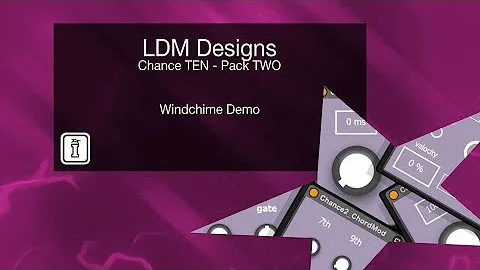
- Chance_Windchime: Off-grid random note generator – simulates windchimes with windspeed control, up to 8 notes, optional quantization
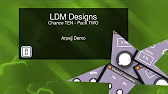
- Arpejj: Enhanced arpeggiator (bonus) – hold mode, random mode, octave cycling, incremental note addition with + button
- Chord-level probability processing with downbeat preservation
- Intelligent harmonic analysis for appropriate extensions
- Direct clip content modification with shuffle, velocity, length randomization
- Scale-constrained random melodies with step limits
- Millisecond-level timing humanization
- Dynamic articulation control via length randomization
- Generative ambient textures with windspeed control
- Complete compatibility with Ableton Live 10, 11, and 12
Transform simple triads into jazz chords. Shuffle clip contents for instant variations. Generate wandering melodies within scale constraints. Add human timing imperfections. Create call-and-response textures. Sequence probability for evolving patterns. Generate ambient textures without input. All with controlled randomness that balances chaos with musical coherence.
Requires: Ableton Live 10/11/12 Standard (with MaxforLive installed) or Suite | Mac or Windows
USER GUIDE: Chance TEN Pack TWO User Guide
Chance Pack Two by LDM Design
WHEN YOU NEED EVEN MORE CHANCE!
MAKE YOUR OWN TRIPLE PACK: Buy any three or more LDM Design products at the same time and get a 20% Discount (automatically applied at checkout)
Following Chance TEN, this pack delivers ten new MaxforLive devices focused on chords, clips, and creative MIDI chaos. Apply probability to entire chords, add jazz extensions, directly manipulate MIDI clip contents, generate constrained random melodies, humanize timing, override note lengths, create call-and-response patterns, sequence probability values, and generate off-grid ambient textures. Bonus arpeggiator with hold mode included.
Inside you’ll find:
- Chance_ChordPlay: Probability gating for entire chords – functions like Chance_Play but treats simultaneous notes as single chord events, PD mode preserves downbeats
- Chance_ChordMod: Probabilistic 7th/9th/11th extensions and 1st/2nd inversions – analyzes major/minor triads, selects appropriate extensions automatically
- Chance_Clip: Direct MIDI clip manipulation – capture clips, shuffle note pitches, randomize velocity and length, AutoTrig for continuous evolution (not compatible with MPE data)
- Chance_DrunkNote: Constrained random melodies – generates scale-based notes with limited step intervals, periodic restart to root prevents extreme wandering
- Chance_Humanize: Timing imperfection – random delays to note start and end, subtle to extreme timing variation, removes mechanical precision
- Chance_Length: Random note duration override – set min/max range in milliseconds or synced divisions, transforms articulation dynamically
- Chance_Respond: Call-and-response generator – triggers reply notes after input, fixed or random pitch modes, filter option for separate instrument routing
- Chance_Stepseq: Sequenced probability – step sequencer for probability values up to 32 steps, 8n or 16n timing, creates evolving probability patterns
- Chance_Windchime: Off-grid random note generator – simulates windchimes with windspeed control, up to 8 notes, optional quantization
- Arpejj: Enhanced arpeggiator (bonus) – hold mode, random mode, octave cycling, incremental note addition with + button
- Chord-level probability processing with downbeat preservation
- Intelligent harmonic analysis for appropriate extensions
- Direct clip content modification with shuffle, velocity, length randomization
- Scale-constrained random melodies with step limits
- Millisecond-level timing humanization
- Dynamic articulation control via length randomization
- Generative ambient textures with windspeed control
- Complete compatibility with Ableton Live 10, 11, and 12
Transform simple triads into jazz chords. Shuffle clip contents for instant variations. Generate wandering melodies within scale constraints. Add human timing imperfections. Create call-and-response textures. Sequence probability for evolving patterns. Generate ambient textures without input. All with controlled randomness that balances chaos with musical coherence.
Requires: Ableton Live 10/11/12 Standard (with MaxforLive installed) or Suite | Mac or Windows
USER GUIDE: Chance TEN Pack TWO User Guide
Additional information
| MaxforLive | MIDI Devices |
|---|---|
| Ableton Live Compatibility | Ableton Live 10 Standard with MaxforLive, Ableton Live 10 Suite, Ableton Live 11 Standard with MaxforLive, Ableton Live 11 Suite, Ableton Live 12 Standard with MaxforLive, Ableton Live 12 Suite |
| Min. Requirements | Ableton Live 10 Standard with MaxforLive Installed or Ableton Live 10 Suite |
| OS | Mac, Windows |
PRICE: £35.00









Product reviews
No reviews yet. Be the first to review this product.
Chance Pack Two by LDM Design
Overview & Expanding Controlled Chaos
Chance Pack TWO builds on the foundation established by Chance TEN with ten new MaxforLive devices that introduce probability and randomization to chords, MIDI clips, note generation, and timing. Where Chance TEN focused on individual note manipulation, Pack TWO expands into chord-level processing, direct clip content modification, and generative note sequences. Chance_ChordPlay and Chance_ChordMod apply probability to entire chord structures. Chance_Clip directly manipulates the contents of MIDI clips in your Live Set. Chance_DrunkNote and Chance_Windchime generate melodic sequences from randomness. The bonus Arpejj arpeggiator adds hold functionality and random modes beyond Live’s built-in arpeggiator.
This pack serves producers seeking controlled unpredictability in harmonic, melodic, and rhythmic content. Probability-based processing creates music that evolves organically without manual programming. Chord extensions and inversions appear probabilistically, adding harmonic interest without deterministic patterns. Clip manipulation enables instant variations on existing MIDI content – shuffle note pitches, randomize velocities, or adjust durations with a single button press. Random note generators provide melodic material constrained by scales and step intervals, balancing chaos with musicality.
Combined with Chance TEN’s devices for note gating, transposition, repetition, and MIDI delay, Chance Pack TWO completes a comprehensive probability toolkit. Use Chance_ChordMod to add jazz extensions to simple triads. Deploy Chance_Clip to create variations on drum patterns or melodic phrases. Layer Chance_DrunkNote over chord progressions for wandering melodic lines. Apply Chance_Humanize to introduce timing imperfections. Sequence probability values with Chance_Stepseq for evolving patterns. The result is music that maintains human-like variation while staying within defined creative boundaries.
Chance_ChordPlay: Probability Gating for Chords
Chance_ChordPlay functions identically to Chance_Play from Pack TEN but operates on entire chords rather than individual notes. Set a probability percentage and only chords that pass the probability check play through. A chord is defined as multiple notes arriving simultaneously – the device treats them as a single event for probability calculation. This creates rhythmic variation at the chord level, thinning out dense chord progressions or creating syncopated harmonic rhythms from steady input patterns.
The PD (Preserve Downbeat) mode ensures chords landing on bar downbeats always play through regardless of probability setting. This maintains rhythmic anchor points while allowing probabilistic variation throughout the rest of the bar. For example, set 40% probability with PD mode enabled. The first chord of each bar plays guaranteed, while subsequent chords have 40% chance of playing. This creates sparse, evolving chord progressions where downbeat emphasis remains consistent.
Chance_ChordPlay excels at creating breathing space in dense harmonic content. Program a four-chord loop playing steady quarter notes. Insert Chance_ChordPlay at 60% probability – the progression suddenly feels less mechanical, with chords occasionally dropping out. Enable PD mode to ensure the progression always starts clearly on the one. Combine with Chance_ChordMod downstream to add extensions only to chords that pass through, creating layered probability where both chord presence and chord voicing remain uncertain.
Chance_ChordMod: Probabilistic Extensions and Inversions
Chance_ChordMod analyzes incoming triads (three-note chords) and probabilistically adds 7th, 9th, or 11th extensions while optionally inverting the voicing to 1st or 2nd inversion. Each extension type has an independent probability control. Set 7th to 50%, 9th to 30%, 11th to 10%, and the device rolls probability for each extension type independently on each incoming chord. The device determines whether the input triad is major or minor and selects harmonically appropriate extensions – major 7th for major triads, minor 7th for minor triads, matching 9ths and 11ths.
The Invert control sets probability for voice-leading changes, raising the root note up an octave (1st inversion) or raising root and 3rd up an octave (2nd inversion). This creates smooth voice-leading motion where chord progressions move through different voicings rather than staying in root position. Combined with extension probabilities, Chance_ChordMod transforms simple triad progressions into jazz-inflected harmonic material with 7th chords, added tensions, and varied voicings appearing unpredictably.
Practical applications include transforming basic chord progressions into complex harmonic material. Program a simple I-IV-V-I progression using root position triads. Insert Chance_ChordMod with moderate extension probabilities (40-60% for 7th, 20-40% for 9th, 10-20% for 11th). The progression gains harmonic sophistication as extensions appear, sometimes playing C major 7, sometimes C major 9, occasionally C major 11. Add inversion probability to create voice-leading movement. The same simple progression sounds different with each repetition while maintaining its underlying harmonic function.
Chance_Clip: Direct MIDI Clip Manipulation
Chance_Clip directly modifies the contents of MIDI clips in the Ableton Live Set, enabling instant variations on existing patterns. Select a clip number and press Capture to save the clip contents into the device. The device stores note positions, pitches, velocities, and lengths. Three manipulation modes provide different variation types. Note Shuffle rearranges the pitch values among existing note positions – if your clip has notes at C, E, G, note shuffle might change them to G, C, E while maintaining their original timing and velocity. Velocity randomization adjusts each note’s velocity by a percentage relative to the original. Length randomization changes note durations relative to their original values.
The central trigger button applies the current manipulation settings to the captured clip content and writes the changes back to the Live Set’s MIDI clip. Press Revert to restore the clip to its original captured state. AutoTrig mode triggers a new randomization automatically on each clip loop, creating continuously evolving patterns. Set Note Shuffle on, Velocity to 30%, Length to 20%, enable AutoTrig – the clip evolves with each repetition, pitch order changing, velocities varying, note lengths adjusting, all while maintaining the original rhythmic placement and note count.
This device transforms static patterns into dynamic, evolving content. Capture a drum pattern, enable Note Shuffle, and watch kick/snare/hat positions rearrange with each loop. Capture a melody, apply velocity and length randomization, and hear phrasing variations emerge. Important note – Chance_Clip is not compatible with MPE data. A warning appears if MPE data exists in the captured clip. For standard MIDI clips (non-MPE), Chance_Clip provides instant variation generation impossible with manual editing.
Chance_DrunkNote: Constrained Random Melodies
Chance_DrunkNote generates random pitches within a specified scale and range, replacing incoming note pitches while preserving their timing, length, and velocity. This creates “drunk walk” melodies where each note moves a limited distance from the previous note, progressing through the scale in small steps rather than jumping randomly across the entire range. The Steps knob sets the maximum interval between successive notes – with Steps at 1, each note can move up or down by one scale degree. Steps at 3 allows up to three scale degrees of movement per note.
Select the scale and root note, set the range (pitch boundaries), and configure the Steps value. Play any MIDI pattern – quarter notes, complex rhythms, whatever timing you want. Chance_DrunkNote uses that timing and velocity information but generates new pitches for each note. The Restart setting resets the pitch sequence to the root note at regular intervals (every bar, every two bars, etc.), preventing the drunk walk from wandering too far from the tonal center and getting stuck in extreme registers.
This device excels at generating melodic content over existing chord progressions. Play simple chords or sustained notes to establish timing. Chance_DrunkNote outputs melodic lines that follow those rhythms but wander through the scale. Set Steps low (1-2) for smooth, stepwise motion. Increase Steps (3-5) for more angular, jumping melodies. Enable Restart every 2 bars to ensure the melody returns to the root periodically, maintaining tonal focus. The combination of scale constraint, step interval limitation, and periodic restarting balances randomness with musical coherence.
Chance_Humanize: Timing Imperfection
Chance_Humanize introduces random timing delays to incoming notes, simulating the slight timing imperfections of human performance. Set the maximum delay time in milliseconds, and the device delays each note’s start and end by a random amount up to that maximum. A 10ms setting creates subtle timing variation barely perceptible but adding organic feel. A 30ms setting produces noticeable looseness. A 50ms setting introduces significant timing drift approaching sloppy or heavily swung feels.
The device delays both note-on and note-off messages independently. This means not only does the note start at a slightly different time than programmed, but its duration also varies slightly. The result is timing variation that affects both rhythmic placement and articulation. Apply Chance_Humanize to programmed drum patterns to remove machine-perfect timing. Use it on quantized MIDI performances to reintroduce human timing feel. Layer it with Chance TEN’s Chance_Play device – Chance_Play thins the pattern probabilistically while Chance_Humanize loosens the timing of notes that play.
Humanization works best when applied subtly. Extreme settings destroy rhythmic coherence and create timing chaos. Start with 5-15ms for subtle humanization on hi-hats and percussion. Use 10-20ms on melodic content. Reserve 30ms+ for special effects or deliberately loose, drunken timing feels. Chance_Humanize adds the imperfection that makes electronic music feel less robotic without requiring manual timing adjustment or multiple takes.
Chance_Length: Random Note Duration
Chance_Length overrides the duration of incoming notes, generating random note lengths within a minimum and maximum range set via a slider interface. Hold Shift while dragging to adjust only one side of the slider. Hold Ctrl/Cmd to shift the entire range together. Set length in milliseconds for fixed-duration modes or in synced bar divisions (1/16n, 1/8n, etc.) for tempo-locked operation.
This device transforms legato passages into staccato, short notes into sustained, or creates rhythmic articulation variations on uniform input. Set a narrow range (e.g., 50-80ms) for slight duration variation maintaining the original articulation character. Set a wide range (e.g., 100-500ms) for dramatic variation from short stabs to long sustains. Sync mode ensures note lengths align with musical timing divisions rather than arbitrary millisecond values, keeping rhythmic relationships coherent even as durations vary.
Combine Chance_Length with other devices for complex articulation control. Place Chance_Play upstream to thin the pattern, then Chance_Length to vary the duration of notes that pass through. Use Chance_Length on sustained pad chords to create breathing, evolving textures where chord tones fade in and out at different rates. Apply it to arpeggios to transform uniform eighth notes into varied durations creating rhythmic interest. The device provides articulation control impossible through manual editing when probability and range remain the creative parameters.
Chance_Respond: Melodic Response Generator
Chance_Respond generates a response note after each incoming note, modeled after Chance_Repeat from Pack TEN but playing a different pitch instead of repeating the original. Set the delay period (synced or free time) for when the response plays relative to the input note. Set response velocity as a percentage of the input note’s velocity. Set probability for whether a response triggers at all. Configure scale and root note, then choose between Fixed mode (always responds with the same pitch) or Range mode (responds with a random note within a specified interval from the input note).
The filter button in the top right removes the original note from the output, sending only the response. This enables routing MIDI from one track to another where the response note triggers a different instrument. For example, route piano MIDI to a track containing Chance_Respond. Set filter on and route the output to a synth pad instrument. Now every piano note triggers a response note on the pad, creating automatic call-and-response between two instruments with independent control over the response’s timing, pitch relationship, and probability.
Musical applications include automatic harmony generation, delayed echo effects with pitch variation, and call-and-response textures. Set Range mode with ±5 scale degrees and 30% probability. Play a melody – roughly one in three notes generates a response note harmonically related but melodically independent. Set Fixed mode to a perfect fifth above and 100% probability for automatic parallel harmony. Combine with Chance_Play on the input to create sparse melodies where only some input notes generate responses, layering probability at both input and response stages.
Chance_Stepseq: Sequenced Probability Values
Chance_Stepseq functions as a step sequencer for probability values rather than notes. Each step has an independent probability percentage set via the multislider interface. As the sequence advances, notes pass through or get blocked based on the current step’s probability setting. Set up to 32 steps with step size at 8th or 16th note divisions. This creates evolving probability patterns where some steps allow most notes through (high probability) while others block most notes (low probability).
The multislider provides visual feedback for probability values across all steps. Draw probability curves – start high, drop to low in the middle, rise again. Create rhythmic probability patterns – high on downbeats, low on offbeats. Program random probability distributions for organic evolution. Unlike Chance_Play’s static probability control, Chance_Stepseq’s probability varies with sequence position, enabling rhythmic probability modulation synchronized to musical time divisions.
Practical uses include creating build-ups and breakdowns by gradually increasing or decreasing probability values across the sequence. Layer multiple instances on different tracks with different probability patterns to create polyrhythmic textures where different elements thin and thicken asynchronously. Combine with Chance TEN’s Chance_Transpose for sequences where both probability and pitch transposition follow step-sequenced patterns. Chance_Stepseq transforms probability from a static parameter into a dynamic, time-varying musical element.
Chance_Windchime: Generative Ambient Textures
Chance_Windchime generates random notes without any MIDI input, simulating windchimes where notes trigger unpredictably as if blown by wind. The Windspeed knob controls generation rate – low values produce sparse, occasional notes, high values create dense, rapid note clusters. Up to 8 different pitches can sound, all selected from the chosen scale. Root note and scale settings determine the available pitch pool. The device operates completely off-grid, generating notes asynchronously relative to Live’s transport unless quantization is enabled.
For controlled chaos, enable quantization to lock note generation to a specific time interval (16th notes, 8th notes, etc.). This constrains the otherwise random timing to musical grid positions, creating the feeling of wind-driven randomness with rhythmic coherence. The device works as a MIDI generator requiring no input – place it in a MIDI track, select an instrument, and notes begin generating based on the Windspeed setting and scale configuration.
Chance_Windchime excels at ambient textures, background atmospheric elements, and generative soundscapes. Set a slow Windspeed with a pentatonic scale and let sparse, melodic notes appear randomly. Increase Windspeed with a chromatic scale for dense, atonal clusters. Combine multiple instances with different scales and Windspeed settings for layered generative textures. Map Windspeed to an automation lane or external controller for dynamic control over generation density. The device transforms Live from a clip-based sequencer into a generative music system where controlled randomness creates continuously evolving musical content.
Arpejj: Enhanced Arpeggiator with Hold Mode
Arpejj is a bonus arpeggiator device offering functionality beyond Live’s built-in arpeggiator, notably including random mode, hold functionality, and octave cycling. Choose from multiple arpeggio modes (up, down, up/down, random, etc.) and set the number of steps. If the step count exceeds the number of held notes, the arpeggiator cycles through octaves of each note until reaching the specified step count, then loops. The Gate knob adjusts note lengths relative to the step size, from short staccato (low gate) to legato (high gate).
Hold mode is Arpejj’s signature feature. Enable Hold, play a chord, release the keys – the arpeggio continues playing the latched notes. Play a new chord and the arpeggiator replaces the held notes with the new chord. Alternatively, hold the + button and press additional notes to add them to the currently arpeggiated note set without replacing existing notes. This enables building complex arpeggios incrementally during performance or adding individual notes to modify the arpeggio pattern while it plays.
The device provides octave shift controls for transposing the arpeggio output and step size selection for rhythmic variation. Random mode creates unpredictable note order within the held chord, generating constantly varying arpeggios from static input. Combine Hold mode with Random mode – play a chord, enable Hold, and the device generates infinite variations on that chord’s arpeggio pattern. Arpejj transforms the arpeggiator from a simple note-order tool into a performance instrument with dynamic control over held note sets and unpredictable sequencing.
Features & Highlights
Ten MaxforLive MIDI Devices: Nine probability-focused devices plus one bonus arpeggiator for comprehensive controlled randomness.
Chord-Level Probability: Chance_ChordPlay and Chance_ChordMod apply probability to entire chords with extensions and inversions.
Direct Clip Manipulation: Chance_Clip modifies MIDI clip contents including note shuffle, velocity, and length randomization.
Intelligent Harmonic Analysis: Chance_ChordMod detects major/minor triads and selects appropriate extensions (major 7th vs minor 7th).
Constrained Random Melodies: Chance_DrunkNote generates scale-based melodies with limited interval steps and periodic restarting.
Timing Humanization: Chance_Humanize adds subtle or extreme timing variation to remove mechanical precision.
Dynamic Articulation: Chance_Length overrides note durations with random values in milliseconds or synced divisions.
Call-and-Response Generation: Chance_Respond triggers melodic replies to incoming notes with pitch, timing, and probability control.
Sequenced Probability: Chance_Stepseq modulates probability values over time via step sequencer interface.
Generative Ambient Textures: Chance_Windchime creates off-grid or quantized random note generation.
Enhanced Arpeggiator: Arpejj adds hold mode, random mode, and incremental note addition to standard arpeggio functionality.
Complete Compatibility: Works with Ableton Live 10, 11, and 12 (Standard with MaxforLive or Suite).
Ideal For
- Producers seeking controlled unpredictability in harmonic and melodic content
- Electronic musicians who want evolving patterns without manual programming
- Jazz and experimental composers exploring probabilistic harmony and voice-leading
- Ambient and generative music creators requiring autonomous note generation
- Anyone looking to add human-like timing imperfections to quantized MIDI
- Performers who need dynamic control over arpeggios with hold and random modes
- Producers who want instant variations on existing MIDI clips and patterns
What’s Included
- Chance_ChordPlay – Probability gating for entire chords with downbeat preservation (.amxd)
- Chance_ChordMod – Probabilistic 7th/9th/11th extensions and inversions (.amxd)
- Chance_Clip – Direct MIDI clip manipulation with shuffle, velocity, and length randomization (.amxd)
- Chance_DrunkNote – Constrained random note generation within scale and step limits (.amxd)
- Chance_Humanize – Random timing delays for organic performance feel (.amxd)
- Chance_Length – Random note duration override with sync or free time (.amxd)
- Chance_Respond – Call-and-response note generation with pitch and timing control (.amxd)
- Chance_Stepseq – Step sequencer for probability values up to 32 steps (.amxd)
- Chance_Windchime – Off-grid random note generator with windspeed control (.amxd)
- Arpejj – Enhanced arpeggiator with hold mode and random sequencing (bonus) (.amxd)
- Comprehensive PDF user manual
- Compatible with Mac and Windows
- Requires Ableton Live 10/11/12 Standard (with MaxforLive) or Suite
Technical Notes
All devices are MaxforLive MIDI effects (.amxd files) requiring Ableton Live Standard with MaxforLive installed or Ableton Live Suite. Chance_Clip is not compatible with MIDI clips containing MPE data. All other devices work with standard MIDI. Devices can be chained in any order to create complex probability systems. For example, chain Chance_Play (from Pack TEN) into Chance_ChordMod into Chance_ChordPlay for layered probability where individual note gating, chord extension, and chord-level gating all operate independently. Minimal CPU usage enables running multiple instances simultaneously.
Explore More from LDM Design
Chance Pack FOUR | LP Pack | FRAKTOR | ADD | View All LDM Design Products
Frequently Asked Questions
A: Chance Pack TWO is a collection of 10 MaxforLive MIDI devices that expand on the probability-based processing introduced in Chance TEN. The pack includes Chance_ChordPlay (probability gating for entire chords with downbeat preservation), Chance_ChordMod (probabilistic 7th/9th/11th extensions and inversions), Chance_Clip (direct MIDI clip manipulation with note shuffle, velocity and length randomization), Chance_DrunkNote (constrained random melody generation within scales), Chance_Humanize (timing imperfection), Chance_Length (random note duration override), Chance_Respond (call-and-response note generation), Chance_Stepseq (step sequencer for probability values), Chance_Windchime (off-grid random note generator), and Arpejj (enhanced arpeggiator with hold mode – bonus device). These devices focus on chord-level processing, clip manipulation, and generative melodies.
A: Yes, Chance Pack TWO consists of MaxforLive devices (.amxd files) that require either Ableton Live Standard with MaxforLive installed separately or Ableton Live Suite (which includes MaxforLive).
A: MaxforLive is a platform that integrates the visual programming environment Max with Ableton Live, allowing users to create and use custom audio, MIDI, and control devices. It’s included with Ableton Live Suite or can be purchased separately for use with Ableton Live Standard.
A: Chance_Clip directly modifies the contents of MIDI clips in your Live Set. First, select a clip number and press Capture to save the clip’s note data into the device. You can then apply three types of manipulation: Note Shuffle (rearranges pitch values among existing note positions while preserving timing), Velocity randomization (adjusts each note’s velocity by a percentage relative to the original), and Length randomization (changes note durations relative to original values). Press the central trigger button to apply changes, use Revert to restore the original, or enable AutoTrig to automatically generate new variations with each clip loop. Important: Chance_Clip is not compatible with MIDI clips containing MPE data.
A: Chance Pack TEN (formerly Chance 10) focuses on individual note manipulation including probability gating, transposition, repetition, velocity modification, MIDI delay, parameter randomization, and parameter triggering. Chance Pack TWO expands into chord-level processing (ChordPlay, ChordMod), direct clip manipulation (Chance_Clip), constrained random melody generation (DrunkNote, Windchime), timing humanization, note length randomization, and call-and-response generation. The two packs complement each other – TEN provides foundational probability tools for individual notes, while TWO adds chord harmony, clip variation, and generative melody capabilities. Both packs work together seamlessly in Ableton Live.
A: Yes. Chance Pack TWO devices integrate fully with Chance TEN devices and other LDM Design MIDI tools. You can chain them in any order to create complex probability systems. For example, use Chance_Play (from Pack TEN) to thin a pattern, then Chance_ChordMod (from Pack TWO) to add extensions to chords that pass through, then Chance_ChordPlay to apply probability at the chord level. Each device operates independently, allowing layered probability where multiple random processes affect the same MIDI stream.
A: You can explore more of LDM Design’s tools and devices here: LDM Design
Important Information
V1.0.0 – Initial Release – December 2020
Our Products are generally provided as Zip file downloads which in all cases will need to be extracted and saved to your hard drive prior to installation. Details on the different file type provided and what to do with them are below.
.alp Files – These are Ableton Live Packs and will either install directly into the Packs Section of the browser of Ableton Live or ask you to save them to your hard drive. For packs that install to the library, when you double click on them you will see a pop up window asking you to confirm that installation is ok as the files are described as “Legacy”. This is fine and you are ok to proceed, the packs are created using the format for an earlier version of Live and so remain compatible with the current version.
.amxd files – These are individual MaxforLive Devices and can be stored anywhere on your hard drive. We’d advise creating a folder for them and then adding that folder as a location within the Places section of Lives Browser.
END-USER LICENSE AGREEMENT FOR ISOTONIK STUDIOS SOFTWARE PRODUCTS.
PLEASE READ THE TERMS AND CONDITIONS OF THIS LICENSE AGREEMENT CAREFULLY BEFORE CONTINUING WITH THIS PROGRAM INSTALL.
This End-User License Agreement (referred to as “EULA”) is a legal agreement between an individual or a single entity (referred to as “LICENSEE”) and Isotonik Studios for the Isotonik Studios software product(s) which may include associated software components, media, printed materials, and “online” or electronic documentation (referred to as “SOFTWARE PRODUCT”). By installing, copying, or otherwise using the SOFTWARE PRODUCT, the LICENSEE agrees to be bound by the terms of this EULA.
This EULA represents the entire agreement concerning the program between the LICENSEE and Isotonik Studios and it supersedes any prior proposal, representation, or understanding between the parties. If the LICENSEE does not agree to the terms of this EULA, the LICENSEE should not install or use the SOFTWARE PRODUCT.
The SOFTWARE PRODUCT is protected by copyright laws and international copyright treaties, as well as other intellectual property laws and treaties. The SOFTWARE PRODUCT is licensed, not sold.
- GRANT OF LICENSE.
The SOFTWARE PRODUCT is licensed as follows:
(a) Installation and Use. Providing that the LICENSEE has paid any applicable license fees, Isotonik Studios grants the LICENSEE the right to install and use copies of the SOFTWARE PRODUCT on up to two computers in the LICENSEE’s possession that are running a validly licensed copy of the operating system for which the SOFTWARE PRODUCT was designed [e.g., Windows 10, macOS]. The computer(s) must be owned by the LICENSEE.
(b) Backup Copies. The LICENSEE may also make copies of the SOFTWARE PRODUCT as may be necessary for backup and archival purposes.
- DESCRIPTION OF OTHER RIGHTS AND LIMITATIONS.
(a) Maintenance of Copyright Notices. The LICENSEE must not remove or alter any copyright notices on any and all copies of the SOFTWARE PRODUCT.
(b) Distribution. The LICENSEE may not distribute registered copies of the SOFTWARE PRODUCT to third parties.
(c) Prohibition on Reverse Engineering, Decompilation, and Disassembly. The LICENSEE may not reverse engineer, decompile, or disassemble the SOFTWARE PRODUCT, except and only to the extent that such activity is expressly permitted by applicable law notwithstanding this limitation.
(d) Rental. The LICENSEE may not rent, lease, or lend the SOFTWARE PRODUCT.
(e) License transfer The LICENSEE may not transfer their license to the SOFTWARE PRODUCT to any third party. Any attempt to do so will be considered a violation of this EULA.
(f) Support Services. Isotonik Studios may provide the LICENSEE with support services related to the SOFTWARE PRODUCT for a period of 12 months following the date of purchase. Any supplemental software code provided to the LICENSEE as part of the Support Services shall be considered part of the SOFTWARE PRODUCT and subject to the terms and conditions of this EULA.
(g) Compliance with Applicable Laws. The LICENSEE must comply with all applicable laws regarding use of the SOFTWARE PRODUCT.
- TERMINATION Without prejudice to any other rights, Isotonik Studios may terminate this EULA if the LICENSEE fails to comply with the terms and conditions of this EULA. In such event, the LICENSEE must destroy all copies of the SOFTWARE PRODUCT in the LICENSEE’s possession.
- COPYRIGHT All title, including but not limited to copyrights, in and to the SOFTWARE PRODUCT and any copies thereof are owned by Isotonik Studios or its suppliers. All title and intellectual property rights in and to the content which may be accessed through use of the SOFTWARE PRODUCT is the property of the respective content owner and may be protected by applicable copyright or other intellectual property laws and treaties. This EULA grants the LICENSEE no rights to use such content. All rights not expressly granted are reserved by Isotonik Studios.
- NO WARRANTIES Isotonik Studios expressly disclaims any warranty for the SOFTWARE PRODUCT. The SOFTWARE PRODUCT is provided ‘As Is’ without any express or implied warranty of any kind, including but not limited to any warranties of merchantability, noninfringement, or fitness of a particular purpose. Isotonik Studios does not warrant or assume responsibility for the accuracy or completeness of any information, text, graphics, links or other items contained within the SOFTWARE PRODUCT. Isotonik Studios makes no warranties respecting any harm that may be caused by the transmission of a computer virus, worm, time bomb, logic bomb, or other such computer program. Isotonik Studios further expressly disclaims any warranty or representation to the LICENSEE or to any third party.
- LIMITATION OF LIABILITY In no event shall Isotonik Studios be liable for any damages (including, without limitation, lost profits, business interruption, or lost information) arising out of the LICENSEE’s use of or inability to use the SOFTWARE PRODUCT, even if Isotonik Studios has been advised of the possibility of such damages. In no event will Isotonik Studios be liable for loss of data or for indirect, special, incidental, consequential (including lost profit), or other damages based in contract, tort or otherwise. Isotonik Studios shall have no liability with respect to the content of the SOFTWARE PRODUCT or any part thereof, including but not limited to errors or omissions contained therein, libel, infringements of rights of publicity, privacy, trademark rights, business interruption, personal injury, loss of privacy, moral rights or the disclosure of confidential information.
More from LDM Design
Frequently Bought Together