Remember when a joint venture between Ableton & Cycling 74 was announced just a few years ago? Well with Ableton now owning wholly Cycling 74, we’re looking forward to an even tighter integration between these two powerful platforms and we fully intend to be at the forefront of developing new & innovative products for them both.
Max4Live accesses the Ableton Live API at a deeper level than allowed by simple MIDI mapping alone we have managed to solve some of the most popular feature requests seen on the Audio Production forums around the world wide web, you’ll find the results of our moments of inspiration with the MaxforLive Control Devices category.
Additionally, within this section of our catalogue you find MaxforLive devices dedicated to enhancing and indeed destroying your audio (or adding just a touch of glitch), creating and rearranging your MIDI and finally producing visuals out of the resulting inspiration.
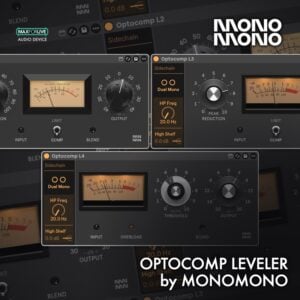
Optocomp Leveler by MonomonoLive 11 & 12 · Max for Live£35.00Original price was: £35.00.£28.00Current price is: £28.00.
Three optical compressors for Ableton Live
What’s inside
Three distinct optical compressor models in one Max for Live device: L2, L3 and L4
L2 modelled on the UREI 1968 drawing of the tube LA-2A, with 12AX7 and 12BH7 amplifier stages and T4 cell behaviour
L3 modelled on the first LA-3A drawing, the solid-state transistor leveller with T4 cell, faster and quieter than the LA-2A with more midrange presence
L4 modelled on the first LA-4, using an RMS detector with LED and photocells, a Ratio switch from 2:1 to 20:1, and a transformerless balanced input topology
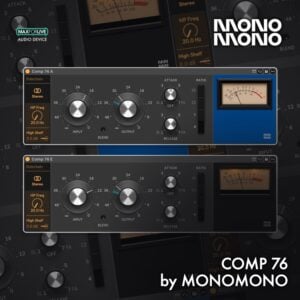
Comp 76 by MonomonoLive 11 & 12 · Max for Live£25.00Original price was: £25.00.£20.00Current price is: £20.00.
Two 1176-modelled FET compressors for Live
What’s inside
Two FET compressor devices in one package: Comp 76 A (bluestripe, 1967 circuit) and Comp 76 E (black-face low-noise, early-seventies circuit)
Comp 76 A adds a clear second harmonic at everyday levels, thickening voices and pulling them forward, with a shade more attack transient and faster gain recovery
Comp 76 E stays clean and controlled at moderate settings, holds on longer at each Release setting, and clips harder when pushed into the red
Circuit-level model of the original circuit: FET gain cell, feedback sidechain, preamp, and class A line amp, modelled part for part
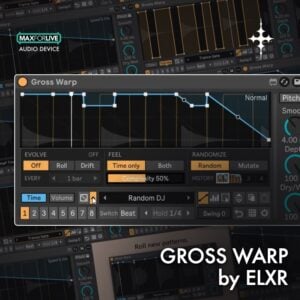
Two independent envelopes: Time for half time, slow-downs, tape stops, scratches, reverses and stutters; Volume for gates, pumps and trance gates, loadable separately so any time shape pairs with any volume shape
231 factory presets covering 24 combos plus Time and Volume folders: Stutter, Half, Stop, Reverse, Scratch, Chop, Glitch, Build, Tape, Pitch, Arp, Swing, Gate, Pump, Trans and more; save, name and star your own favourites
Eight patterns per device with instant, next-beat or next-bar switching; automate the Pattern parameter to sequence effects across your arrangement
Three drawing modes: Line (points and curves), Block (paint steps on the grid) and Select (move, copy, paste and flip a section); snap from 1/4 to 1/32 with triplet support, pattern length 1/4 bar to 4 bars, and Swing
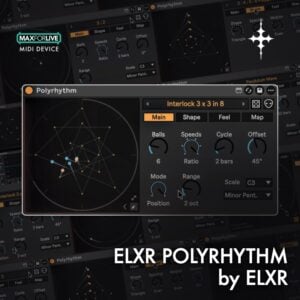
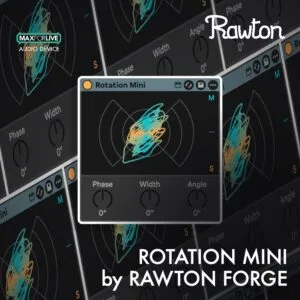
23 polyrhythm types, from simple ratios like 3:2 and 5:4:3 to stacks of speeds, nested polygons, phasing patterns and classic timelines
Shape, Spacing and Motion controls: triangle plays three notes per lap, pentagon five; Euclidean spacing, Swing, Gravity and Nested corner modes available
Draw mode: draw your own trigger lines and the path the dots travel, on a grid or freehand
Map any dot to any Live parameter with individual Min and Max per mapping, as many dots as needed
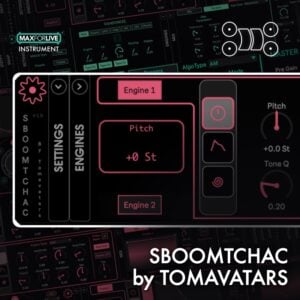
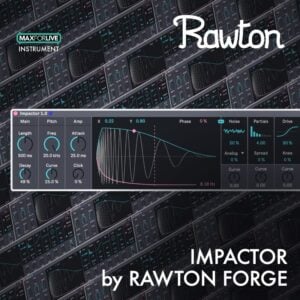
Two parallel synthesis engines per hit, each independently configurable, that collide rather than simply layer
14 engine types including kicks, snares, metallic resonators, claps, hats, FM bells, pulsar buzz, noise, chord synths and samplers
12 mixing algorithms including ring modulation, vocoding, folding, granulation and phase distortion, all controlled by a single Mix slider with an MSEG envelope
Hand-drawn MSEG (multi-segment envelope generator) control over amplitude and pitch per engine, plus a dedicated Mix MSEG
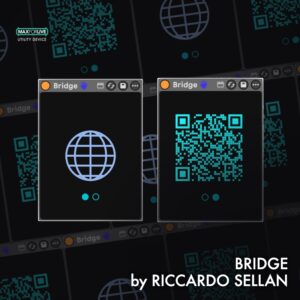
Control Ableton Live from any browser on your network
What’s inside
Web-based control surface: control your Live Set from any device on the same network via a browser at a local URL or scanned QR code
Built-in local web server runs on port 7900 inside a deliberately minimal Max for Live device, with a globe icon to open the interface and a QR code display for instant phone and tablet connection
Customisable drag-and-drop canvas: build multi-page control surfaces by adding, moving, resizing and recolouring sliders, toggles and menus for any track parameter, device or global control
Full parameter coverage across Mixer controls (Volume, Pan, Mute, Solo), Sends, individual device parameters, Clips, and global session controls including Play, Stop, Record, Metronome, Overdub and BPM
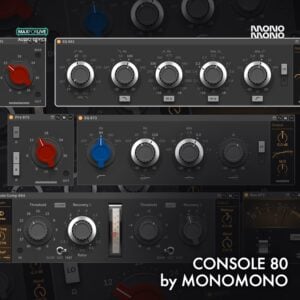
Console 80 by MonomonoLive 11 & 12 · Max for Live(8)£90.00Original price was: £90.00.£72.00Current price is: £72.00.
Neve channel strip suite for Ableton Live
What’s inside
Six devices covering the full signal path: Pre 873, EQ 873, Pre 881, EQ 881, Diode Comp 854 and Bus 872, modelled on the Neve 1073, 1081, 2254 and 1272 circuits
Class A and Class AB preamp designs: Pre 873 models the single-ended class A circuit with its even-order harmonic character; Pre 881 models the push-pull class AB output stage for a cleaner result at normal levels, with high-order harmonics at the extremes noted by Rupert Neve himself
Serial number system: every device carries a six-digit serial that draws transformers, inductors, resistors, capacitors, output stage bias and compressor rectifier diodes each within factory tolerance, so no two channels ever measure quite the same
Consecutive serials come from the same production batch for a matched stereo pair; distant serials spread wider across the tolerance window, broadening the stereo field and giving the track more space
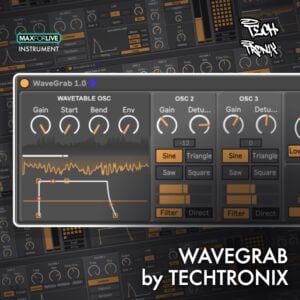
Monophonic Spectral Morphing Wavetable Synthesizer built exclusively for Ableton Live and Push 3 Controller Mode
Automated file-parsing engine: drag any wavetable into the interface and Wavegrab instantly analyses the file, calculates the number of frames in the Wavetable and stretches them to 256 frames, with no manual pre-processing or morphing required.
64-bit floating-point architecture delivers sub-frame interpolation, avoiding digital stepping and artefacts for an exceptionally clean, high-fidelity morph between adjacent waveforms
Waveform bend modulation, operating like PWM but applicable to any waveform, routeable to the same destinations as wavetable position for complex modulations
Four complementary Max for Live devices: MBK Pan, MBK Mix, MBK Space and MBK Scene, plus MBK EzPan for simplified binaural panning
MBK Pan places mono or stereo sources in a full 3D binaural space, with automatable spatial movement and optional early reflections that improve source localisation
MBK Mix monitors channel-based multichannel streams up to 32 channels (5.1, 7.1, 7.1.4 and custom formats) and ambisonic streams up to 4th order (25 channels) in binaural
MBK Space is a binaural reverberator placed on a return track; it collects early reflections from MBK Pan and MBK Mix devices and distributes them in a coherent resonant 3D space, with additional audio inputs for non-binaural tracks
Console 40 by MONOMONOLive 11 & 12 · Max for Live(8)£90.00Original price was: £90.00.£72.00Current price is: £72.00.
Large format console suite for Ableton Live
What’s inside
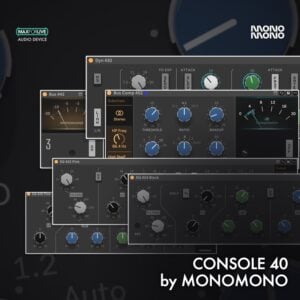
EQ 422 Pink: four-band parametric EQ with high- and low-pass filters, gain-dependent bell widths, and ×3 and ÷3 switches that extend the mid bands deep into the lows or high into the air
EQ 424 Black: four-band parametric EQ with constant-width bells at any gain, a resonance trim on the high-pass, and shelf or bell toggles on the LF and HF bands for precise, surgical control
EQ 426 Orange: four-band parametric EQ with narrow, Pultec-style bells whose Q trades width for reach, and a low shelf that lifts well past its printed range for broad, weighty tonal moves
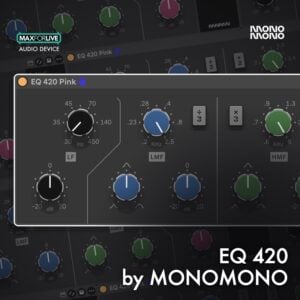
EQ 420: a streamlined version of the 422, with four bands and wider range for fast, natural tone shaping without the additional filters or M/S options
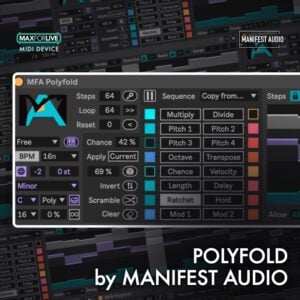
16 interdependent sequencers with up to 1024 steps per lane, independent loop length, direction, and bar reset per lane, totalling up to 16,384 steps across the device
Dual Stage Rate Architecture: shared base rate modified per step by independent Multiply and Divide sequencer lanes, supporting even, triplet, and unrestricted rates for compound rhythmic folding and layered subdivision
Polyphonic Pitch System with four discrete-range pitch sequencers, per-note probability, preset pattern libraries, random pattern selection, and internal custom pattern storage and recall
Optional Octave sequencer with Euclidean control, Transposition phrase sequencer, real-time MIDI transposition, and Drums mode for instant Drum Rack usage
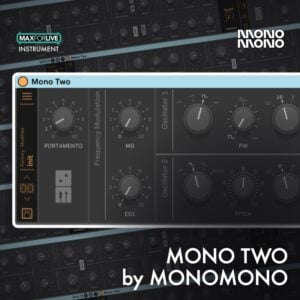
Two oscillators: VCO 1 covers triangle, sawtooth, PWM square, and noise with a Pulse Width dial that sweeps from a full hollow square to a thin buzzing sliver; VCO 2 adds sawtooth, two fixed pulse widths, and ring modulation against Osc 1, plus a Pitch knob that detunes up to plus or minus 12 semitones
Dual resonant filters in series, high-pass into low-pass, each switchable between OTA and Korg35-style topologies with circuit-accurate saturation, independent Cutoff and Peak controls, and both capable of self-oscillation
Morphing Modulation Generator: one LFO whose Waveform dial continuously morphs from falling sawtooth through symmetric triangle to rising sawtooth, free-running from 0.1 Hz to around 20 Hz or tempo-synced to Live with phase reset on transport and per-note reset
Onboard patch bay with 15 modulation sources and destinations including MG triangle, MG square, EG1, EG1 inverted, EG2 inverted, Mult, VCO 1 PWM, VCO 2 CV, TRIG IN, EG1 TRIG, MG Wave, and MG Freq for complex self-patching architectures
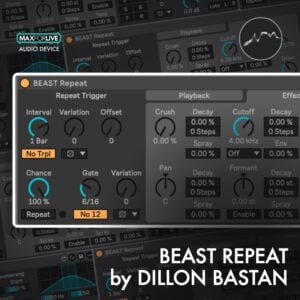
All classic Beat Repeat features fully intact: interval, grid, gate, and variation controls as the foundation, with additional variation modes and interval options beyond the original
Real-time pitch shifting via FFT and Overlap Add (maintains playback speed, ideal for lo-fi textures) plus classic repitch/speed mode, with per-repeat pitch envelope and pitch decay up or down
Speed stretching using granular or phase vocoder (FFT) algorithms, with stepped decay or per-repeat envelope shaping
Stepped decay and spray across Grid, Width, Panning, Filter, Redux, and Formant, letting parameters evolve dramatically across each triggered repeat sequence
We use cookies to keep the site working, understand how it's used, and (optionally) personalise the experience. You can accept all, reject all, or pick what you're happy with.