
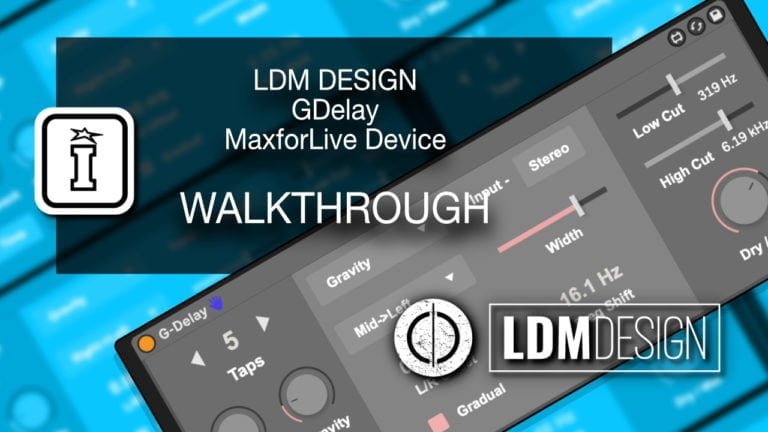
GDelay by LDM Design
DELAY THAT DANCES THROUGH SPACE
MAKE YOUR OWN TRIPLE PACK: Buy any three or more LDM Design products at the same time and get a 20% Discount (automatically applied at checkout)
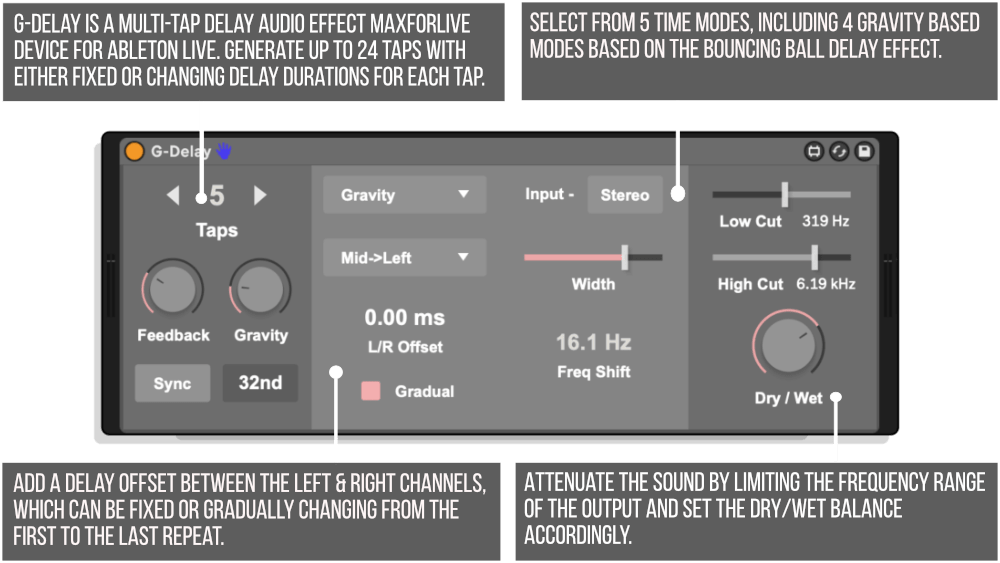
Traditional delays use feedback loops. GDelay generates up to 24 individual taps that don’t feed back, giving you complete control over how each repeat behaves in time and space. The result? Bouncing ball effects, stereo choreography, and expanding soundscapes impossible with conventional delay architectures.
Inside you’ll find:
- 5 Gravity Modes — Normal, Gravity (bouncing ball), Antigravity, Updown, Downup timing behaviors
- 8 Spatial Modes — Carve paths through the stereo field (Centred, Pingpong, Left>Right, Right>Left, Mid>Pingpong, Mid>Left, Mid>Right, PingaPonga)
- Gradual Width Expansion — Stereo width increases with each successive tap for three-dimensional effects
- Up to 24 Individual Taps — Complete control over each repeat’s timing, position, and character
- Random Pitch Shift — Add frequency variation to each tap for natural or glitchy effects
- Low/High Cut Filters — Shape the frequency content of your delay tails
- Tempo Sync or Milliseconds — Rhythmic or free-time control
Perfect for sound designers, electronic producers, and live performers who need delay effects that move, expand, and evolve. Multi-tap precision meets spatial choreography for delay sounds that dance through your mix.
Requires Ableton Live 11/12 Standard with MaxforLive or Suite | Mac/Windows
USER GUIDE: G-Delay User Guide
GDelay by LDM Design
DELAY THAT DANCES THROUGH SPACE
MAKE YOUR OWN TRIPLE PACK: Buy any three or more LDM Design products at the same time and get a 20% Discount (automatically applied at checkout)
Traditional delays use feedback loops. GDelay generates up to 24 individual taps that don’t feed back, giving you complete control over how each repeat behaves in time and space. The result? Bouncing ball effects, stereo choreography, and expanding soundscapes impossible with conventional delay architectures.
Inside you’ll find:
- 5 Gravity Modes — Normal, Gravity (bouncing ball), Antigravity, Updown, Downup timing behaviors
- 8 Spatial Modes — Carve paths through the stereo field (Centred, Pingpong, Left>Right, Right>Left, Mid>Pingpong, Mid>Left, Mid>Right, PingaPonga)
- Gradual Width Expansion — Stereo width increases with each successive tap for three-dimensional effects
- Up to 24 Individual Taps — Complete control over each repeat’s timing, position, and character
- Random Pitch Shift — Add frequency variation to each tap for natural or glitchy effects
- Low/High Cut Filters — Shape the frequency content of your delay tails
- Tempo Sync or Milliseconds — Rhythmic or free-time control
Perfect for sound designers, electronic producers, and live performers who need delay effects that move, expand, and evolve. Multi-tap precision meets spatial choreography for delay sounds that dance through your mix.
Requires Ableton Live 11/12 Standard with MaxforLive or Suite | Mac/Windows
USER GUIDE: G-Delay User Guide
Product reviews
No reviews yet. Be the first to review this product.
GDelay by LDM Design
Most delays use feedback loops, where the output continuously feeds back into itself until it fades to nothing. GDelay takes a fundamentally different approach, generating up to 24 individual taps that don’t feed back at all. The result? Complete control over how each repeat behaves, opening up creative possibilities impossible with traditional delay architectures.
This isn’t just another delay plugin. GDelay lets you sculpt bouncing ball effects where each tap accelerates naturally, carve paths through the stereo field where repeats dance from left to right, and create expanding soundscapes where width increases with each successive echo. The multi-tap architecture combined with spatial positioning and gravity-based timing makes this an essential tool for sound designers and producers seeking dynamic, evolving delay effects.
Overview & Architecture
Traditional delays rely on a single feedback path, limiting your control over individual repeats. GDelay generates each delay tap as a discrete instance, giving you independent control over timing, panning, pitch, and filtering for every repeat. You can create up to 24 taps, each positioned precisely in time and space.
The feedback parameter works differently here too. Instead of creating an infinite loop, it progressively reduces the amplitude of each successive tap while maintaining your specified number of repeats. You get the familiar decay curve of traditional delay with the precision control of multi-tap architecture.
Gravity Modes – Bouncing Ball & Beyond
Normal Mode creates equally-spaced delay taps, functioning like a traditional delay but with the multi-tap advantages. Set your interval, choose your tap count, and dial in your feedback for classic delay sounds with spatial enhancement.
Gravity Mode simulates a bouncing ball, where each tap occurs closer to the previous one as the “ball” loses height. Set the largest delay time with the interval parameter, then use the Gravity control to determine how quickly the ball loses bounce. Perfect for percussive elements, impact effects, or adding natural decay to any sound.
Antigravity Mode reverses the effect, starting with tight repetitions that gradually spread further apart, like a ball bouncing upward against reverse gravity. Creates unique rising tension effects and unusual rhythmic patterns.
Updown and Downup Modes combine gravity concepts in different sequences, offering even more variation in how your delay taps accelerate or decelerate over time. These modes excel at creating complex, evolving rhythmic textures.
Spatial Modes – Carving Stereo Paths
GDelay’s eight spatial modes let you choreograph how your delay taps move through the stereo field. Each tap can occupy a different position, creating movement and depth impossible with mono or simple ping-pong delays.
Centred keeps all taps in the center. Pingpong alternates each tap between hard left and right. Left>Right and Right>Left progressively pan from one side to the other across all taps. Mid>Pingpong starts centered then expands to alternating sides. Mid>Left and Mid>Right travel from center to one side. PingaPonga creates complex multi-directional movement patterns.
The Width parameter scales how much of the stereo field these spatial modes use. Full width gives dramatic hard-panned effects, while reduced width creates subtle positional shifts that add dimension without overwhelming your mix. For the most effective spatial positioning, the device recommends using Mono input mode, ensuring each channel starts with equal level for perfect spatial control.
Gradual Stereo Width Expansion
GDelay’s L/R Offset parameter introduces a time delay on the right channel, creating stereo width through the Haas effect. When the Gradual parameter is engaged, this offset starts at 0ms on the first tap and progressively increases to your set value on the final tap. Each successive repeat gets wider, creating an expanding, three-dimensional effect where the delay seems to grow in space as it decays. This technique works beautifully on vocals, leads, and atmospheric elements.
Additional Sound Shaping
Pitch Shift applies random pitch variation to each tap, with your parameter setting the maximum random amount. Subtle values add gentle frequency variation for natural-sounding repeats, while higher values create glitchy, detuned effects perfect for experimental sound design.
Low Cut and High Cut filters shape the frequency content of all delay taps. Roll off lows from 100Hz to 2kHz to keep bass frequencies clean, or cut highs from 4kHz to 10kHz to darken repeats and push them into the background. Essential tools for making your delay effects sit properly in dense mixes.
Tempo Sync locks delay timing to your project tempo using note values, perfect for rhythmic effects. Switch to millisecond mode for precise timing control independent of tempo, ideal for sound design and special effects work.
How to Use
Insert GDelay on any audio track or return track in Ableton Live. For return track use, set the Dry/Wet to 100% wet and control the effect amount with your send level. On insert tracks, use the Dry/Wet control to blend the effect with your dry signal.
Start with a basic setup: select Normal mode, set 8-12 taps, choose a spatial mode (Pingpong works great), and adjust feedback to taste. From there, experiment with gravity modes for evolving rhythmic patterns, activate Gradual width expansion for three-dimensional effects, or add pitch shift for detuned textures.
All parameters are fully mappable to Push, MIDI controllers, or automation. Modulate the Gravity parameter for dynamic timing shifts, automate spatial Width for movement that evolves throughout your track, or map Pitch Shift to an expression pedal for real-time sound mangling.
Ideal For
Sound designers seeking creative delay effects beyond traditional feedback loops. Electronic producers building evolving spatial textures. Experimental musicians exploring gravity-based timing. Live performers who want dynamic, mappable delay control. Anyone working with percussion who wants natural-sounding bouncing ball effects. Mixers who need precise control over individual delay taps for surgical stereo positioning.
What’s Included
- GDelay MaxforLive audio effect device
- Comprehensive user guide with parameter explanations
- Full parameter mapping for Push and MIDI controllers
- Compatible with Ableton Live 11 & 12 (Standard with MaxforLive or Suite)
Requirements
- Ableton Live 11 Standard with MaxforLive installed, or Ableton Live 11/12 Suite
- Mac or Windows operating system
GDelay by LDM Design reimagines what delay effects can be. Multi-tap architecture meets gravity-based timing and spatial choreography for delay sounds that move, expand, and evolve in ways traditional feedback delays simply cannot achieve.
TRIPLE PACK SAVINGS
MAKE YOUR OWN TRIPLE PACK: Buy any three or more LDM Design products at the same time and get a 20% Discount (automatically applied at checkout)
Explore More LDM Design Tools: Hepta Delay | Gravity Pack | Chance Pack THREE | Noizebox | View All LDM Design Products
Frequently Asked Questions
A: GDelay is a MaxforLive multi-tap delay effect that generates up to 24 individual delay taps instead of using traditional feedback loops. This architecture enables unique features including gravity-based timing modes (bouncing ball effects), 8 spatial modes for choreographing stereo movement, gradual stereo width expansion, and per-tap pitch shifting. The result is delay effects that move, expand, and evolve in ways conventional delays cannot achieve.
A: Yes, GDelay is a MaxforLive device.
A: MaxforLive is a platform that integrates the visual programming environment Max with Ableton Live, allowing users to create and use custom audio, MIDI, and control devices.
A: Traditional delays create repeats by feeding the output back into the input, limiting control over individual echoes. GDelay generates each of its up to 24 taps as discrete instances, giving you independent control over the timing, spatial position, pitch, and characteristics of every single repeat. This enables effects like bouncing ball timing (where taps accelerate naturally), progressive stereo width expansion, and spatial choreography that are impossible with feedback-based delays.
A: GDelay offers 5 timing modes: Normal (equally-spaced taps like traditional delay), Gravity (bouncing ball effect where taps accelerate), Antigravity (taps spread further apart over time), Updown, and Downup (combining gravity concepts in different sequences). The Gravity parameter controls how quickly the bouncing ball loses “height” in gravity-based modes.
A: You can explore more of LDM Design’s tools and devices here: LDM Design
Important Information
V1.0.0 – Initial Release
Our Products are generally provided as Zip file downloads which in all cases will need to be extracted and saved to your hard drive prior to installation. Details on the different file type provided and what to do with them are below.
.alp Files – These are Ableton Live Packs and will either install directly into the Packs Section of the browser of Ableton Live or ask you to save them to your hard drive. For packs that install to the library, when you double click on them you will see a pop up window asking you to confirm that installation is ok as the files are described as “Legacy”. This is fine and you are ok to proceed, the packs are created using the format for an earlier version of Live and so remain compatible with the current version.
.amxd files – These are individual MaxforLive Devices and can be stored anywhere on your hard drive. We’d advise creating a folder for them and then adding that folder as a location within the Places section of Lives Browser.
END-USER LICENSE AGREEMENT FOR ISOTONIK STUDIOS SOFTWARE PRODUCTS.
PLEASE READ THE TERMS AND CONDITIONS OF THIS LICENSE AGREEMENT CAREFULLY BEFORE CONTINUING WITH THIS PROGRAM INSTALL.
This End-User License Agreement (referred to as “EULA”) is a legal agreement between an individual or a single entity (referred to as “LICENSEE”) and Isotonik Studios for the Isotonik Studios software product(s) which may include associated software components, media, printed materials, and “online” or electronic documentation (referred to as “SOFTWARE PRODUCT”). By installing, copying, or otherwise using the SOFTWARE PRODUCT, the LICENSEE agrees to be bound by the terms of this EULA.
This EULA represents the entire agreement concerning the program between the LICENSEE and Isotonik Studios and it supersedes any prior proposal, representation, or understanding between the parties. If the LICENSEE does not agree to the terms of this EULA, the LICENSEE should not install or use the SOFTWARE PRODUCT.
The SOFTWARE PRODUCT is protected by copyright laws and international copyright treaties, as well as other intellectual property laws and treaties. The SOFTWARE PRODUCT is licensed, not sold.
- GRANT OF LICENSE.
The SOFTWARE PRODUCT is licensed as follows:
(a) Installation and Use. Providing that the LICENSEE has paid any applicable license fees, Isotonik Studios grants the LICENSEE the right to install and use copies of the SOFTWARE PRODUCT on up to two computers in the LICENSEE’s possession that are running a validly licensed copy of the operating system for which the SOFTWARE PRODUCT was designed [e.g., Windows 10, macOS]. The computer(s) must be owned by the LICENSEE.
(b) Backup Copies. The LICENSEE may also make copies of the SOFTWARE PRODUCT as may be necessary for backup and archival purposes.
- DESCRIPTION OF OTHER RIGHTS AND LIMITATIONS.
(a) Maintenance of Copyright Notices. The LICENSEE must not remove or alter any copyright notices on any and all copies of the SOFTWARE PRODUCT.
(b) Distribution. The LICENSEE may not distribute registered copies of the SOFTWARE PRODUCT to third parties.
(c) Prohibition on Reverse Engineering, Decompilation, and Disassembly. The LICENSEE may not reverse engineer, decompile, or disassemble the SOFTWARE PRODUCT, except and only to the extent that such activity is expressly permitted by applicable law notwithstanding this limitation.
(d) Rental. The LICENSEE may not rent, lease, or lend the SOFTWARE PRODUCT.
(e) License transfer The LICENSEE may not transfer their license to the SOFTWARE PRODUCT to any third party. Any attempt to do so will be considered a violation of this EULA.
(f) Support Services. Isotonik Studios may provide the LICENSEE with support services related to the SOFTWARE PRODUCT for a period of 12 months following the date of purchase. Any supplemental software code provided to the LICENSEE as part of the Support Services shall be considered part of the SOFTWARE PRODUCT and subject to the terms and conditions of this EULA.
(g) Compliance with Applicable Laws. The LICENSEE must comply with all applicable laws regarding use of the SOFTWARE PRODUCT.
- TERMINATION Without prejudice to any other rights, Isotonik Studios may terminate this EULA if the LICENSEE fails to comply with the terms and conditions of this EULA. In such event, the LICENSEE must destroy all copies of the SOFTWARE PRODUCT in the LICENSEE’s possession.
- COPYRIGHT All title, including but not limited to copyrights, in and to the SOFTWARE PRODUCT and any copies thereof are owned by Isotonik Studios or its suppliers. All title and intellectual property rights in and to the content which may be accessed through use of the SOFTWARE PRODUCT is the property of the respective content owner and may be protected by applicable copyright or other intellectual property laws and treaties. This EULA grants the LICENSEE no rights to use such content. All rights not expressly granted are reserved by Isotonik Studios.
- NO WARRANTIES Isotonik Studios expressly disclaims any warranty for the SOFTWARE PRODUCT. The SOFTWARE PRODUCT is provided ‘As Is’ without any express or implied warranty of any kind, including but not limited to any warranties of merchantability, noninfringement, or fitness of a particular purpose. Isotonik Studios does not warrant or assume responsibility for the accuracy or completeness of any information, text, graphics, links or other items contained within the SOFTWARE PRODUCT. Isotonik Studios makes no warranties respecting any harm that may be caused by the transmission of a computer virus, worm, time bomb, logic bomb, or other such computer program. Isotonik Studios further expressly disclaims any warranty or representation to the LICENSEE or to any third party.
- LIMITATION OF LIABILITY In no event shall Isotonik Studios be liable for any damages (including, without limitation, lost profits, business interruption, or lost information) arising out of the LICENSEE’s use of or inability to use the SOFTWARE PRODUCT, even if Isotonik Studios has been advised of the possibility of such damages. In no event will Isotonik Studios be liable for loss of data or for indirect, special, incidental, consequential (including lost profit), or other damages based in contract, tort or otherwise. Isotonik Studios shall have no liability with respect to the content of the SOFTWARE PRODUCT or any part thereof, including but not limited to errors or omissions contained therein, libel, infringements of rights of publicity, privacy, trademark rights, business interruption, personal injury, loss of privacy, moral rights or the disclosure of confidential information.
More from LDM Design
Frequently Bought Together