
Jellygon by Mudjaq
MODULATION THAT MOVES LIKE IT'S ALIVE.
MAKE YOUR OWN TRIPLE PACK: Buy any three or more MUDJAQ products at the same time and get a 20% Discount (automatically applied at checkout)
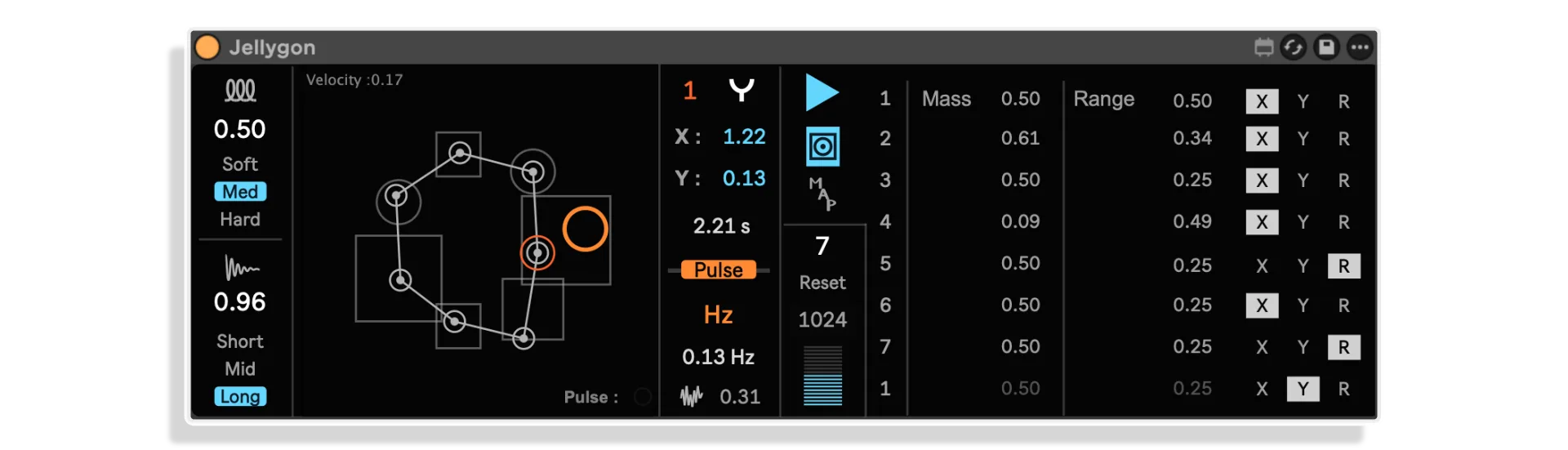
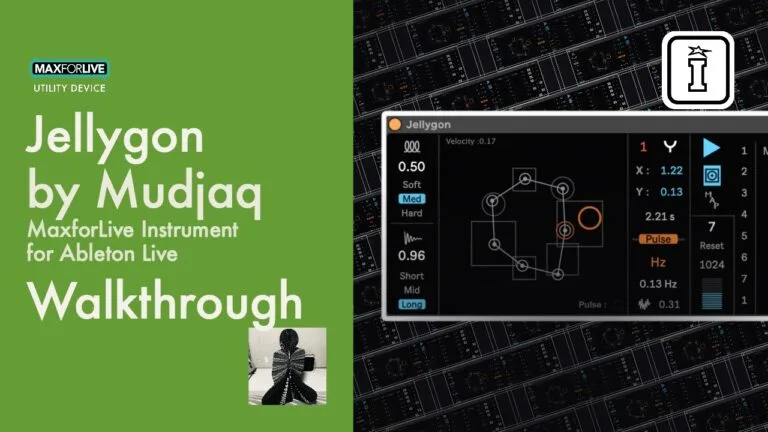
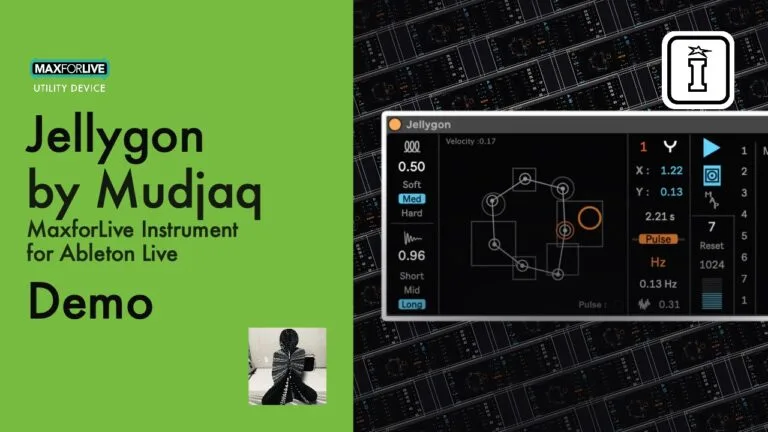
Jellygon by MUDJAQ is an 8-mapping spring physics modulator for Ableton Live: a device that treats modulation not as a pattern or an LFO, but as a living, bouncing, jelly-like system of interconnected points responding to real physical forces. Grab, push, and pulse your way to modulation that feels genuinely unpredictable, organic, and alive.
- Spring physics engine: 8 mapped parameters modulated by interconnected spring simulation points
- Grab & Pulse controls: Apply force directly to trigger motion, intuitive, performance-ready interaction
- Spring Rate & Damp: Fine-tune stiffness and damping for everything from gentle wobble to chaotic noise
- Individual mass settings: Each point has its own mass for nuanced, non-uniform behaviour
- Wild mode tendency: Built-in unpredictability that can push modulation into intense, runaway territory
- Parameter Range & Range Type: Dial in exactly how much each mapped parameter is affected
- Handle XY control: Visual, tactile manipulation of modulation sources in real time
- Ableton Live 12 compatible: Works with Live 12 Suite or Standard with Max for Live installed
USER GUIDE:
Jellygon Userguide
Jellygon by Mudjaq
MODULATION THAT MOVES LIKE IT'S ALIVE.
MAKE YOUR OWN TRIPLE PACK: Buy any three or more MUDJAQ products at the same time and get a 20% Discount (automatically applied at checkout)
Jellygon by MUDJAQ is an 8-mapping spring physics modulator for Ableton Live: a device that treats modulation not as a pattern or an LFO, but as a living, bouncing, jelly-like system of interconnected points responding to real physical forces. Grab, push, and pulse your way to modulation that feels genuinely unpredictable, organic, and alive.
- Spring physics engine: 8 mapped parameters modulated by interconnected spring simulation points
- Grab & Pulse controls: Apply force directly to trigger motion, intuitive, performance-ready interaction
- Spring Rate & Damp: Fine-tune stiffness and damping for everything from gentle wobble to chaotic noise
- Individual mass settings: Each point has its own mass for nuanced, non-uniform behaviour
- Wild mode tendency: Built-in unpredictability that can push modulation into intense, runaway territory
- Parameter Range & Range Type: Dial in exactly how much each mapped parameter is affected
- Handle XY control: Visual, tactile manipulation of modulation sources in real time
- Ableton Live 12 compatible: Works with Live 12 Suite or Standard with Max for Live installed
USER GUIDE:
Jellygon Userguide
Buying for someone?Send a gift card →
Additional information
| MaxforLive | Audio Devices |
|---|---|
| OS | Mac, Windows |
| Ableton Live Compatibility | Ableton Live 12 Standard with MaxforLive, Ableton Live 12 Suite |
| Min. Requirements | Ableton Live 12 Suite or Ableton Live 12 Standard with Max for Live installed |
PRICE: £14.00
Product reviews
5 out of 5
3 reviews
How item rating is calculated
We show the average based on reviews. Only genuine reviews are displayed.
Sort by
September 1, 2026
This reviewer bought this product from our store.
Nice modulation tool, don't always ubnerstand precisely when what happens why but it's part of the fun
I recommend this product
June 30, 2026
This reviewer bought this product from our store.
Jellygon (The Expressive Controller)
Jellygon by Mudjaq is specifically designed to be an expressive and malleable real-time control interface. Its visual strength: It is ideal for when you are mid-set with your MacBook Pro M1 Pro and want to alter the overall aesthetic without resorting to linear automations. You can use Jellygon's fluid geometry to cross-map color, feedback, and contrast parameters in Videosync 2. It allows you to "shape" visual behavior in a gestural and intuitive way right from the Ableton screen or via a physical controller like the Push.
Music/Visual
I recommend this product
June 28, 2026
This reviewer bought this product from our store.
I have just started to explore it, and it is already very intriguing. I need to continue to puzzle through the documentation, as is virtually always the case for me! It's time to check out the walkthrough video. At any rate, if you're into modulations that go way beyond the usual, give this a serious look. The description says the modulations feel organic and alive, and that is for real.
I recommend this product
Jellygon by Mudjaq
Most modulators hand you a shape (a sine wave, a random curve, an envelope) and ask you to map it to something. Jellygon throws that playbook out entirely. Instead of a static waveform, it gives you a spring physics simulation: a network of interconnected points that push, pull, bounce, and react to one another in real time. The result is modulation that doesn’t just move: it behaves.
Created by MUDJAQ, Jellygon is an 8-mapping modulator built around a spring physics engine. Each of the eight points in the system acts as a modulation source, and each one is physically connected to the others. Nudge one, and the ripple spreads. Apply a pulse, and the whole system lurches into motion. Adjust the mass on a single point and watch how the entire network recalibrates. This isn’t modulation you program. It’s modulation you set in motion and then ride.
The Vibe
Jellygon sits beautifully at the intersection of organic movement and controlled chaos. For producers working in ambient, experimental, or generative music, it opens up a world of slowly evolving textures that never quite repeat, the kind of subtle, breathing modulation that makes a synth pad feel like it’s actually alive. Push the spring stiffness up, dial in a heavier mass, and suddenly you’re in territory that feels like a system on the verge of collapse: perfect for industrial textures, noise-driven techno, or glitchy, unpredictable sound design.
The performance dimension is where Jellygon really sets itself apart. Because you can apply force in real time using the Grab and Pulse controls, this isn’t just a set-and-forget modulator: it’s a performance instrument. Grab a handle, pull it across the XY space, and release it; the spring system reacts, overshoots, oscillates, and gradually settles (or doesn’t, if that’s your intention). Pulse it at a set speed for rhythmic, percussive modulation bursts. It’s the kind of interaction that makes you want to record a live take rather than draw automation.
Key Features
- Spring physics simulation: A genuine physics engine drives all modulation: interconnected points that react to one another rather than running independently
- 8 mappable modulation sources: Each point in the simulation can be mapped to any automatable parameter in Ableton Live, giving you up to 8 simultaneous modulation targets
- Spring Rate control: Adjust the stiffness of the spring to define how quickly and sharply the system responds, from slow, elastic drift to tight, snappy reaction
- Damp control: Set the damping duration to determine how long motion continues after a force is applied, from quick, controlled decay to long, sustained oscillation
- Individual mass settings: Each handle has its own mass value, allowing non-uniform, complex physical behaviour across the network of points
- Handle XY / Grab: Directly manipulate individual points in 2D space: intuitive, hands-on control for live performance and sound design exploration
- Handle Attack: Shape how each point responds when force is initially applied, adding an additional layer of expressiveness to the system
- Pulse & Pulse Speed: Trigger a burst of force at a defined speed, ideal for generating rhythmic or periodic modulation patterns without manual interaction
- Parameter Range & Range Type: Precisely control the minimum and maximum values each modulation source can reach, and define the type of range mapping applied
- Wild tendency: A deliberate instability baked into the system. Push Jellygon far enough and it will run wild, generating intense, unpredictable modulation events
How It Works
At its core, Jellygon places eight points into a simulated physical space where each one has mass, is connected via spring forces, and is subject to damping. When you apply force to any point (either by grabbing and dragging it via the Handle XY interface, or by triggering a Pulse), the spring connections transmit that energy across the network. Heavier points move more slowly and carry more inertia; lighter ones snap back quickly. Tighter springs create sharper, more responsive movement; looser springs produce slow, wandering drift.
Each point’s position in this simulated space is read as a modulation value and mapped directly to a parameter of your choosing inside Ableton Live. As the system moves, those mapped parameters move with it: filter cutoffs sweep, reverb sizes expand and contract, pitch drifts, gain shifts. And because the physics engine is continuous and interconnected, no two moments are ever quite the same. Even a system that appears to have settled will occasionally be nudged by residual energy into a new cycle of movement.
The combination of Grab, Pulse, Spring Rate, Damp, and mass settings means you have genuine creative control over the character of the modulation (from predictable, musical wobble through to full-on chaotic behaviour) without ever drawing a single automation lane.
Who Is It For?
Jellygon is made for producers who are bored of predictable modulation. If you’ve ever wanted your synths to breathe without using an LFO, your effects to drift without drawing automation, or your live performance to feel genuinely reactive and unscripted, this is the tool. It’s equally at home in ambient and experimental production, in live techno or industrial sets where unpredictability is a feature, and in sound design contexts where you need movement that feels human and physical rather than mathematically perfect. Map it to anything: filter cutoff, reverb send, delay feedback, pitch, volume, pan. The spring doesn’t care. It just moves.
Technical Details
Jellygon requires Ableton Live 12 Suite, or Ableton Live 12 Standard with the Max for Live add-on installed. Compatible with both Mac and Windows.
🎁 MAKE YOUR OWN TRIPLE PACK: SAVE 20%
Buy any three or more MUDJAQ products at the same time and get a 20% discount, automatically applied at checkout. Mix and match across the full range.
Frequently Asked Questions
A: Jellygon can modulate any automatable parameter in Ableton Live: filter cutoff, reverb size, delay feedback, pitch, volume, pan, and much more. It supports up to 8 simultaneous mapped parameters, each driven by one of the spring simulation points.
A: Both. In the studio it’s a powerful generative modulation source for evolving textures and unpredictable movement. In a live context, the Grab and Pulse controls let you interact with the physics system in real time, making it a genuinely expressive performance instrument.
A: The wild tendency refers to a built-in instability in the spring system that can cause modulation to escalate and run unpredictably when pushed. You can influence it via the Spring Rate, Damp, and mass settings, but part of the point of Jellygon is embracing that unpredictability as a creative tool.
A: A standard LFO produces a repeating mathematical waveform. Jellygon produces modulation driven by a physical simulation, meaning each point’s movement is shaped by spring forces, inertia, mass, and damping. The result is movement that never quite repeats and responds dynamically to real-time input.
A: Pulse applies a burst of force to the spring system at a defined speed, triggering motion without you needing to manually grab a handle. This is useful for generating rhythmic or periodic modulation events, or for kicking the system back into motion after it has settled.
A: Yes. The Parameter Range and Range Type controls let you define both the minimum and maximum values each modulation source can reach, as well as the style of range mapping applied. This means you can keep modulation subtle and musical, or push it to the full extent of a parameter’s range.
A: Jellygon is designed and tested for Ableton Live 12. It requires either Ableton Live 12 Suite or Ableton Live 12 Standard with the Max for Live add-on installed. Compatibility with earlier versions of Live is not guaranteed.
A: If you purchase three or more MUDJAQ products in a single transaction at Isotonik Studios, a 20% discount is automatically applied at checkout. No code needed: just add three or more MUDJAQ products to your basket.
Important Information
v1.0.0 – Initial Release
Our Products are generally provided as Zip file downloads which in all cases will need to be extracted before use. For Max for Live Devices please place the extracted device in your User Library. For Ableton Live Packs please double click the extracted .alp file to install. For Ableton Live Projects please place in your projects folder.
END-USER LICENSE AGREEMENT FOR ISOTONIK STUDIOS SOFTWARE PRODUCTS.
PLEASE READ THE TERMS AND CONDITIONS OF THIS LICENSE AGREEMENT CAREFULLY BEFORE CONTINUING WITH THIS PROGRAM INSTALL.
This End-User License Agreement (referred to as “EULA”) is a legal agreement between an individual or a single entity (referred to as “LICENSEE”) and Isotonik Studios for the Isotonik Studios software product(s) which may include associated software components, media, printed materials, and “online” or electronic documentation (referred to as “SOFTWARE PRODUCT”). By installing, copying, or otherwise using the SOFTWARE PRODUCT, the LICENSEE agrees to be bound by the terms of this EULA.
This EULA represents the entire agreement concerning the program between the LICENSEE and Isotonik Studios and it supersedes any prior proposal, representation, or understanding between the parties. If the LICENSEE does not agree to the terms of this EULA, the LICENSEE should not install or use the SOFTWARE PRODUCT.
The SOFTWARE PRODUCT is protected by copyright laws and international copyright treaties, as well as other intellectual property laws and treaties. The SOFTWARE PRODUCT is licensed, not sold.
- GRANT OF LICENSE.
The SOFTWARE PRODUCT is licensed as follows:
(a) Installation and Use. Providing that the LICENSEE has paid any applicable license fees, Isotonik Studios grants the LICENSEE the right to install and use copies of the SOFTWARE PRODUCT on up to two computers in the LICENSEE’s possession that are running a validly licensed copy of the operating system for which the SOFTWARE PRODUCT was designed [e.g., Windows 10, macOS]. The computer(s) must be owned by the LICENSEE.
(b) Backup Copies. The LICENSEE may also make copies of the SOFTWARE PRODUCT as may be necessary for backup and archival purposes.
- DESCRIPTION OF OTHER RIGHTS AND LIMITATIONS.
(a) Maintenance of Copyright Notices. The LICENSEE must not remove or alter any copyright notices on any and all copies of the SOFTWARE PRODUCT.
(b) Distribution. The LICENSEE may not distribute registered copies of the SOFTWARE PRODUCT to third parties.
(c) Prohibition on Reverse Engineering, Decompilation, and Disassembly. The LICENSEE may not reverse engineer, decompile, or disassemble the SOFTWARE PRODUCT, except and only to the extent that such activity is expressly permitted by applicable law notwithstanding this limitation.
(d) Rental. The LICENSEE may not rent, lease, or lend the SOFTWARE PRODUCT.
(e) License transfer The LICENSEE may not transfer their license to the SOFTWARE PRODUCT to any third party. Any attempt to do so will be considered a violation of this EULA.
(f) Support Services. Isotonik Studios may provide the LICENSEE with support services related to the SOFTWARE PRODUCT for a period of 12 months following the date of purchase. Any supplemental software code provided to the LICENSEE as part of the Support Services shall be considered part of the SOFTWARE PRODUCT and subject to the terms and conditions of this EULA.
(g) Compliance with Applicable Laws. The LICENSEE must comply with all applicable laws regarding use of the SOFTWARE PRODUCT.
- TERMINATION Without prejudice to any other rights, Isotonik Studios may terminate this EULA if the LICENSEE fails to comply with the terms and conditions of this EULA. In such event, the LICENSEE must destroy all copies of the SOFTWARE PRODUCT in the LICENSEE’s possession.
- COPYRIGHT All title, including but not limited to copyrights, in and to the SOFTWARE PRODUCT and any copies thereof are owned by Isotonik Studios or its suppliers. All title and intellectual property rights in and to the content which may be accessed through use of the SOFTWARE PRODUCT is the property of the respective content owner and may be protected by applicable copyright or other intellectual property laws and treaties. This EULA grants the LICENSEE no rights to use such content. All rights not expressly granted are reserved by Isotonik Studios.
- NO WARRANTIES Isotonik Studios expressly disclaims any warranty for the SOFTWARE PRODUCT. The SOFTWARE PRODUCT is provided ‘As Is’ without any express or implied warranty of any kind, including but not limited to any warranties of merchantability, noninfringement, or fitness of a particular purpose. Isotonik Studios does not warrant or assume responsibility for the accuracy or completeness of any information, text, graphics, links or other items contained within the SOFTWARE PRODUCT. Isotonik Studios makes no warranties respecting any harm that may be caused by the transmission of a computer virus, worm, time bomb, logic bomb, or other such computer program. Isotonik Studios further expressly disclaims any warranty or representation to the LICENSEE or to any third party.
- LIMITATION OF LIABILITY In no event shall Isotonik Studios be liable for any damages (including, without limitation, lost profits, business interruption, or lost information) arising out of the LICENSEE’s use of or inability to use the SOFTWARE PRODUCT, even if Isotonik Studios has been advised of the possibility of such damages. In no event will Isotonik Studios be liable for loss of data or for indirect, special, incidental, consequential (including lost profit), or other damages based in contract, tort or otherwise. Isotonik Studios shall have no liability with respect to the content of the SOFTWARE PRODUCT or any part thereof, including but not limited to errors or omissions contained therein, libel, infringements of rights of publicity, privacy, trademark rights, business interruption, personal injury, loss of privacy, moral rights or the disclosure of confidential information.
More from Mudjaq