
Trisektor by LDM Design
HOW MUCH FUN CAN A DELAY BE?
MAKE YOUR OWN TRIPLE PACK: Buy any three or more LDM Design products at the same time and get a 20% Discount (automatically applied at checkout)
Trisektor splits audio into three frequency bands, applies independent delays to each, then runs everything through dub-style flutter, bitcrush, distortion, and a modulated comb filter before reassembling the chaos.
Inside you’ll find:
- Three-band frequency splitting with adjustable crossover points (bass, mids, highs)
- Independent delay time, offset, and feedback per band
- Dub-style flutter effect with rate control in Hertz or sync times
- Bitcrush with adjustable bit depth and sample rate reduction
- Analog-style overdrive distortion
- Modulated comb filter for metallic, resonant coloration
- Per-band volume control and output stage filtering
- Stereo width control with independent offset dials
- Channel linking for fast stereo delay setup
- Solo and mute per frequency band
- Dual panel interface: front panel for timing, effects panel for character
- Delay times in milliseconds or sync intervals
- High cut and low cut output filters
- Dry/wet control for parallel processing
Bass echoes tight and clean while highs trail off into filtered infinity. Mids get crushed and distorted while the rest stays pristine. Everything from subtle spatial dynamics to full-on psychedelic freak-out, all from surgical frequency-conscious delay architecture.
Requires: Ableton Live 10/11/12 Standard (with MaxforLive) or Suite | Mac & Windows
USER GUIDE: Trisektor USER GUIDE
Trisektor by LDM Design
HOW MUCH FUN CAN A DELAY BE?
MAKE YOUR OWN TRIPLE PACK: Buy any three or more LDM Design products at the same time and get a 20% Discount (automatically applied at checkout)
Trisektor splits audio into three frequency bands, applies independent delays to each, then runs everything through dub-style flutter, bitcrush, distortion, and a modulated comb filter before reassembling the chaos.
Inside you’ll find:
- Three-band frequency splitting with adjustable crossover points (bass, mids, highs)
- Independent delay time, offset, and feedback per band
- Dub-style flutter effect with rate control in Hertz or sync times
- Bitcrush with adjustable bit depth and sample rate reduction
- Analog-style overdrive distortion
- Modulated comb filter for metallic, resonant coloration
- Per-band volume control and output stage filtering
- Stereo width control with independent offset dials
- Channel linking for fast stereo delay setup
- Solo and mute per frequency band
- Dual panel interface: front panel for timing, effects panel for character
- Delay times in milliseconds or sync intervals
- High cut and low cut output filters
- Dry/wet control for parallel processing
Bass echoes tight and clean while highs trail off into filtered infinity. Mids get crushed and distorted while the rest stays pristine. Everything from subtle spatial dynamics to full-on psychedelic freak-out, all from surgical frequency-conscious delay architecture.
Requires: Ableton Live 10/11/12 Standard (with MaxforLive) or Suite | Mac & Windows
USER GUIDE: Trisektor USER GUIDE
Additional information
| MaxforLive | Audio Devices |
|---|---|
| Ableton Live Compatibility | Ableton Live 10 Standard with MaxforLive, Ableton Live 10 Suite, Ableton Live 11 Standard with MaxforLive, Ableton Live 11 Suite, Ableton Live 12 Standard with MaxforLive, Ableton Live 12 Suite |
| Min. Requirements | Ableton Live 10 Standard with MaxforLive Installed or Ableton Live 10 Suite |
| OS | Mac, Windows |
PRICE: £21.00
Product reviews
FEATURES
No reviews yet. Be the first to review this product.
Trisektor by LDM Design
Overview & Inspiration
Trisektor splits your audio into three frequency bands, applies independent delays to each, then runs the results through dub-style flutter, bitcrush, distortion, and a modulated comb filter before reassembling everything into cohesive sonic chaos.
Most delays treat your audio as a single entity. Trisektor sees bass, mids, and highs as separate worlds that can echo at different rates, decay at different speeds, and interact with effects independently. The low end might delay in tight sync while the highs flutter and stretch. Your mids could stay clean while bass gets crushed and distorted. This frequency-conscious approach creates spatial dynamics impossible with traditional single-band delays.
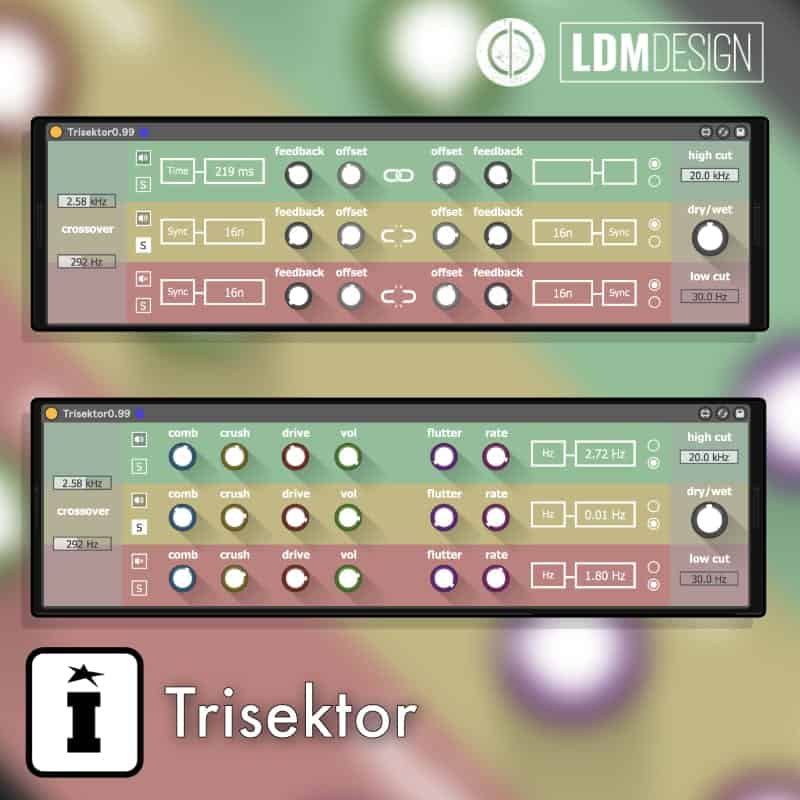
The interface divides into two panels. The front panel handles core delay parameters: time, feedback, offset, and stereo linking across all three bands. The effects panel adds character: classic dub flutter that wobbles the delay speed, bitcrush that degrades the signal, overdrive that adds grit, a modulated comb filter for metallic resonance, and volume control to tame the chaos. Switch between panels to balance precision delay timing with effect intensity, creating everything from subtle spatial enhancement to full psychedelic freak-out.
The Three-Band Architecture
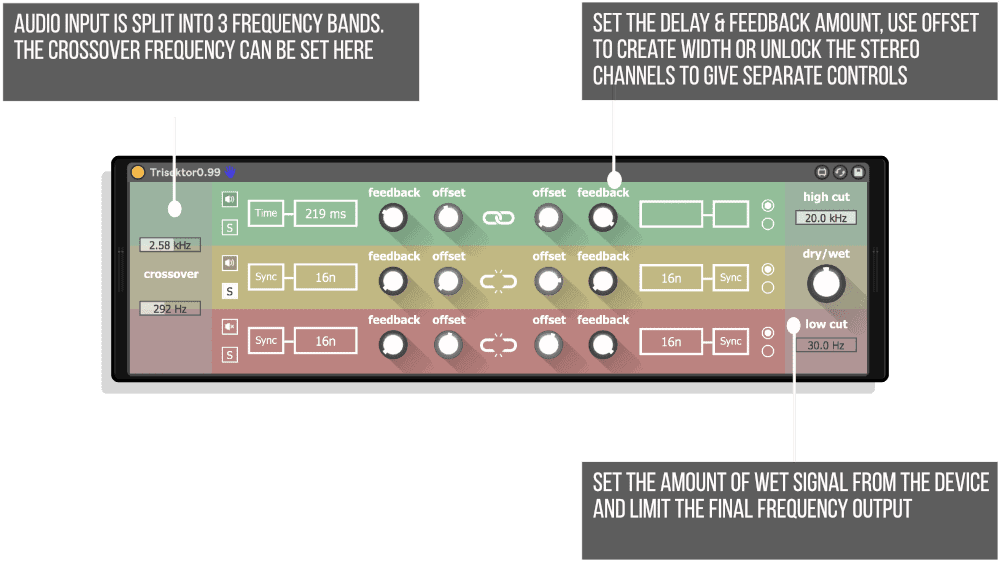
Trisektor begins with crossover frequency controls on the left side of the device. Set the low crossover (default 200 Hz) and high crossover (default 2 kHz) to define your three bands. Audio below the low crossover becomes the bass band. Audio between the two crossovers becomes the mid band. Audio above the high crossover becomes the high band.
This frequency splitting opens creative possibilities unavailable in traditional delays. Keep your bass tight with short delay times and minimal feedback while your highs trail off into long, filtered echoes. Solo individual bands to focus on specific frequency ranges during sound design. Mute bands to exclude frequencies from delay processing entirely. The three-band approach gives you surgical control over which parts of your sound echo and how.
Each band includes its own row of controls in the front panel: delay time (ms or sync), offset (stereo width), feedback (repetition intensity), and dedicated output/solo buttons. When you link channels, the left controls set values for both stereo channels, but offset dials remain independent for creating width even in linked mode. This design makes it fast to dial in cohesive stereo delay settings while retaining precise control over stereo imaging.
Front Panel: Core Delay Controls
Band Output and Solo: Each of the three bands has an output button that acts as a mute switch. Turn off any band to exclude that frequency range from delay processing entirely. The solo button isolates a single band, perfect for fine-tuning delay parameters for specific frequencies without the full mix context. Use solo mode to dial in perfect bass delay settings, then unsolo to hear how they interact with mid and high delays.
Delay Time: Set delay time in milliseconds or sync intervals for each band independently. In linked channel mode, the left delay time controls both stereo channels, but you can still use offset to create stereo width. Millisecond mode gives you precise control for tight slapback or experimental timing. Sync mode locks delays to musical divisions for rhythmic effects that stay in time with your track’s tempo.
Offset: Create stereo width by offsetting the right channel’s delay time relative to the left. These controls work even when channels are linked, making it easy to set matched delay times then add width with offset. Small offset amounts create subtle spatial enhancement. Larger offsets produce ping-pong effects or disorienting stereo movement. Each band has independent offset control for complex stereo imaging across the frequency spectrum.
Feedback: Controls how much of the delayed signal feeds back into the delay line for repeated echoes. Low feedback creates single echoes or short trails. High feedback produces long, decaying delay tails. In linked mode, the left feedback control sets the amount for both channels, simplifying stereo delay setup. Because feedback is per-band, you can create bass that echoes twice, mids that echo four times, and highs that trail off into infinity.
Link Channels: The link button synchronizes left and right channel delay times and feedback amounts, making it fast to dial in cohesive stereo settings. Even with channels linked, offset controls remain independent, allowing you to create stereo width without breaking the link. This workflow matches how most producers think about stereo delays: matched timing with adjustable width.
Effects Panel: Character and Color
Click the panel select button to reveal the effects panel, where Trisektor’s character lives. These effects process the delay output for each band before the signal reaches the final output stage.
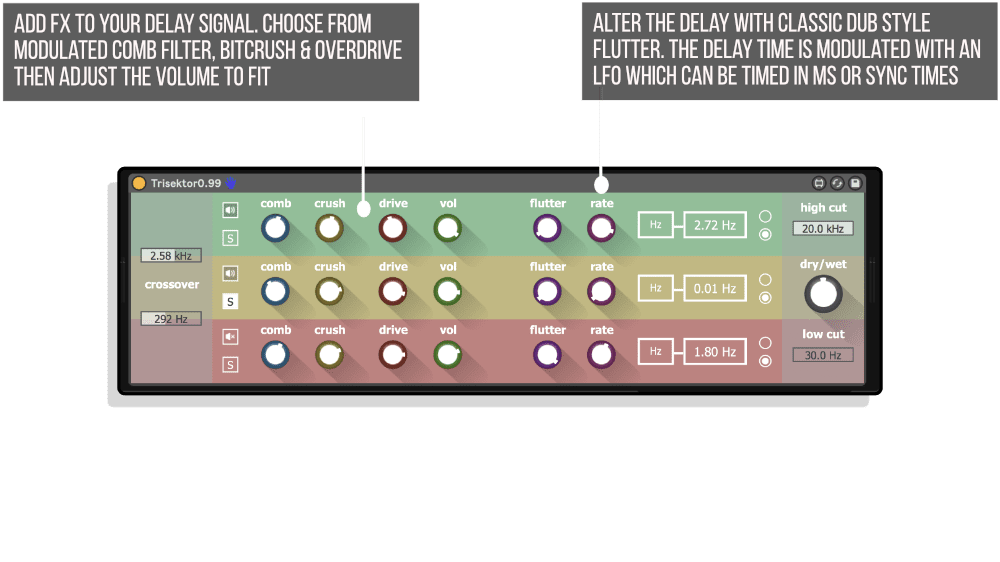
Comb Filter: A modulated comb filter adds metallic, resonant coloration to the delayed signal. The dial acts as a dry/wet control, blending between clean delays and heavily filtered, ringing echoes. Comb filtering creates that distinctive “through a telephone” or “inside a metal tube” quality, perfect for adding otherworldly character to delays. The modulation keeps the filter moving, preventing static resonances and adding organic movement.
Crush: Reduces bit depth and sampling rate to degrade the delayed signal with digital artifacts. Subtle settings add grit and texture reminiscent of vintage samplers. Extreme settings create glitchy, lo-fi chaos with aliasing and quantization noise. Crushing works particularly well on high-frequency delays, creating fizzy, degraded trails that sit behind clean dry signals. Different per band, you could crush only the bass for grimey low-end echoes while keeping mids and highs pristine.
Overdrive: Adds analog-style distortion to the delayed signal. Use subtle amounts for warmth and saturation that helps delays sit in dense mixes. Push harder for aggressive distortion that turns clean echoes into walls of fuzz. Because overdrive happens after the delay but before feedback, distorted signals feed back into the delay line, creating increasingly saturated echo trails. Combined with high feedback, overdrive can push delays into self-oscillating noise walls.
Volume: Attenuates the delayed signal before it hits the output stage. Essential when layering multiple effects, as comb filtering, distortion, and crushing can all add significant level. Use volume to prevent clipping or to balance the delayed signal against the dry signal. Each band has independent volume control, letting you adjust the balance of bass, mid, and high delay levels in the final mix.
Flutter: Creates the classic dub delay wobble by modulating delay time with a low-frequency oscillator. This produces pitch-shifting effects reminiscent of tape delay wow and flutter or the sound of a delay unit’s tape speed fluctuating. The flutter rate can be set in Hertz for free-running modulation or in sync times for rhythmic wobble locked to your track’s tempo. Sync’d flutter at 1/4 or 1/8 note rates creates pulsing, rhythmic pitch modulation. Slow, unsync’d flutter adds subtle organic movement.
Output Stage
After delays and effects, the signal hits the output stage on the right side of the device. High cut and low cut filters let you shape the final frequency range, useful for removing rumble from bass delays or taming harsh highs from distorted echo trails. The dry/wet control blends between completely dry signal and fully processed delays, with everything in between for parallel delay mixing.
This final filtering stage differs from the input crossovers. The crossovers split audio into bands for independent delay processing. The output filters sculpt the frequency range of the entire processed signal after all bands are recombined. Use output filtering to ensure delays fit in your mix without cluttering important frequency ranges occupied by other elements.
Features & Highlights
Three Independent Frequency Bands: Process bass, mids, and highs with separate delay times, feedback amounts, and effect settings for surgical control over which frequencies echo and how.
Dub-Style Flutter: Classic tape delay wobble effect with rate control in Hertz or sync times for everything from subtle organic movement to rhythmic pitch modulation.
Complete Effects Chain: Modulated comb filter, bitcrush, overdrive, and volume control per band add character ranging from subtle coloration to extreme degradation.
Stereo Width Control: Independent offset dials for each band create stereo width even when channels are linked, making it fast to dial in cohesive stereo delays with precise imaging control.
Dual Panel Interface: Switch between front panel (delay parameters) and effects panel (character controls) for workflow that separates timing from tone.
Flexible Timing: Set delay times in milliseconds for precise control or sync intervals for musical, tempo-locked echoes that adapt to your project’s BPM.
Output Stage Filtering: High cut and low cut filters sculpt the final frequency range after all processing, ensuring delays fit in your mix without frequency buildup.
Per-Band Solo and Mute: Isolate or exclude individual frequency bands for focused sound design and surgical delay application.
How to Use
Drop Trisektor on any audio track as an audio effect. Start with the default crossover settings (200 Hz low, 2 kHz high) and adjust to match your source material. For drums, try lower crossovers to keep kick and snare in separate bands. For synths, experiment with higher crossovers to isolate lead frequencies from pad textures.
Set delay times for each band. Short times (1-50ms) create slapback and doubling effects. Medium times (50-200ms) produce rhythmic echoes. Long times (200ms+) create spacious trails. Use sync mode to lock delays to musical divisions – try 1/16 notes on highs, 1/8 notes on mids, and 1/4 notes on bass for polyrhythmic delay patterns.
Adjust feedback to control echo decay. Low feedback (10-30%) creates single echoes. Medium feedback (30-60%) produces moderate trails. High feedback (60-90%) generates long, evolving delays. Extreme feedback (90%+) approaches self-oscillation and infinite sustain, useful for experimental drone textures and feedback walls.
Switch to the effects panel to add character. Start subtle with light flutter and minimal crush or overdrive. Listen to how each effect colors the delayed signal. Push harder for more extreme textures – heavy bitcrush on highs creates lo-fi fizz, aggressive overdrive on bass adds weight and grit, strong comb filtering on mids produces metallic resonance.
Use the dry/wet control to balance delays against your dry signal. 100% wet for pure delay effects on aux tracks. 20-40% wet for subtle spatial enhancement on individual tracks. Adjust output filters to prevent delays from cluttering important frequency ranges in your mix.
Ideal For
- Dub and reggae producers who need authentic tape delay flutter and character
- Electronic music producers looking for surgical frequency-specific delay control
- Sound designers creating psychedelic, experimental, or otherworldly spatial effects
- Mix engineers who want delays on specific frequency ranges without affecting the full spectrum
- Ambient and atmospheric producers building complex, evolving soundscapes
- Anyone who finds traditional single-band delays too simple or limiting
- Producers who want one delay device capable of subtle enhancement and extreme chaos
What’s Included
- Trisektor: 3-band delay unit (.amxd)
- Comprehensive PDF user guide
- Mac and Windows compatible
- Requires Ableton Live 10/11/12 Standard (with MaxforLive) or Suite
Technical Notes
Trisektor is a MaxforLive audio effect that processes audio in real-time with minimal latency. The frequency crossover uses high-quality filters to split the audio cleanly without phase issues. All delay times can be modulated via Live’s automation system. The device works with any audio source including instruments, vocals, drums, and full mixes.
CPU usage scales with the number of active effects. Running all effects on all three bands uses moderate CPU. Disable effects or mute bands you’re not using to optimize performance in large projects. The device supports both mono and stereo signals, with stereo signals taking advantage of the offset and channel linking features.
Explore More from LDM Design
Chance Pack FOUR | LP Pack | FRAKTOR | ADD | View All LDM Design Products
Frequently Asked Questions
A: Trisektor is a MaxforLive 3-band delay unit for Ableton Live that splits audio into three independent frequency bands (bass, mids, highs) and processes each with separate delay times, feedback amounts, and effects. The device features dub-style flutter effects, bitcrush, overdrive distortion, and a modulated comb filter. You can create everything from subtle spatial enhancement to extreme psychedelic delay effects by controlling which frequencies echo, how they decay, and what character gets added through the effects chain.
A: Yes, Trisektor is a MaxforLive device.
A: MaxforLive is a platform that integrates the visual programming environment Max with Ableton Live, allowing users to create and use custom audio, MIDI, and control devices.
A: Trisektor uses crossover filters to split your audio into three bands: bass (below the low crossover), mids (between low and high crossover), and highs (above the high crossover). Each band has independent delay time, feedback, offset, and effect settings. This lets you apply short, tight delays to bass while highs trail off with long, filtered echoes, or crush the mids while keeping bass and highs clean. The frequency-specific approach creates spatial effects impossible with traditional single-band delays.
A: The flutter effect creates classic dub-style tape delay wobble by modulating the delay time with a low-frequency oscillator. This produces pitch-shifting effects reminiscent of tape delays with fluctuating tape speed. The flutter rate can be set in Hertz for free-running modulation or synced to tempo for rhythmic wobble. It’s essential for authentic dub delay sounds and psychedelic spatial effects.
A: Yes, Trisektor works with both mono and stereo sources. With stereo signals, you get full access to the offset controls and channel linking features for creating stereo width. With mono sources, the device still provides all three-band processing, effects, and delay capabilities.
A: You can explore more of LDM Design’s tools and devices here: LDM Design
Important Information
V1.0.0 – Initial Release
Our Products are generally provided as Zip file downloads which in all cases will need to be extracted and saved to your hard drive prior to installation. Details on the different file type provided and what to do with them are below.
.alp Files – These are Ableton Live Packs and will either install directly into the Packs Section of the browser of Ableton Live or ask you to save them to your hard drive. For packs that install to the library, when you double click on them you will see a pop up window asking you to confirm that installation is ok as the files are described as “Legacy”. This is fine and you are ok to proceed, the packs are created using the format for an earlier version of Live and so remain compatible with the current version.
.amxd files – These are individual MaxforLive Devices and can be stored anywhere on your hard drive. We’d advise creating a folder for them and then adding that folder as a location within the Places section of Lives Browser.
END-USER LICENSE AGREEMENT FOR ISOTONIK STUDIOS SOFTWARE PRODUCTS.
PLEASE READ THE TERMS AND CONDITIONS OF THIS LICENSE AGREEMENT CAREFULLY BEFORE CONTINUING WITH THIS PROGRAM INSTALL.
This End-User License Agreement (referred to as “EULA”) is a legal agreement between an individual or a single entity (referred to as “LICENSEE”) and Isotonik Studios for the Isotonik Studios software product(s) which may include associated software components, media, printed materials, and “online” or electronic documentation (referred to as “SOFTWARE PRODUCT”). By installing, copying, or otherwise using the SOFTWARE PRODUCT, the LICENSEE agrees to be bound by the terms of this EULA.
This EULA represents the entire agreement concerning the program between the LICENSEE and Isotonik Studios and it supersedes any prior proposal, representation, or understanding between the parties. If the LICENSEE does not agree to the terms of this EULA, the LICENSEE should not install or use the SOFTWARE PRODUCT.
The SOFTWARE PRODUCT is protected by copyright laws and international copyright treaties, as well as other intellectual property laws and treaties. The SOFTWARE PRODUCT is licensed, not sold.
- GRANT OF LICENSE.
The SOFTWARE PRODUCT is licensed as follows:
(a) Installation and Use. Providing that the LICENSEE has paid any applicable license fees, Isotonik Studios grants the LICENSEE the right to install and use copies of the SOFTWARE PRODUCT on up to two computers in the LICENSEE’s possession that are running a validly licensed copy of the operating system for which the SOFTWARE PRODUCT was designed [e.g., Windows 10, macOS]. The computer(s) must be owned by the LICENSEE.
(b) Backup Copies. The LICENSEE may also make copies of the SOFTWARE PRODUCT as may be necessary for backup and archival purposes.
- DESCRIPTION OF OTHER RIGHTS AND LIMITATIONS.
(a) Maintenance of Copyright Notices. The LICENSEE must not remove or alter any copyright notices on any and all copies of the SOFTWARE PRODUCT.
(b) Distribution. The LICENSEE may not distribute registered copies of the SOFTWARE PRODUCT to third parties.
(c) Prohibition on Reverse Engineering, Decompilation, and Disassembly. The LICENSEE may not reverse engineer, decompile, or disassemble the SOFTWARE PRODUCT, except and only to the extent that such activity is expressly permitted by applicable law notwithstanding this limitation.
(d) Rental. The LICENSEE may not rent, lease, or lend the SOFTWARE PRODUCT.
(e) License transfer The LICENSEE may not transfer their license to the SOFTWARE PRODUCT to any third party. Any attempt to do so will be considered a violation of this EULA.
(f) Support Services. Isotonik Studios may provide the LICENSEE with support services related to the SOFTWARE PRODUCT for a period of 12 months following the date of purchase. Any supplemental software code provided to the LICENSEE as part of the Support Services shall be considered part of the SOFTWARE PRODUCT and subject to the terms and conditions of this EULA.
(g) Compliance with Applicable Laws. The LICENSEE must comply with all applicable laws regarding use of the SOFTWARE PRODUCT.
- TERMINATION Without prejudice to any other rights, Isotonik Studios may terminate this EULA if the LICENSEE fails to comply with the terms and conditions of this EULA. In such event, the LICENSEE must destroy all copies of the SOFTWARE PRODUCT in the LICENSEE’s possession.
- COPYRIGHT All title, including but not limited to copyrights, in and to the SOFTWARE PRODUCT and any copies thereof are owned by Isotonik Studios or its suppliers. All title and intellectual property rights in and to the content which may be accessed through use of the SOFTWARE PRODUCT is the property of the respective content owner and may be protected by applicable copyright or other intellectual property laws and treaties. This EULA grants the LICENSEE no rights to use such content. All rights not expressly granted are reserved by Isotonik Studios.
- NO WARRANTIES Isotonik Studios expressly disclaims any warranty for the SOFTWARE PRODUCT. The SOFTWARE PRODUCT is provided ‘As Is’ without any express or implied warranty of any kind, including but not limited to any warranties of merchantability, noninfringement, or fitness of a particular purpose. Isotonik Studios does not warrant or assume responsibility for the accuracy or completeness of any information, text, graphics, links or other items contained within the SOFTWARE PRODUCT. Isotonik Studios makes no warranties respecting any harm that may be caused by the transmission of a computer virus, worm, time bomb, logic bomb, or other such computer program. Isotonik Studios further expressly disclaims any warranty or representation to the LICENSEE or to any third party.
- LIMITATION OF LIABILITY In no event shall Isotonik Studios be liable for any damages (including, without limitation, lost profits, business interruption, or lost information) arising out of the LICENSEE’s use of or inability to use the SOFTWARE PRODUCT, even if Isotonik Studios has been advised of the possibility of such damages. In no event will Isotonik Studios be liable for loss of data or for indirect, special, incidental, consequential (including lost profit), or other damages based in contract, tort or otherwise. Isotonik Studios shall have no liability with respect to the content of the SOFTWARE PRODUCT or any part thereof, including but not limited to errors or omissions contained therein, libel, infringements of rights of publicity, privacy, trademark rights, business interruption, personal injury, loss of privacy, moral rights or the disclosure of confidential information.
More from LDM Design
Frequently Bought Together
 ★ Popular