
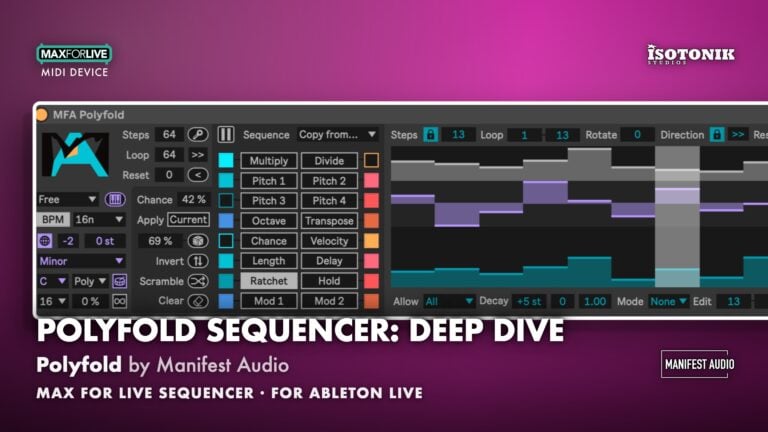
Polyfold
POLYCYCLIC, POLYMETRIC, POLYPHONIC MAX FOR LIVE SEQUENCER
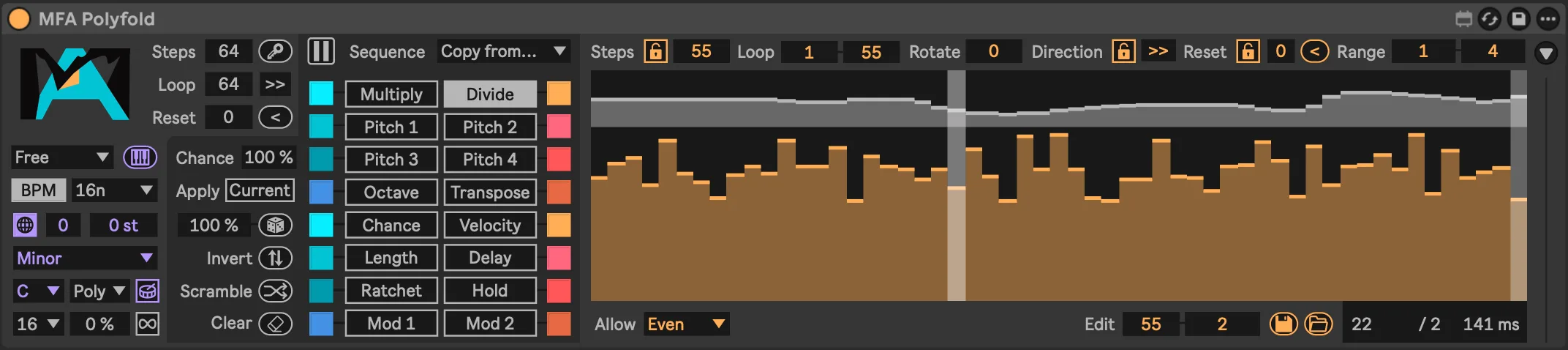
Polyfold, designed by Ableton Certified Trainer Noah Pred, gives you 16 independent parameter lanes with up to 1024 steps each, totalling up to 16,384 steps unfolding across polymetric cycles. It combines dual-stage rate architecture, a polyphonic pitch system, probabilistic control, and integrated OSC and MIDI routing into one unified sequencing ecosystem.
- Scale of control: 16 interdependent sequencers, up to 1024 steps per lane, independent loop lengths, directions, and bar resets per lane.
- Dual Stage Rate Architecture: Shared base rate shaped per step by independent Multiply and Divide sequencers, supporting even, triplet, and unrestricted rates for compound rhythmic folding.
- Polyphonic Pitch System: Four discrete-range pitch sequencers with per-note probability, preset pattern libraries, Euclidean octave control, transposition phrase sequencing, and Drums mode for instant Drum Rack usage.
- Probabilistic and expressive control: Chance lanes for Multiply, Divide, Pitch, Octave, Ratchet, and Delay; per-step deviation for Velocity and Length; unique ratchetting with pitch, velocity, and length decay.
- Modulation and routing: Two modulation sequencers with multi-mapping output, OSC transmission per sequencer, optional MIDI CC output, and up to 64 X-Relay routing busses.
- Live 12 integration: Natively scale and key aware, theme adaptive, and fully optimised for Push with all parameters accessible.
Manifest Audio
Manifest Audio delivers inspiration to your studio via innovative creative tools developed for Max for Live by Ableton Certified Trainer, Noah Pred.
View all products by Manifest AudioOverview
Multidimensional Sequencing System
Every sequencer you have used before has felt the ceiling. Eight steps, sixteen, sixty-four, and then you are looping the same phrase. Polyfold removes that ceiling. Sixteen independent lanes, each running up to 1024 steps with its own loop length, direction, and bar reset, unfold across polymetric cycles that compound on themselves. Dual Multiply and Divide sequencers reshape the base rate at every single step, which means the rhythmic structure breathes and shifts in ways a fixed grid simply cannot reach.
Your pitch material is equally deep. Four discrete pitch sequencers run in parallel, each with per-note probability, preset pattern libraries, and optional Euclidean octave control. Chance lanes, per-step deviation, and an expressive ratchet architecture with pitch and velocity decay add controlled fragmentation whenever you need it. OSC transmission, MIDI CC output, and up to 64 X-Relay routing busses send sequences anywhere in your Live set. Natively scale and key aware in Live 12, theme adaptive, and fully mapped for Push, Polyfold is the sequencing infrastructure your long-form compositions have been waiting for.
- 16 interdependent sequencers with up to 1024 steps per lane, independent loop length, direction, and bar reset per lane, totalling up to 16,384 steps across the device
- Dual Stage Rate Architecture: shared base rate modified per step by independent Multiply and Divide sequencer lanes, supporting even, triplet, and unrestricted rates for compound rhythmic folding and layered subdivision
- Polyphonic Pitch System with four discrete-range pitch sequencers, per-note probability, preset pattern libraries, random pattern selection, and internal custom pattern storage and recall
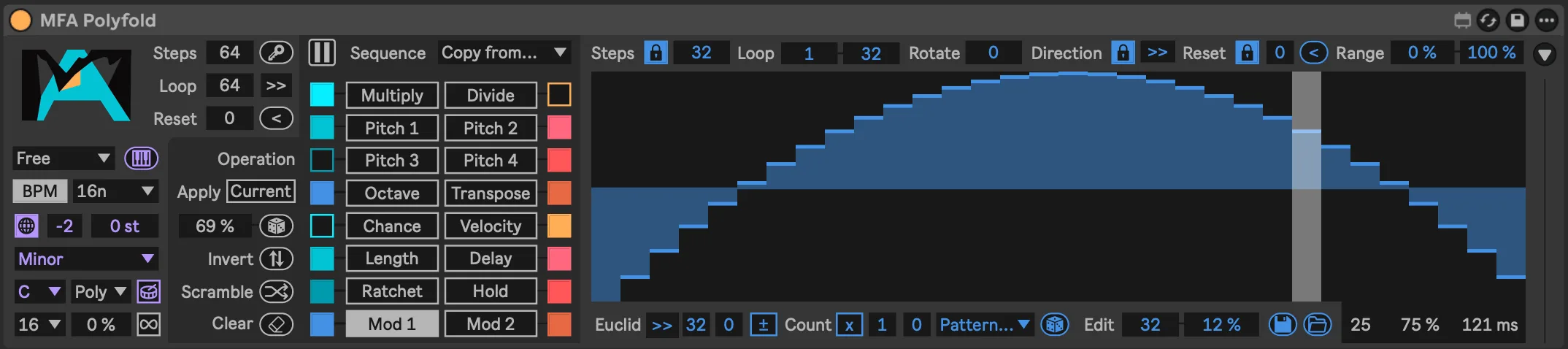
- Optional Octave sequencer with Euclidean control, Transposition phrase sequencer, real-time MIDI transposition, and Drums mode for instant Drum Rack usage
- Chance lanes for Multiply, Divide, Pitch 1 to 4, Octave, Ratchet, and Delay; per-step deviation lanes for Velocity and Length across all parameter lanes
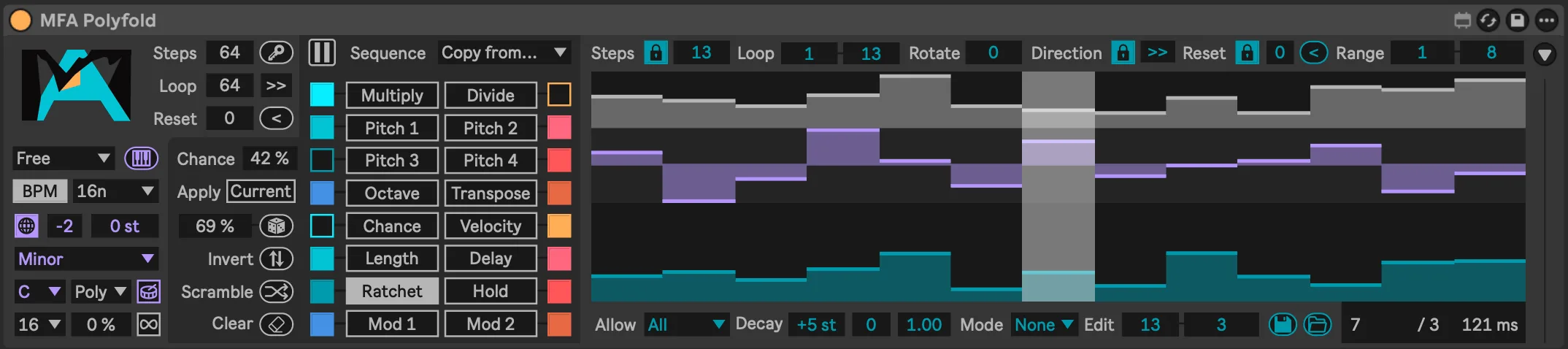
- Unique ratchetting with pitch, velocity, and length decay, pitch decay deviation, and optional clip, wrap, and fold behaviours for intricate probabilistic ornamentation
- Two modulation sequencers with dedicated mappers, Depth, Jitter, Smooth, and activation controls, combining for multi-mapping output across the set
- OSC transmission per sequencer, optional MIDI CC output, and up to 64 X-Relay routing busses for distributed MIDI output across your Live set
- Natively integrated with Live 12 scale and key, device colours that adapt automatically to your Live theme, and all parameters ready and available on Push
- Global lock system, multiple play modes, optional global swing, global octave and semitone transposition, and a Grid view option for structural control
- Max for Live MIDI Device .amxd device
- User manual (PDF)
Reviews
No reviews yet. Be the first to review this product.










Important Information
CHANGELOG
v1.1.5 · released 30 Sep 2026
Resolved an issue where Time-based millisecond rates might not be stored as expected.
v1.1.4 · 28 September 2026
Clock improvements and a new optional force Quantization parameter.
v1.1.3 · 27 September 2026
Powers of 2 quantization option on both Multiply and Divide rate sequencers.
v1.0.1 · 26 September 2026
Powers of 2 quantization option on both Multiply and Divide rate sequencers.
INSTALLATION
Our Products are generally provided as Zip file downloads which in all cases will need to be extracted and saved to your hard drive prior to installation. Details on the different file type provided and what to do with them are below.
.alp Files – These are Ableton Live Packs and will either install directly into the Packs Section of the browser of Ableton Live or ask you to save them to your hard drive. For packs that install to the library, when you double click on them you will see a pop up window asking you to confirm that installation is ok as the files are described as “Legacy”. This is fine and you are ok to proceed, the packs are created using the format for an earlier version of Live and so remain compatible with the current version.
.amxd files – These are individual MaxforLive Devices and can be stored anywhere on your hard drive. We’d advise creating a folder for them and then adding that folder as a location within the Places section of Lives Browser.
LICENSE
END-USER LICENSE AGREEMENT FOR ISOTONIK STUDIOS SOFTWARE PRODUCTS.
PLEASE READ THE TERMS AND CONDITIONS OF THIS LICENSE AGREEMENT CAREFULLY BEFORE CONTINUING WITH THIS PROGRAM INSTALL.
This End-User License Agreement (referred to as “EULA”) is a legal agreement between an individual or a single entity (referred to as “LICENSEE”) and Isotonik Studios for the Isotonik Studios software product(s) which may include associated software components, media, printed materials, and “online” or electronic documentation (referred to as “SOFTWARE PRODUCT”). By installing, copying, or otherwise using the SOFTWARE PRODUCT, the LICENSEE agrees to be bound by the terms of this EULA.
This EULA represents the entire agreement concerning the program between the LICENSEE and Isotonik Studios and it supersedes any prior proposal, representation, or understanding between the parties. If the LICENSEE does not agree to the terms of this EULA, the LICENSEE should not install or use the SOFTWARE PRODUCT.
The SOFTWARE PRODUCT is protected by copyright laws and international copyright treaties, as well as other intellectual property laws and treaties. The SOFTWARE PRODUCT is licensed, not sold.
- GRANT OF LICENSE.
The SOFTWARE PRODUCT is licensed as follows:
(a) Installation and Use. Providing that the LICENSEE has paid any applicable license fees, Isotonik Studios grants the LICENSEE the right to install and use copies of the SOFTWARE PRODUCT on up to two computers in the LICENSEE’s possession that are running a validly licensed copy of the operating system for which the SOFTWARE PRODUCT was designed [e.g., Windows 10, macOS]. The computer(s) must be owned by the LICENSEE.
(b) Backup Copies. The LICENSEE may also make copies of the SOFTWARE PRODUCT as may be necessary for backup and archival purposes.
- DESCRIPTION OF OTHER RIGHTS AND LIMITATIONS.
(a) Maintenance of Copyright Notices. The LICENSEE must not remove or alter any copyright notices on any and all copies of the SOFTWARE PRODUCT.
(b) Distribution. The LICENSEE may not distribute registered copies of the SOFTWARE PRODUCT to third parties.
(c) Prohibition on Reverse Engineering, Decompilation, and Disassembly. The LICENSEE may not reverse engineer, decompile, or disassemble the SOFTWARE PRODUCT, except and only to the extent that such activity is expressly permitted by applicable law notwithstanding this limitation.
(d) Rental. The LICENSEE may not rent, lease, or lend the SOFTWARE PRODUCT.
(e) License transfer The LICENSEE may not transfer their license to the SOFTWARE PRODUCT to any third party. Any attempt to do so will be considered a violation of this EULA.
(f) Support Services. Isotonik Studios may provide the LICENSEE with support services related to the SOFTWARE PRODUCT for a period of 12 months following the date of purchase. Any supplemental software code provided to the LICENSEE as part of the Support Services shall be considered part of the SOFTWARE PRODUCT and subject to the terms and conditions of this EULA.
(g) Compliance with Applicable Laws. The LICENSEE must comply with all applicable laws regarding use of the SOFTWARE PRODUCT.
- TERMINATION Without prejudice to any other rights, Isotonik Studios may terminate this EULA if the LICENSEE fails to comply with the terms and conditions of this EULA. In such event, the LICENSEE must destroy all copies of the SOFTWARE PRODUCT in the LICENSEE’s possession.
- COPYRIGHT All title, including but not limited to copyrights, in and to the SOFTWARE PRODUCT and any copies thereof are owned by Isotonik Studios or its suppliers. All title and intellectual property rights in and to the content which may be accessed through use of the SOFTWARE PRODUCT is the property of the respective content owner and may be protected by applicable copyright or other intellectual property laws and treaties. This EULA grants the LICENSEE no rights to use such content. All rights not expressly granted are reserved by Isotonik Studios.
- NO WARRANTIES Isotonik Studios expressly disclaims any warranty for the SOFTWARE PRODUCT. The SOFTWARE PRODUCT is provided ‘As Is’ without any express or implied warranty of any kind, including but not limited to any warranties of merchantability, noninfringement, or fitness of a particular purpose. Isotonik Studios does not warrant or assume responsibility for the accuracy or completeness of any information, text, graphics, links or other items contained within the SOFTWARE PRODUCT. Isotonik Studios makes no warranties respecting any harm that may be caused by the transmission of a computer virus, worm, time bomb, logic bomb, or other such computer program. Isotonik Studios further expressly disclaims any warranty or representation to the LICENSEE or to any third party.
- LIMITATION OF LIABILITY In no event shall Isotonik Studios be liable for any damages (including, without limitation, lost profits, business interruption, or lost information) arising out of the LICENSEE’s use of or inability to use the SOFTWARE PRODUCT, even if Isotonik Studios has been advised of the possibility of such damages. In no event will Isotonik Studios be liable for loss of data or for indirect, special, incidental, consequential (including lost profit), or other damages based in contract, tort or otherwise. Isotonik Studios shall have no liability with respect to the content of the SOFTWARE PRODUCT or any part thereof, including but not limited to errors or omissions contained therein, libel, infringements of rights of publicity, privacy, trademark rights, business interruption, personal injury, loss of privacy, moral rights or the disclosure of confidential information.
Frequently Asked Questions
What is Polyfold?
Polyfold is a polycyclic, polymetric, polyphonic Max for Live sequencer designed by Ableton Certified Trainer Noah Pred. It provides 16 independent parameter lanes each with up to 1024 steps, a dual-stage rate architecture, a polyphonic pitch system, probabilistic control, and integrated OSC and MIDI routing, all within Ableton Live.
Which version of Ableton Live do I need to run Polyfold?
Polyfold requires Ableton Live 12.0 Standard or Suite with Max for Live. It runs on both Mac and Windows.
How does Polyfold differ from a standard step sequencer?
Most sequencers operate within 8 to 64 step limits. Polyfold supports up to 1024 steps per lane across 16 independent lanes, totalling up to 16,384 steps. Each lane has its own loop length, direction, and bar reset. Dual Multiply and Divide sequencers reshape the base rate at every step, enabling rhythmic structures that a fixed-grid sequencer cannot produce.
Can Polyfold send MIDI and modulation to other devices in my Live set?
Yes. Each pitch lane can be independently routed via the bundled X-Relay utility for distributed MIDI output. Polyfold also offers OSC transmission per sequencer, optional MIDI CC output, and up to 64 X-Relay routing busses, so sequences can be sent anywhere in your set.
Does Polyfold work with Live 12's scale and key system?
Yes. Polyfold is natively integrated with Live 12’s scale and key for a seamless workflow. The step edit display shows notes with the scale and key applied.
Is Polyfold optimised for Push, and does it adapt to my Live theme?
Yes. All parameters are ready and available on Push. Device colours also adapt automatically to your preferred Live theme.
In Depth
Polyfold: A Full Sequencing Ecosystem for Ableton Live
Most sequencers give you 8 to 64 steps and call it creative freedom. You already know the ceiling that sets. Polyfold, designed by Ableton Certified Trainer Noah Pred, operates on a different scale entirely. It is a polycyclic, polymetric, polyphonic Max for Live sequencer with 16 independent parameter lanes, each holding up to 1024 steps. That is 16,384 total steps unfolding across your Live set, with every lane running its own loop length, direction, and rate.
Polyfold is not a sketch tool or a generative effect. It is a full sequencing ecosystem, combining hardware-grade step depth with advanced modulation routing and long-form compositional control in a single device.
16 Independent Parameter Lanes
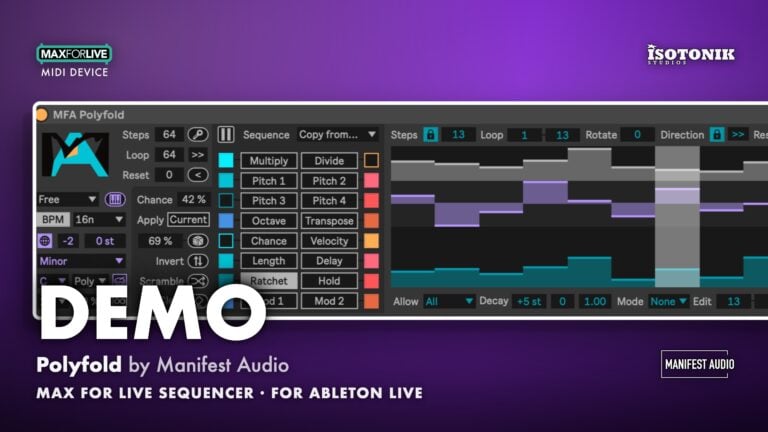
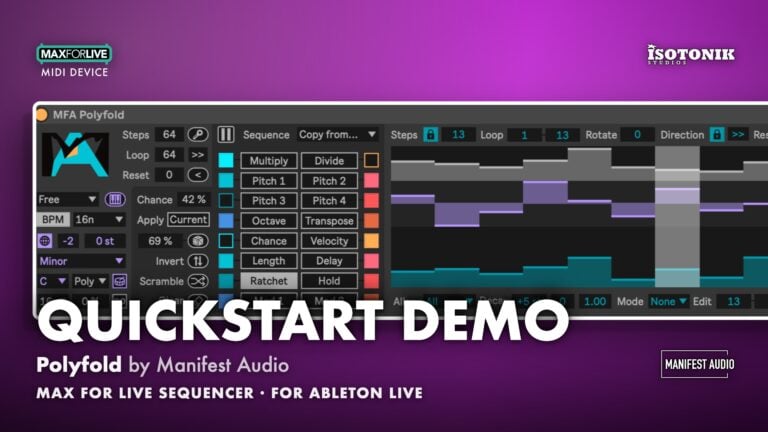
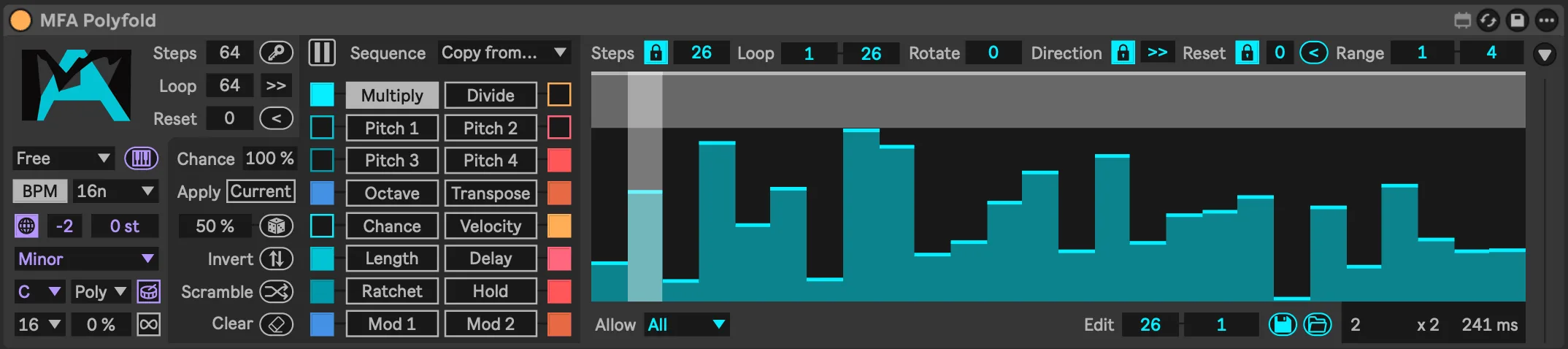
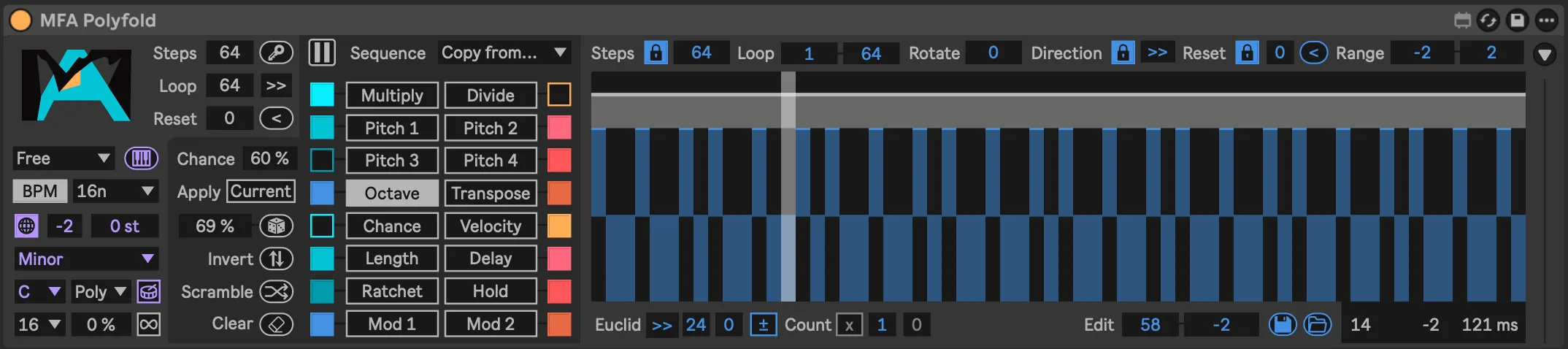
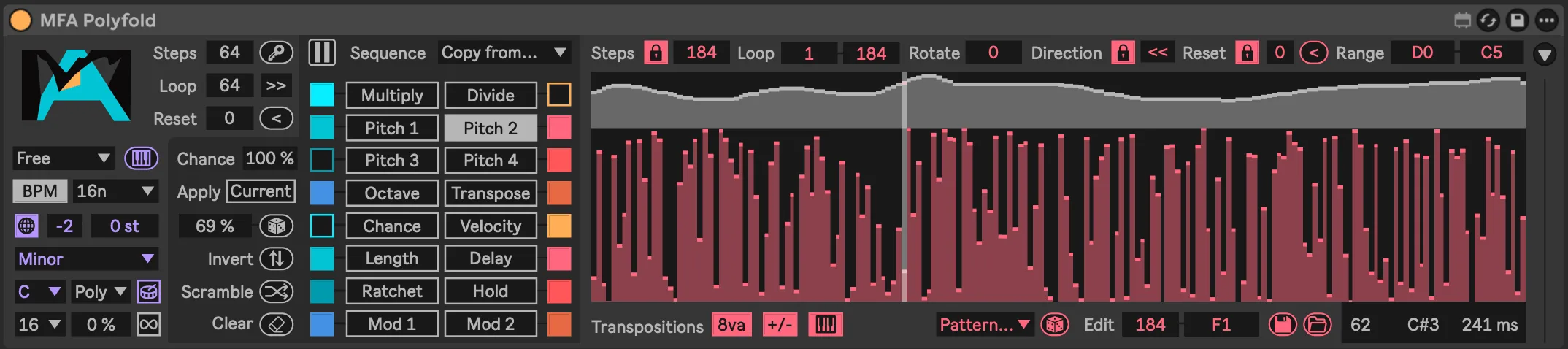
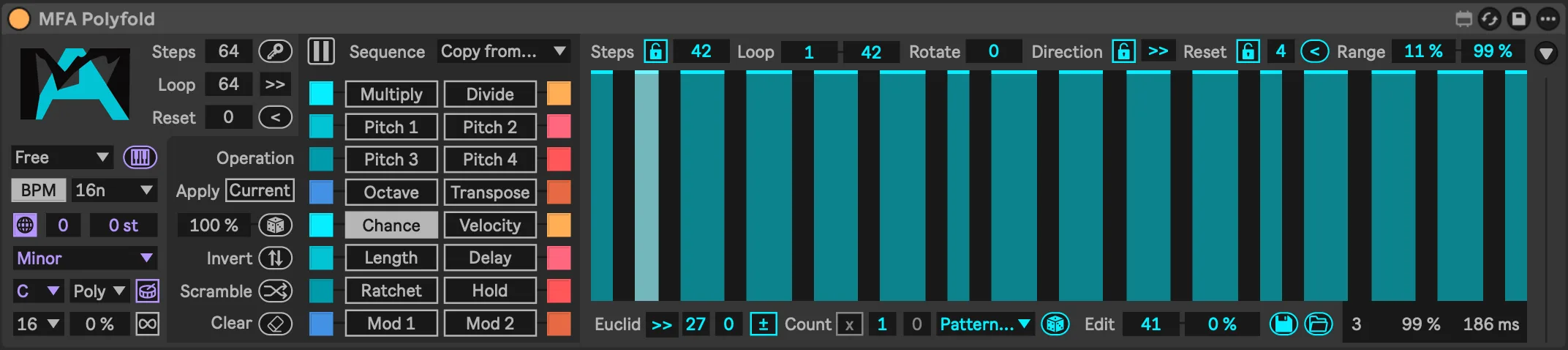
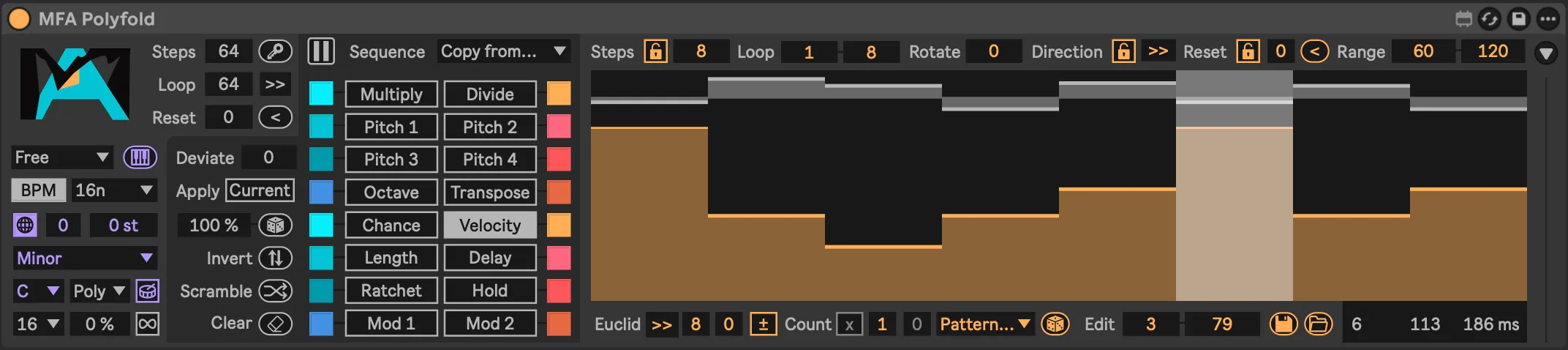
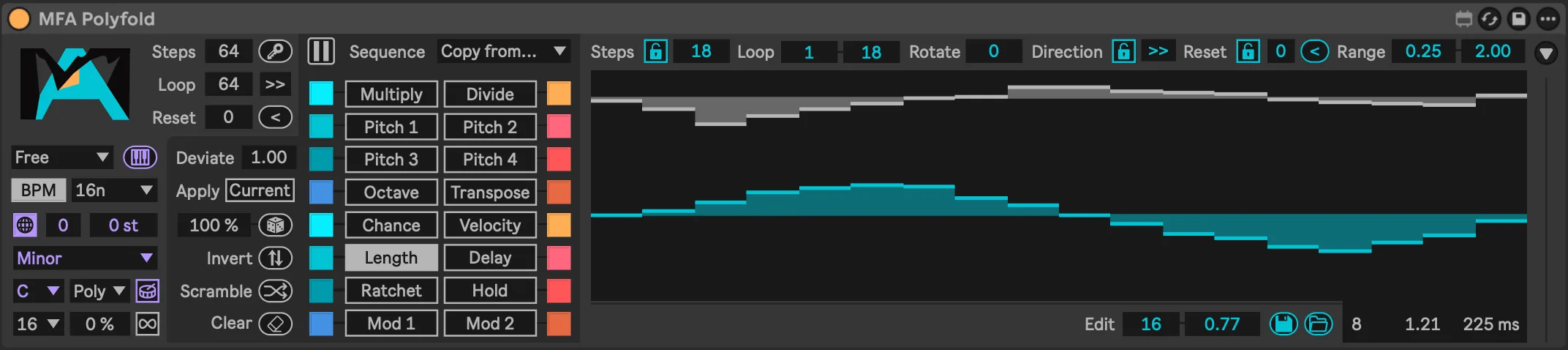
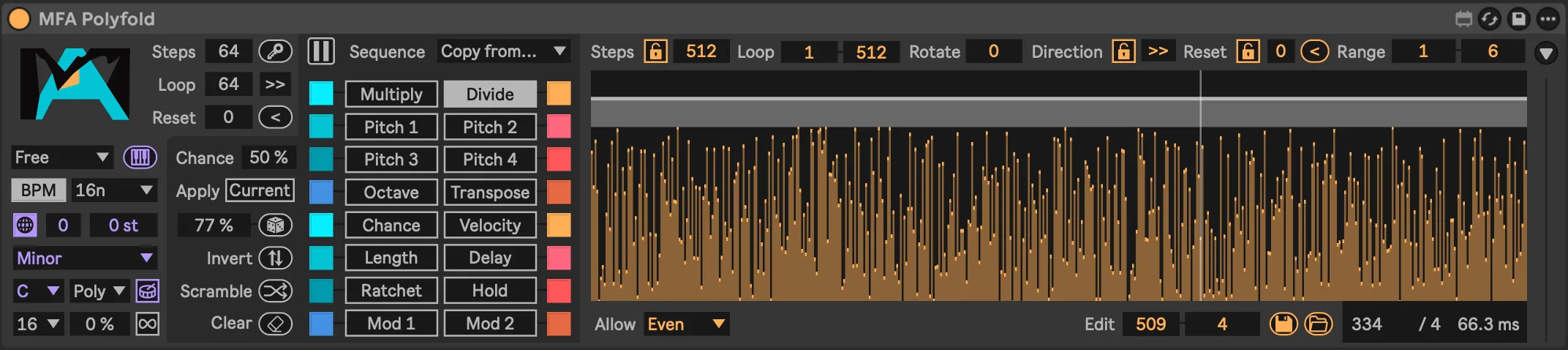
Each of the 16 lanes handles a specific job: Multiply, Divide, four Pitch lanes, Octave, Transpose, Chance, Velocity, Length, Delay, Hold, and two Mod lanes. Every lane runs independently, with its own loop length, direction, play mode, and optional bar reset. A global lock system lets you selectively freeze structure across lanes while others continue to evolve. Global octave and semitone transposition, optional global swing, and multiple play modes all sit inside the same unified interface.
Dual Stage Rate Architecture
The Multiply and Divide lanes are themselves sequencers. They combine per step to modify the shared Base Rate, which means the rhythmic grid itself folds and shifts cycle by cycle. Even, triplet, and unrestricted rates are all available. Each rate stage carries its own unique length, so compound per-step rhythmic control emerges naturally as the lanes interact. The result is layered subdivision that would take several devices to approximate anywhere else.
Polyphonic Pitch System
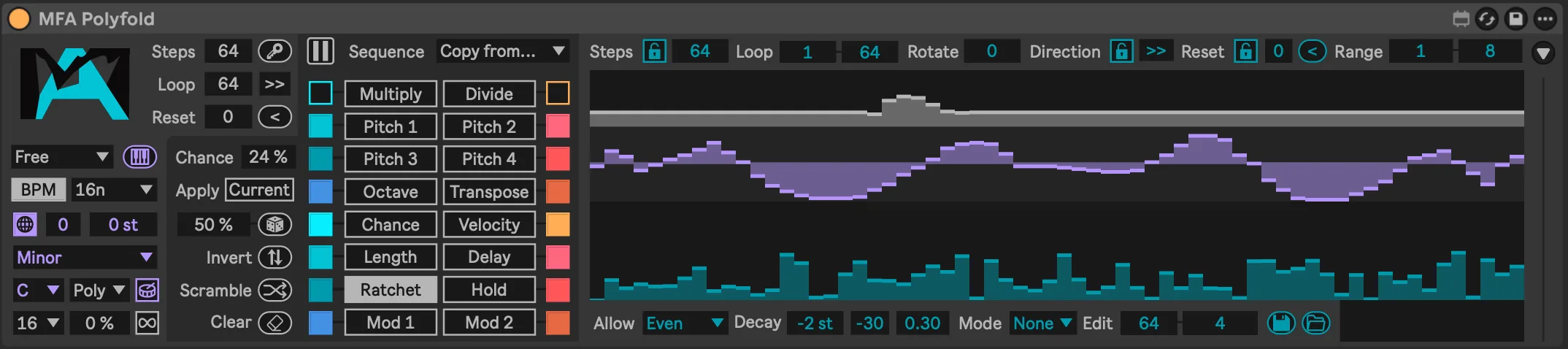
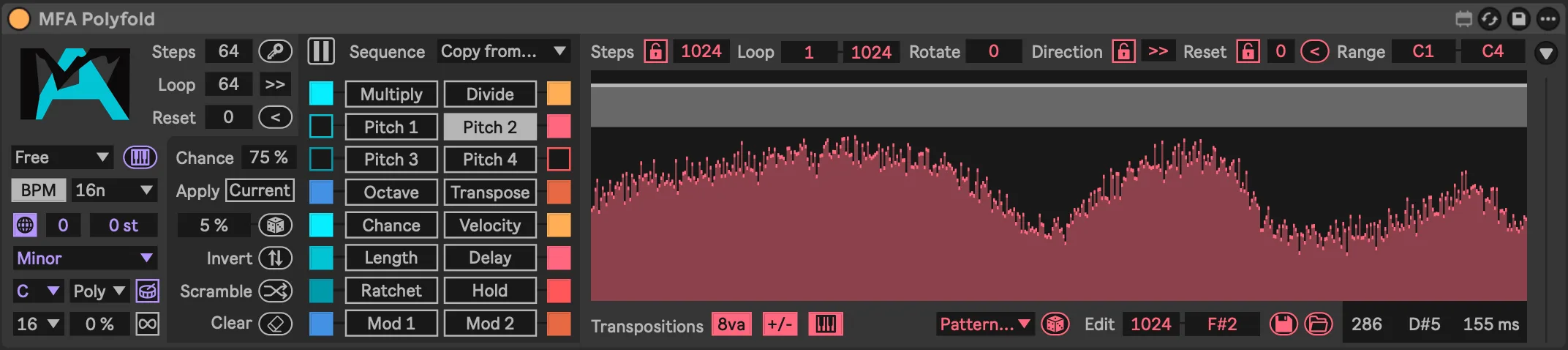
Four discrete-range pitch sequencers run in parallel. Each carries per-note probability, access to preset pattern libraries, random pattern selection, and internal custom pattern storage. An optional Octave sequencer adds Euclidean control. An optional Transposition phrase sequencer and real-time MIDI transposition sit alongside it. The whole system is scale-aware, natively integrated with Live 12’s key and scale settings so every note lands in context. A Drums mode gives instant compatibility with Drum Rack. Each pitch lane routes independently via the bundled X-Relay utility, with up to 64 routing busses sending sequences wherever they need to go across your set.
Extended Parameter Sequencing and Ratchet Architecture
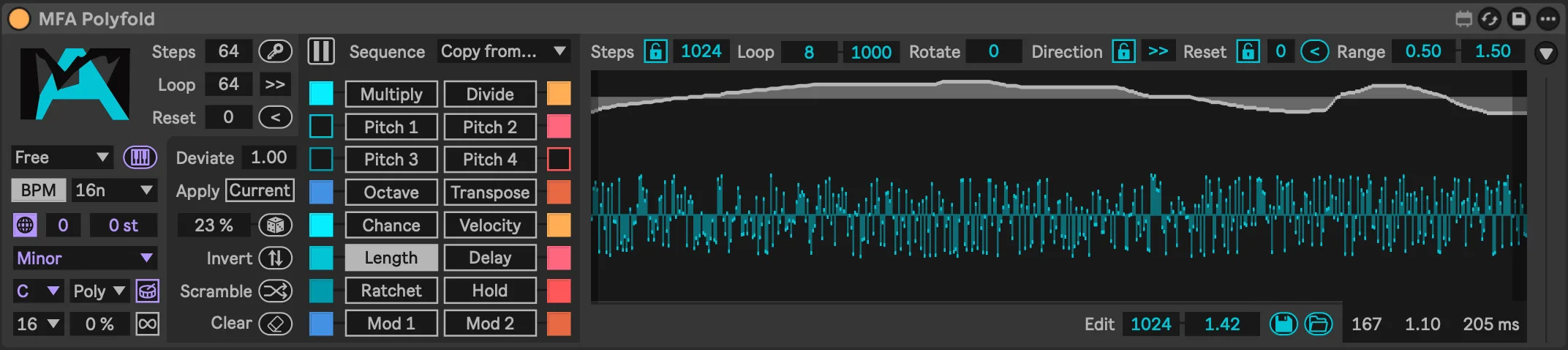
Multiply, Divide, each Pitch lane, Octave, Ratchet, and Delay all carry dedicated chance lanes. Velocity and Length carry per-step deviation lanes. Every parameter lane features expressive output ranges for real-time control. The ratchet system is its own architecture: pitch, velocity, and length each decay independently, with pitch decay deviation and optional clip, wrap, and fold behaviours. Controlled density, fragmentation, and rate-relative recursive rhythmic subdivision all emerge probabilistically inside your cycles, without manual programming of every event.
Modulation and External Control
Two modulation sequencers combine for multi-mapping output, each with dedicated mappers featuring Depth, Jitter, Smooth, and activation controls. OSC transmission is available per sequencer alongside optional MIDI CC output. That extended routing means Polyfold reaches well beyond the instrument it is sitting on, controlling external software and hardware across your full setup.
Workflow Integration
Polyfold reads your Info View annotations directly in Live: hover over any parameter and the detail appears without leaving your session. The device adapts visually to your chosen Live theme. Every parameter is mapped and available on Push. Scale and key sync with Live 12 natively, so transposing your set takes Polyfold with it automatically.
What Is New in Version 1.1.1
The Octave sequencer gains a Main or Transpose clock toggle. The step edit display now shows the note with scale and key applied, so what you see reflects what you hear.
What Was New in Version 1.1
Two dedicated modulation mappers arrived for each Mod sequencer, with Depth, Jitter, Smooth, and activation. Euclidean and Count-based pattern options were added to the Length sequencer. A new Grid view option was introduced alongside a range of improvements and optimisations.
Compatibility
Polyfold requires Ableton Live 12.0 Standard or Suite on Mac or Windows.
More from Manifest Audio
 -19%
-19%