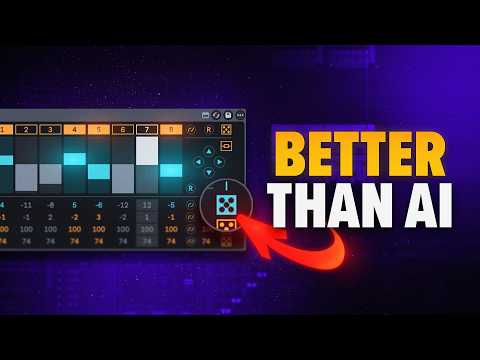
Zdrewe dives into the best free and creative sequencers for Ableton Live, offering endless inspiration without the need for AI or overpriced tools.
Explore Free and Unique Sequencers That Do More Than Just Repeat Notes
Forget soulless AI-generated melodies or overpriced plugins. In this video, Zdrewe takes us through some of the most inspiring and genuinely creative sequencers available for Ableton Live — many of which are completely free. With a mix of simplicity and deep customization, these tools offer limitless melodic potential without compromising your workflow.
Acid Bass Bliss with Sting
Starting with Sting — a bass pattern generator that nails that 90s racing game vibe — Zdrewe demonstrates how two clicks can turn randomness into something surprisingly usable. With high resonance and some filtering, Sting outputs wild acid lines, and when paired with a Scale device, those chaotic basslines can be shaped to follow harmonic rules. Its standout feature? The MIDI function, which lets you transform your own basslines into fresh variations instantly.
Melodic Sequencers That Spark Ideas
For users of older Ableton versions or those looking for new flavor, Zdrewe highlights a few melodic sequencers like Repeat — a close alternative to the native pack. The UI offers powerful manual and random options for pitch, spread, and rhythmic generation. Quick changes create exciting happy accidents, essential for sparking ideas. Bonus points for those diving into velocity and length mapping to modulate filters or releases dynamically.
The Magic of Pentatonics and Euclidian Geometry
A solid tip: pentatonic scales make sequences sound good faster. Zdrewe doubles down on Euclidian sequencers, favoring Meridian, which now supports multiple receiver tracks from a single instance. This allows one master pattern to route to multiple MIDI tracks — ideal for complex multi-instrument setups without clutter.
Ableton 12’s Step Arpeggiator: A Native Gem
Ableton Live 12 introduces Step ARP, which builds upon the classic arpeggiator with controls for chance, length, and velocity modulation. The ability to map its output to plugin parameters (like auto-filter frequency) creates natural-sounding movement, perfect for both hardware and software synths.
Gravitron and DFR: Creative Twists on Arpeggiation
Gravitron pushes boundaries further by allowing chord insertion, bass note injections, and quick direction shifts. Its simple pattern selector makes it easy to explore new textures. And if all else fails, DFR delivers a satisfying trance-tinged arpeggio with zero effort — just press play and enjoy. Even though its interface can be a little busy, its randomization features make it worth the learning curve.
Final Thoughts
Zdrewe’s message is clear: tools like these sequencers can breathe life into your sessions without needing AI or presets. With a bit of experimentation and a solid creative spark, you can build captivating ideas from scratch using only these clever devices.