Deviation adds even harmonics through asymmetric signal deformation, delivering mono-compatible stereo saturation, PWM-style modulation, and textured grit in a single Max for Live device.
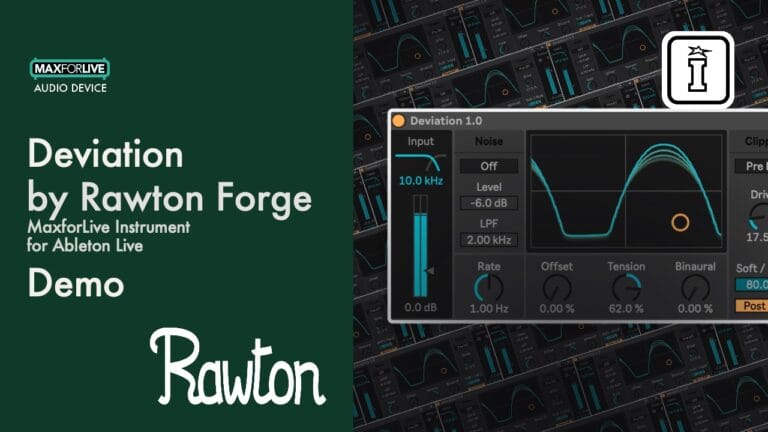
Deviation by Rawton Forge is an asymmetric binaural wave shaper for Max for Live that goes well beyond standard saturation. By deforming your signal asymmetrically, it introduces even harmonics that a classic symmetric saturator simply cannot produce, opening up a richer, more complex tonal palette for any source you run through it.
What It Does
At the heart of Deviation is the Tension control. Where a conventional saturator produces only odd harmonics through symmetric clipping, Tension bends the signal asymmetrically, bringing even harmonics into the picture. The result is a warmer, more characterful distortion that sits differently in a mix.
The Binaural control desynchronises the left and right modulation signals, creating genuine stereo width from a mono-compatible foundation. Run a bassline through Deviation, dial in some Binaural, and you get a fully stereo saturated signal that still collapses cleanly to mono. A sidechain ring-modulated white noise layer adds texture and grit on top, while the professional-grade soft/hard clipper with an adjustable knee keeps output levels in check. Auto Gain measures the input level and automatically matches the output, so your gain staging stays consistent as you experiment.
- Asymmetric wave shaping: Tension deforms the signal asymmetrically to introduce even harmonics absent from standard saturators
- Binaural stereo control: Desynchronises left and right LFO modulation for mono-compatible stereo width
- PWM-style modulation: Modulate Tension with the built-in LFO to produce pulse-width-modulation-style movement
- Sidechain ring-modulated noise: Adds textural grit and presence without overwhelming the core signal
- Soft/hard clipper with adjustable knee: Professional-grade limiting to shape transients and prevent unwanted peaks
- Auto Gain: Automatically calibrates output to match input level for transparent level-matched comparisons
How to Use It
- Insert Deviation on a bassline, synth, or drum bus and begin with Tension at a low value to hear the even harmonic content being added
- Increase Tension gradually and compare with a symmetric saturator to hear the difference in harmonic character
- Enable the LFO and assign it to Tension to create PWM-style animation and movement in pads or leads
- Raise the Binaural control to desynchronise left and right modulation, then verify mono compatibility by checking a stereo meter or collapsing to mono in your DAW
- Use the noise layer sparingly for subtle grit, or push it further for heavily textured, industrial-style processing
- Engage Auto Gain before A/B comparing treated and untreated signals to make level-matched decisions
- Pair Deviation with a stereo visualiser to watch the waveform behaviour change in real time as you adjust parameters
Why It Matters
Even harmonic distortion is a cornerstone of analogue warmth, and it has historically been difficult to replicate convincingly in the digital domain without dedicated hardware or complex signal chains. Deviation brings that capability into a single, tightly designed Max for Live device with modulation and stereo processing built in. For producers working with electronic music, sound design, or anything that benefits from controlled harmonic richness, it fills a genuine gap in the standard Ableton toolkit.