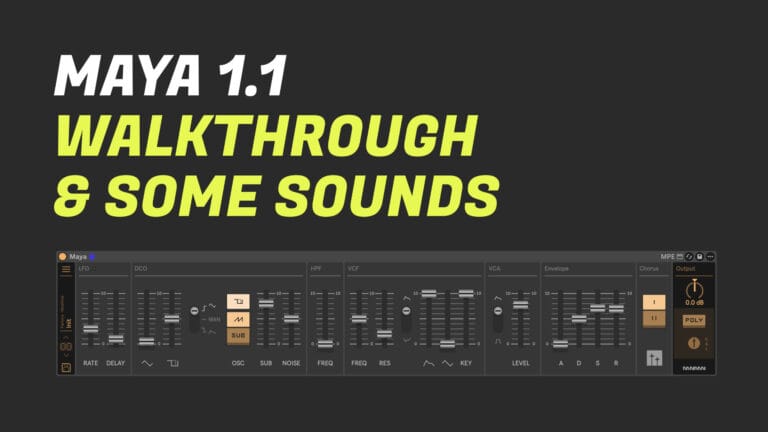
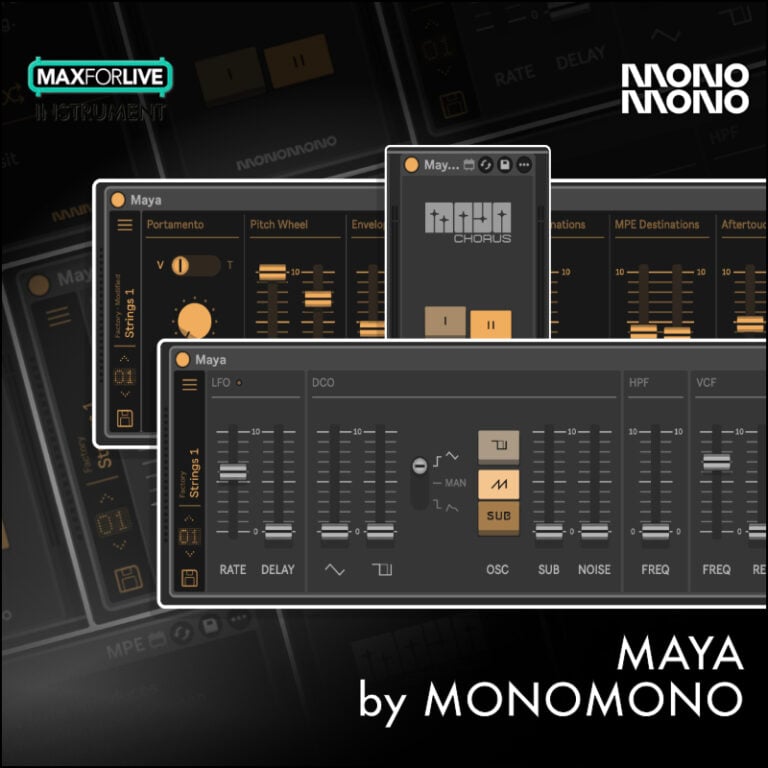
Monomono’s Maya v1.1 brings Unison Mode, voice calibration via the Serials feature, a phase-correct sub oscillator, and expanded MPE routing to this Juno-6 emulation for Ableton Live.
Maya by Monomono started life as a faithful Roland Juno-6 emulation for Ableton Live, and version 1.1 represents the most significant step yet in closing the gap between plugin and hardware. What began as a quality-of-life preset tidy-up grew into a substantial DSP overhaul, a new Unison Mode, an expanded voice calibration system, and a completely reworked MPE implementation. The walkthrough also includes a direct side-by-side comparison with a real Juno-6 and a live session jam to demonstrate the results in a musical context.
What It Does
Maya v1.1 models the six-voice polyphonic architecture of the Roland Juno-6 with a new level of accuracy. The sub oscillator phase has been corrected to match the hardware precisely, and the DSP across the board has been refined to reduce discrepancies between the plugin and a real unit. Presets now sit completely outside the undo stack, which resolves a long-standing workflow friction point.
The headline addition is Unison Mode, which replicates the Juno-6 service and calibration mode by stacking all six voices onto a single note simultaneously. The result is a dense, powerful mono synthesiser with six oscillators running in parallel. Pair this with the new Serials feature, which lets you assign six individual serial numbers to introduce per-voice component drift, and you can dial in anything from a perfectly tuned modern sound to a rich, slightly chaotic vintage character where each voice deviates subtly in pitch, filter response, and amplitude.
The MPE system has been rebuilt from scratch and is now active by default. New modulation routings cover Attack, Decay, and Release on the envelope, and LFO rate can now be controlled by both MPE positional data and by the envelope curve itself. This means LFO speed can rise and fall dynamically in response to how a note decays, opening up a range of expressive, evolving textures. A Mixer Normalisation toggle has also been added as an optional convenience, keeping output volume consistent when switching between preset configurations with different numbers of active oscillators.
How to Use It
- Run the side-by-side comparison first to hear how closely the updated DSP tracks the hardware Juno-6 before making any changes to your presets.
- Load a preset and switch to Unison Mode on the back panel to hear all six voices stack into a single mono voice. Start with a simple patch to make the difference clear.
- Randomise the Serials values in Unison Mode to introduce vintage drift between voices. Subtle differences in pitch and filter character emerge depending on the numbers entered; treat the serial fields as a personal stamp on the instrument.
- Enable MPE in your controller settings if you are using Push 3 or a similar MPE-capable device. Assign LFO rate or envelope Attack to the MPE position routing and play across the pad surface to hear the modulation respond to finger position in real time.
- Use the envelope-to-LFO routing to create naturally evolving filter or vibrato effects that change speed as notes sustain and release, without needing a separate modulation source.
- Toggle Mixer Normalisation on or off depending on your use case. On is useful for consistent preset browsing; off preserves the analogue behaviour where adding more oscillators increases the drive into the VCA model.
Why It Matters
The Juno-6 is one of the most recognisable synthesiser voices in electronic music, and the gap between a well-made emulation and the real hardware is usually felt more than heard. Maya v1.1 addresses that gap at the DSP level with a corrected sub oscillator phase and tighter voice modelling, while the Serials system acknowledges that much of what people love about vintage hardware is precisely its imperfection. The addition of deep MPE integration makes Maya relevant not just as a nostalgic tone tool but as an expressive, touch-sensitive instrument for contemporary performance and production workflows.