
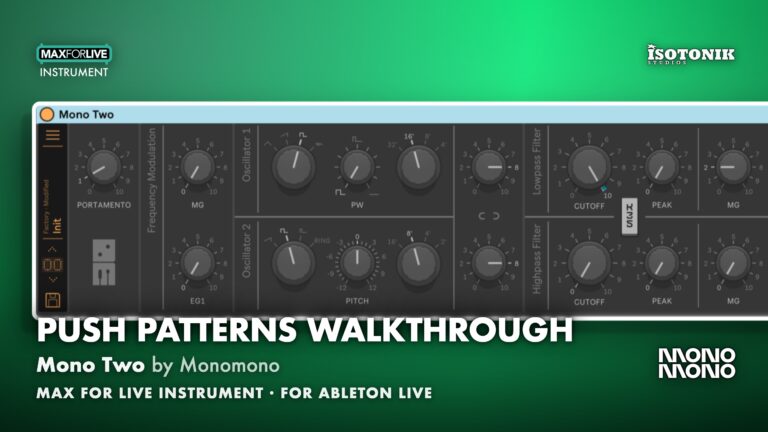

Mono Two by Monomono
TWO OSCILLATORS, ONE VOICE, ENDLESS POSSIBILITY
Mono Two is a monophonic synthesizer for Ableton Live inspired by the expressive, semi-modular spirit of early 1980s analog design. Built around two oscillators, a patchable signal path, dual resonant filters, and a morphing LFO, it covers everything from deep bass lines and slicing leads to animated textures that shift with every patch connection made.
- Two Oscillators: VCO 1 offers triangle, sawtooth, PWM, and noise; VCO 2 adds sawtooth, square, pulse, and ring modulation against Osc 1
- Dual Resonant Filters: high-pass into low-pass in series, switchable between OTA and Korg35-style topologies with circuit-accurate saturation
- Morphing Modulation Generator: one LFO that continuously morphs from falling sawtooth through triangle to rising sawtooth, free-running or tempo-synced
- Patchable Signal Path: onboard patch bay with 15 modulation sources lets you rewire the synth in real time for complex, evolving sounds
- Two Envelope Generators: a fast three-stage EG1 for pitch and filter hits, plus a full five-stage Hold-Attack-Decay-Sustain-Release EG2 driving the VCA
- Stereo Spread: component-tolerance-style pitch and filter drift between channels plus chorus transforms the mono signal into a wide stereo image
- MPE & Aftertouch: full MPE support for expressive per-note control, alongside Push 2 and Push 3 Standalone compatibility
- 4× Oversampled: filter and output stage run at four times the sample rate for pristine audio quality
USER GUIDE:
Mono Two Manual
Buying for someone?Send a gift card →
Overview
Patchable mono synth for Ableton Live
Two oscillators, a patchable signal path, dual resonant filters, and a morphing LFO: Mono Two puts the expressive, semi-modular spirit of early 1980s analog design inside Ableton Live. From deep, rumbling bass lines to slicing leads and animated textures that shift with every patch connection made, the sound engine rewards exploration because every routing decision changes the character in ways you can hear immediately. A full PDF user guide is included in your download.
- Two oscillators: VCO 1 covers triangle, sawtooth, PWM square, and noise with a Pulse Width dial that sweeps from a full hollow square to a thin buzzing sliver; VCO 2 adds sawtooth, two fixed pulse widths, and ring modulation against Osc 1, plus a Pitch knob that detunes up to plus or minus 12 semitones
- Dual resonant filters in series, high-pass into low-pass, each switchable between OTA and Korg35-style topologies with circuit-accurate saturation, independent Cutoff and Peak controls, and both capable of self-oscillation
- Morphing Modulation Generator: one LFO whose Waveform dial continuously morphs from falling sawtooth through symmetric triangle to rising sawtooth, free-running from 0.1 Hz to around 20 Hz or tempo-synced to Live with phase reset on transport and per-note reset
- Onboard patch bay with 15 modulation sources and destinations including MG triangle, MG square, EG1, EG1 inverted, EG2 inverted, Mult, VCO 1 PWM, VCO 2 CV, TRIG IN, EG1 TRIG, MG Wave, and MG Freq for complex self-patching architectures
- Two envelope generators: a fast three-stage EG1 (Delay, Attack, Release) for pitch and filter hits, plus a full five-stage EG2 (Hold, Attack up to 16 s, Decay, Sustain, Release up to 29 s) driving the VCA, with Legato and Unipolar/Bipolar toggles
- Dedicated Frequency Modulation section sweeping both oscillator pitches together, with LFO depth and percussive EG1 pitch snap, plus TOTAL and FREQ 1+2 patch inputs for simultaneous VCO and filter modulation
- Portamento with Off, All Notes, and Legato modes, letting playing style determine whether notes slide or snap
- Stereo Spread using component-tolerance-style pitch and filter drift between channels plus chorus, and a Back Panel with pitch wheel range, aftertouch, and MPE destinations alongside per-channel serial-number tolerances for analogue-style stereo character
- Full MPE and aftertouch support for expressive per-note control, with Push 2 and Push 3 Standalone compatibility
- 4x oversampled filter and output stage for pristine audio quality
- Max for Live Instrument .amxd device
- User manual (PDF)
Reviews
It growls like a barely tamed beast
Excellent UI, awesome sound!
a truly great little synth
Just a characterful, fun and playable synth -- especially if you have a Push 3.
Sounds incredible!


The Sound Engine
Two Oscillators, Dual Filters, Full Modulation
At its core, Mono Two pairs two voltage-controlled oscillators whose combined output feeds into a dual-filter stage before reaching the VCA. The Oscillator Mixer blends the two with independent level dials and a Link mode that keeps their balance as you push the combined signal harder into the filter's saturating input stage.


The Patch Bay
15 Sources, Real-Time Rewiring
The onboard patch bay exposes outputs for MG triangle, MG square, EG1, EG1 inverted, EG2 inverted, and a Mult with two normalised copies of EG2, plus inputs for VCO 1 PWM, VCO 2 CV, TRIG IN, EG1 TRIG, MG Wave, MG Freq, and more, enough routing for complex, self-patching architectures.
Important Information
CHANGELOG
## v1.01 – 15 August 2026
— Cleaned up unused presets
— Cleaned up and refined Live annotations
INSTALLATION
Our Products are generally provided as Zip file downloads which in all cases will need to be extracted and saved to your hard drive prior to installation. Details on the different file type provided and what to do with them are below.
.alp Files – These are Ableton Live Packs and will either install directly into the Packs Section of the browser of Ableton Live or ask you to save them to your hard drive. For packs that install to the library, when you double click on them you will see a pop up window asking you to confirm that installation is ok as the files are described as “Legacy”. This is fine and you are ok to proceed, the packs are created using the format for an earlier version of Live and so remain compatible with the current version.
.amxd files – These are individual MaxforLive Devices and can be stored anywhere on your hard drive. We’d advise creating a folder for them and then adding that folder as a location within the Places section of Lives Browser.
LICENSE
END-USER LICENSE AGREEMENT FOR ISOTONIK STUDIOS SOFTWARE PRODUCTS.
PLEASE READ THE TERMS AND CONDITIONS OF THIS LICENSE AGREEMENT CAREFULLY BEFORE CONTINUING WITH THIS PROGRAM INSTALL.
This End-User License Agreement (referred to as “EULA”) is a legal agreement between an individual or a single entity (referred to as “LICENSEE”) and Isotonik Studios for the Isotonik Studios software product(s) which may include associated software components, media, printed materials, and “online” or electronic documentation (referred to as “SOFTWARE PRODUCT”). By installing, copying, or otherwise using the SOFTWARE PRODUCT, the LICENSEE agrees to be bound by the terms of this EULA.
This EULA represents the entire agreement concerning the program between the LICENSEE and Isotonik Studios and it supersedes any prior proposal, representation, or understanding between the parties. If the LICENSEE does not agree to the terms of this EULA, the LICENSEE should not install or use the SOFTWARE PRODUCT.
The SOFTWARE PRODUCT is protected by copyright laws and international copyright treaties, as well as other intellectual property laws and treaties. The SOFTWARE PRODUCT is licensed, not sold.
- GRANT OF LICENSE.
The SOFTWARE PRODUCT is licensed as follows:
(a) Installation and Use. Providing that the LICENSEE has paid any applicable license fees, Isotonik Studios grants the LICENSEE the right to install and use copies of the SOFTWARE PRODUCT on up to two computers in the LICENSEE’s possession that are running a validly licensed copy of the operating system for which the SOFTWARE PRODUCT was designed [e.g., Windows 10, macOS]. The computer(s) must be owned by the LICENSEE.
(b) Backup Copies. The LICENSEE may also make copies of the SOFTWARE PRODUCT as may be necessary for backup and archival purposes.
- DESCRIPTION OF OTHER RIGHTS AND LIMITATIONS.
(a) Maintenance of Copyright Notices. The LICENSEE must not remove or alter any copyright notices on any and all copies of the SOFTWARE PRODUCT.
(b) Distribution. The LICENSEE may not distribute registered copies of the SOFTWARE PRODUCT to third parties.
(c) Prohibition on Reverse Engineering, Decompilation, and Disassembly. The LICENSEE may not reverse engineer, decompile, or disassemble the SOFTWARE PRODUCT, except and only to the extent that such activity is expressly permitted by applicable law notwithstanding this limitation.
(d) Rental. The LICENSEE may not rent, lease, or lend the SOFTWARE PRODUCT.
(e) License transfer The LICENSEE may not transfer their license to the SOFTWARE PRODUCT to any third party. Any attempt to do so will be considered a violation of this EULA.
(f) Support Services. Isotonik Studios may provide the LICENSEE with support services related to the SOFTWARE PRODUCT for a period of 12 months following the date of purchase. Any supplemental software code provided to the LICENSEE as part of the Support Services shall be considered part of the SOFTWARE PRODUCT and subject to the terms and conditions of this EULA.
(g) Compliance with Applicable Laws. The LICENSEE must comply with all applicable laws regarding use of the SOFTWARE PRODUCT.
- TERMINATION Without prejudice to any other rights, Isotonik Studios may terminate this EULA if the LICENSEE fails to comply with the terms and conditions of this EULA. In such event, the LICENSEE must destroy all copies of the SOFTWARE PRODUCT in the LICENSEE’s possession.
- COPYRIGHT All title, including but not limited to copyrights, in and to the SOFTWARE PRODUCT and any copies thereof are owned by Isotonik Studios or its suppliers. All title and intellectual property rights in and to the content which may be accessed through use of the SOFTWARE PRODUCT is the property of the respective content owner and may be protected by applicable copyright or other intellectual property laws and treaties. This EULA grants the LICENSEE no rights to use such content. All rights not expressly granted are reserved by Isotonik Studios.
- NO WARRANTIES Isotonik Studios expressly disclaims any warranty for the SOFTWARE PRODUCT. The SOFTWARE PRODUCT is provided ‘As Is’ without any express or implied warranty of any kind, including but not limited to any warranties of merchantability, noninfringement, or fitness of a particular purpose. Isotonik Studios does not warrant or assume responsibility for the accuracy or completeness of any information, text, graphics, links or other items contained within the SOFTWARE PRODUCT. Isotonik Studios makes no warranties respecting any harm that may be caused by the transmission of a computer virus, worm, time bomb, logic bomb, or other such computer program. Isotonik Studios further expressly disclaims any warranty or representation to the LICENSEE or to any third party.
- LIMITATION OF LIABILITY In no event shall Isotonik Studios be liable for any damages (including, without limitation, lost profits, business interruption, or lost information) arising out of the LICENSEE’s use of or inability to use the SOFTWARE PRODUCT, even if Isotonik Studios has been advised of the possibility of such damages. In no event will Isotonik Studios be liable for loss of data or for indirect, special, incidental, consequential (including lost profit), or other damages based in contract, tort or otherwise. Isotonik Studios shall have no liability with respect to the content of the SOFTWARE PRODUCT or any part thereof, including but not limited to errors or omissions contained therein, libel, infringements of rights of publicity, privacy, trademark rights, business interruption, personal injury, loss of privacy, moral rights or the disclosure of confidential information.
Frequently Asked Questions
What version of Ableton Live do I need to run Mono Two?
Mono Two requires Ableton Live 11 or later, running the Suite edition or Standard with MaxforLive installed. It is not compatible with Intro licences.
Does Mono Two work with Push?
Yes. Mono Two has full support for Push 3 Standalone as well as Push 2.
What is the difference between the two filter topologies?
Mono Two offers two switchable filter topologies on its dual resonant filter stage. The first is modelled on the Korg35-chip circuit found in the original hardware’s earlier production runs – it is more aggressive and distorted in character. The second is modelled on the OTA circuit introduced in later production, which is cleaner and more tamed. Both are switchable per patch and each topology includes circuit-accurate saturation.
How does the Modulation Generator's Waveform control work?
The Waveform dial does not switch between fixed LFO shapes – it continuously morphs a single shape. At position 0 you get a falling sawtooth (percussive and urgent); at position 5 it settles into a symmetric triangle (the classic vibrato wobble); at position 10 it becomes a rising sawtooth (slow build, sudden drop, like a reversed tape). Any position in between blends smoothly between those extremes.
Can I synchronise the LFO to my Live session tempo?
Yes. The Free/Sync toggle on the Modulation Generator locks the LFO rate to your Live session tempo in musical subdivisions. When the Live transport starts, the LFO phase resets automatically. If you change the rate whilst the transport is running, the phase adjusts to match the current play position. Note that rate modulation via the patch bay only works in Free mode – Sync mode keeps the rate locked to tempo and ignores incoming CV.
What is the difference between the three Portamento modes?
Off disables glide entirely so every note snaps instantly to pitch. All Notes enables continuous glide between every played note regardless of how you play. Legato activates glide only when you press a new key whilst still holding the previous one – separated notes snap to pitch, connected notes slide, giving you direct control over the effect through your playing style.
What does the Spread control do, and does Mono Two output stereo?
Mono Two’s core signal path is monophonic, but the Spread control widens the output into a stereo image. Turning Spread toward S introduces component-tolerance-style pitch and filter drift between the left and right channels – similar to the natural variation between analogue components – plus a chorus effect. Keeping it at M delivers a focused, centred mono-compatible signal. The serial numbers visible on the Back Panel determine the exact tolerances applied to each channel.
What are EG1 and EG2 and how do they differ?
EG1 is a fast three-stage envelope with Delay, Attack, and Release stages. It is primarily designed for pitch and filter modulation – for example, adding a percussive pitch snap on attack – and can be triggered independently of the main envelope via the EG1 TRIG patch bay input. EG2 is a full five-stage envelope with Hold, Attack, Decay, Sustain, and Release; it drives the VCA by default and can also be routed to filter cutoff. EG2 also has a Unipolar/Bipolar toggle that changes whether the envelope rests at zero or swings into negative values, and a Hold parameter that keeps the gate open after key release before Release begins.
In Depth
Mono Two is a monophonic synthesizer for Ableton Live that takes the expressive, semi-modular spirit of early 1980s analog design as its starting point. Built around two oscillators and a patchable signal path, it covers everything from deep, rumbling bass lines and slicing leads to animated textures that shift and evolve with every connection made. Requires Ableton Live 11+ Suite.
The Sound Engine
At its core, Mono Two pairs two voltage-controlled oscillators whose combined output feeds into a dual-filter stage before reaching the VCA. Oscillator 1 covers triangle, sawtooth, PWM square, and noise, with a Pulse Width dial that sweeps from a full, hollow square all the way down to a thin, buzzing sliver — and a patch bay input that lets any of the 15 modulation sources take over PWM duty cycle in real time. Oscillator 2 adds sawtooth, two fixed pulse widths (0.5 and 0.3 duty cycle), and ring modulation against Osc 1, plus a Pitch knob that detunes it up to ±12 semitones for everything from lush chorus-style thickening to full harmonic intervals. The Oscillator Mixer blends the two with independent level dials and a Link mode that keeps their balance as you push the combined signal harder into the filter’s saturating input stage.
Dual Resonant Filters
The two filters run in series — high-pass first, then low-pass — matching the signal order of the original hardware. Each has its own Cutoff and Peak (resonance) control and can be driven into self-oscillation. Mono Two offers two switchable filter topologies: a more aggressive, distorted circuit modelled on the earlier Korg35-chip design, and a cleaner, more tamed response modelled on the OTA circuit introduced in later production runs. Both filters accept independent modulation from the LFO and from Envelope 2, with dedicated attenuator dials for each destination on both the high-pass and low-pass stages.
Frequency Modulation & the Patch Bay
A dedicated Frequency Modulation section sits before the Mixer and sweeps the pitch of both oscillators together. The MG dial sets LFO depth; the EG1 dial adds a percussive pitch snap on attack — the classic analog blip used in drum and pluck sounds. Patch the TOTAL input and one signal simultaneously sweeps VCO pitch and both filter cutoffs. Patch the FREQ 1+2 input and EG1’s dial becomes an attenuator for whatever external source you connect. The onboard patch bay exposes outputs for MG triangle, MG square, EG1, EG1 inverted, EG2 inverted, and a Mult with two normalised copies of EG2, plus inputs for VCO 1 PWM, VCO 2 CV, TRIG IN, EG1 TRIG, MG Wave, MG Freq, and more — enough routing for complex, self-patching architectures.
Modulation Generator
The Modulation Generator is a single LFO whose Waveform dial continuously morphs from a falling sawtooth (percussive, urgent) through a symmetric triangle (the classic vibrato wobble) to a rising sawtooth (slow build, sudden drop). In free mode the rate runs from 0.1 Hz to around 20 Hz; engage Sync and the rate locks to your Live session tempo in musical subdivisions, with phase resetting automatically when the transport starts. A separate Reset Phase button re-triggers the LFO phase on every key press for perfectly consistent modulation on each note.
Envelope Generators
EG1 is a fast three-stage envelope (Delay, Attack, Release) designed for pitch and filter hits independent of the main amplitude shape. EG2 is a full five-stage envelope (Hold, Attack, Decay, Sustain, Release) that drives the VCA by default, with Attack ranging from 0 to 16 seconds, Decay and Release up to 29 seconds, and Sustain from 0 to 100 %. A Legato toggle controls whether overlapping notes restart the envelopes or let the sound glide through unbroken. A Unipolar/Bipolar toggle changes whether EG2 rests at zero or swings below it, giving filter modulation a negative starting point for inward-sweeping effects. The Hold control keeps a note open after key release, before Release begins.
Portamento
Portamento can be set to Off (instant pitch changes), All Notes (continuous glide between every played note), or Legato (glide only when a new key is pressed while the previous one is still held). The Legato portamento mode lets you control the glide effect entirely through your playing style — connected notes slide, separated notes snap.
Output, Spread & the Back Panel
The Output section provides a level knob adjustable from −24 dB to +24 dB, and a Spread control that widens the inherently mono signal into a stereo image using component-tolerance-style pitch and filter drift between channels, plus chorus. Keeping Spread at M delivers a focused, centred presence; turning it toward S adds progressive width. The Back Panel — accessed by clicking the Mono Two or MNMN logo — reveals additional controls including portamento rate mode selection, pitch wheel semitone range, pitch MPE semitone amount, and assignable destinations for pitch wheel, aftertouch, and MPE modulation. Serial numbers on the back panel introduce tolerances between left and right channels for analogue-style stereo character.
Compatibility
- Requires Ableton Live 11+ Suite
- Full support for Push 3 Standalone and Push 2
- MPE and aftertouch support for expressive per-note playing
- 4× oversampled filter and output stage
- 15 patch bay modulation sources and destinations
- Dual filter topologies: OTA and Korg35-style, switchable per patch
More from Monomono
 -20%New★ Popular
 ★ Popular
 ★ Popular
 ★ Popular
 -30%★ Popular
Frequently Bought Together