
Strum Roll by LDM Design
CREATE NUANCED AND REALISTIC GUITAR CHORD PATTERNS WITH EASE!
TRIPLE PACK SAVINGS: Add any three or more LDM Design products to your cart and save 20% automatically at checkout!
Translating guitar chords from online diagrams into Ableton’s piano roll is tedious and error-prone. Strum Roll solves this with a visual guitar fretboard GUI where you click directly on fret positions to program chords exactly as they appear in chord diagrams. No transposition math. No counting intervals. Just click the frets shown in the diagram, then trigger realistic upstrokes and downstrokes with adjustable strum timing, velocity randomization, and MIDI sequencing.
Inside you’ll find:
- Visual guitar fretboard GUI with clickable fret positions
- 8 chord slots for storing different voicings
- Up and down strum arrows for realistic strumming articulation
- Adjustable strum time (0-30ms+ delay between strings)
- Velocity randomization for humanized, organic performances
- Alternative tunings: Drop D, Open G, and more
- Octave control for pitch range adjustment
- MIDI note assignment for up/down stroke triggering
- Note length articulation – control how many strings sound
- Note display mode shows note names on fretboard
- Works with guitar samples, synths, or any MIDI instrument
- Perfect for non-guitarists programming guitar parts
- Ideal for guitarists translating chord shapes to MIDI
- Creative strum timing effects on synthesizers and pads
Find any guitar chord diagram online. Click those fret positions in Strum Roll. Trigger with MIDI notes for sequenced strumming patterns. Adjust strum time and velocity randomization for realistic or creative articulation. Use alternative tunings for different styles. Apply to guitar samples for authentic performances or route to synthesizers for unique textural effects.
Requires: Ableton Live 10/11/12 Standard (with MaxforLive installed) or Suite | Mac or Windows
USER GUIDE: StrumRoll User Guide
Strum Roll by LDM Design
CREATE NUANCED AND REALISTIC GUITAR CHORD PATTERNS WITH EASE!
TRIPLE PACK SAVINGS: Add any three or more LDM Design products to your cart and save 20% automatically at checkout!
Translating guitar chords from online diagrams into Ableton’s piano roll is tedious and error-prone. Strum Roll solves this with a visual guitar fretboard GUI where you click directly on fret positions to program chords exactly as they appear in chord diagrams. No transposition math. No counting intervals. Just click the frets shown in the diagram, then trigger realistic upstrokes and downstrokes with adjustable strum timing, velocity randomization, and MIDI sequencing.
Inside you’ll find:
- Visual guitar fretboard GUI with clickable fret positions
- 8 chord slots for storing different voicings
- Up and down strum arrows for realistic strumming articulation
- Adjustable strum time (0-30ms+ delay between strings)
- Velocity randomization for humanized, organic performances
- Alternative tunings: Drop D, Open G, and more
- Octave control for pitch range adjustment
- MIDI note assignment for up/down stroke triggering
- Note length articulation – control how many strings sound
- Note display mode shows note names on fretboard
- Works with guitar samples, synths, or any MIDI instrument
- Perfect for non-guitarists programming guitar parts
- Ideal for guitarists translating chord shapes to MIDI
- Creative strum timing effects on synthesizers and pads
Find any guitar chord diagram online. Click those fret positions in Strum Roll. Trigger with MIDI notes for sequenced strumming patterns. Adjust strum time and velocity randomization for realistic or creative articulation. Use alternative tunings for different styles. Apply to guitar samples for authentic performances or route to synthesizers for unique textural effects.
Requires: Ableton Live 10/11/12 Standard (with MaxforLive installed) or Suite | Mac or Windows
USER GUIDE: StrumRoll User Guide
Buying for someone?Send a gift card →
Additional information
| MaxforLive | MIDI Devices, Sequencers |
|---|---|
| Ableton Live Compatibility | Ableton Live 10 Standard with MaxforLive, Ableton Live 10 Suite, Ableton Live 11 Standard with MaxforLive, Ableton Live 11 Suite, Ableton Live 12 Standard with MaxforLive, Ableton Live 12 Suite |
| Min. Requirements | Ableton Live 10 Standard with MaxforLive Installed or Ableton Live 10 Suite |
| OS | Mac, Windows |
PRICE: £12.00
Product reviews
4 out of 5
2 reviews
How item rating is calculated
We show the average based on reviews. Only genuine reviews are displayed.
Sort by
June 7, 2024
This reviewer bought this product from our store.
As a guitar player I really love how easy this device makes translating guitar chord voicing over to midi. I’ve ended up getting way more use out of it than I originally thought I would’ve. Using it conjunction with Udo R. Brauna’s Step Arpeggiator also makes it very easy to emulate more complex guitar picking patterns. The one downside is that it only has 8 chord slots, but you can easily circumvent that by putting a second instance in a parallel midi chain and then adjust what notes trigger the chords on the second instance.
August 5, 2023
This reviewer bought this product from our store.
Great product, I only wish I could use midi (or atleast assign midi) to trigger the output & that the output chords actually recorded midi. Right now the only way to use it is to click and play it with the mouse and record it with a resample track.
Strum Roll by LDM Design
Overview & The Guitar Chord Problem
Strum Roll solves a fundamental problem for producers programming guitar parts in Ableton Live – translating guitar chord voicings into piano roll MIDI is tedious, error-prone, and disconnected from how guitarists think about chords. Guitar chord diagrams are everywhere online showing finger positions on frets and strings, but converting these visual representations into piano roll notes requires transposing each string’s pitch individually while accounting for open strings, alternate tunings, and proper voicing intervals. Strum Roll provides a guitar fretboard GUI where you click directly on frets to program chords exactly as they appear in guitar diagrams, then adds realistic strumming articulation with adjustable timing, velocity randomization, and up/down strum directions.
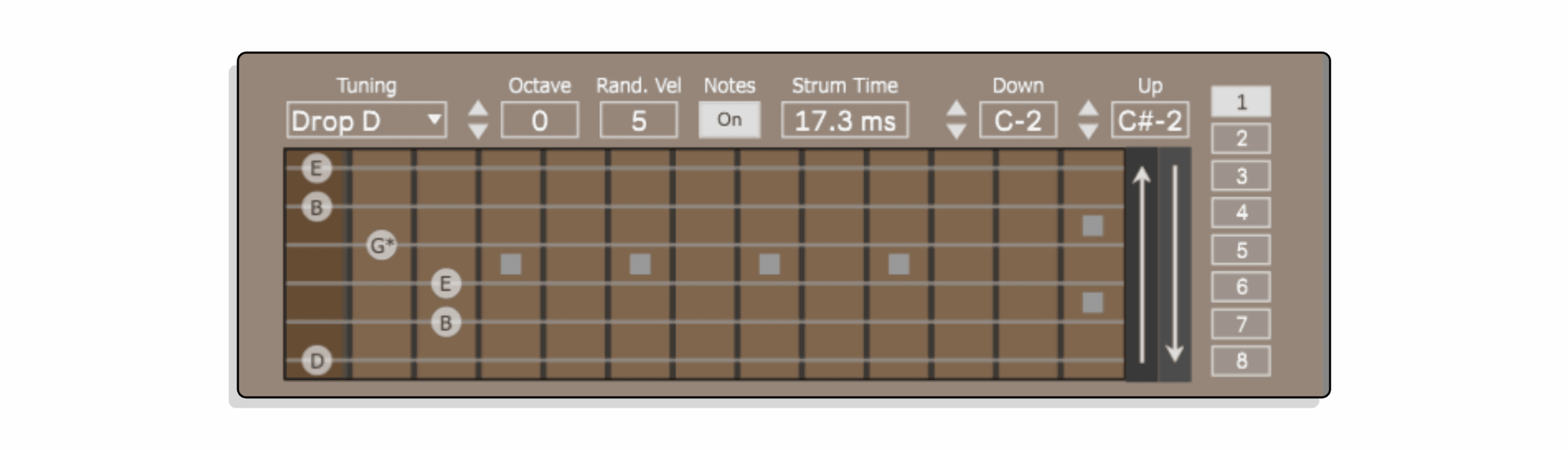
The device features a visual guitar neck displaying the 3rd, 5th, 7th, 9th, and 12th fret markers. Click any fret position on any string to activate that note. Click and drag horizontally across multiple strings to set bar chords. The darker section on the left represents open strings (unfretted). Strings without any fret clicked remain silent. Store up to 8 different chord voicings, accessible via numbered buttons on the right. Arrow buttons trigger upstrokes (low to high strings) or downstrokes (high to low strings) with adjustable strum time determining the delay between each string sounding.
This workflow matches how guitarists conceptualize chords – as physical shapes on the fretboard rather than abstract pitch collections. Find any guitar chord online (there are thousands of free chord diagram resources), look at the fret positions, click those positions in Strum Roll, and the chord plays correctly voiced with proper string intervals. No mental translation required. No piano roll transposition. No counting semitones between strings. The fretboard GUI is the interface. Combined with strumming articulation controls, the device generates guitar-like performances from simple MIDI triggers, working equally well with sampled guitar instruments, synthesizers, or any sound source.
Fretboard GUI and Chord Programming
The fretboard display shows six horizontal strings (standard guitar tuning by default) with vertical fret positions marked. Click any intersection point to activate that note. The visual feedback is immediate – clicked positions light up showing which notes are active in the current chord. To program a simple C major chord in standard tuning, click the open (dark) section on the A string (5th string), third fret on the D string (4th string), second fret on the G string (3rd string), open on the B string (2nd string), and first fret on the high E string (1st string). The chord is now programmed exactly as it appears in guitar diagrams found online or in chord books.
Bar chords – where one finger frets multiple strings at the same fret – are equally simple. Click and drag horizontally across strings at any fret position to activate multiple notes simultaneously. For an F major bar chord, click-drag across all six strings at the first fret, then add individual notes at higher frets for the full voicing. The interface accommodates partial chords, power chords (root and fifth only), open voicings, and complex jazz chords with equal ease. If a string has no active fret, that string doesn’t play, enabling the dropped strings and selective string choices characteristic of guitar voicings.
Eight chord slots (numbered 1-8 on the right side) store different voicings. Click a number to switch between chords for editing or playback. This enables programming complete chord progressions – slot 1 might be C major, slot 2 is F major, slot 3 is G major, slot 4 is A minor. Cycle through slots while programming to build your progression, then trigger each slot via MIDI notes for sequenced playback. The visual nature makes editing intuitive – see immediately which strings are active, which frets are pressed, and how the voicing will sound before triggering playback.
Strumming Articulation and Timing
Strumming articulation is Strum Roll’s signature feature beyond basic chord programming. Two arrow buttons between the fretboard and chord slots trigger upstrokes and downstrokes. The up arrow plays from lowest string to highest string (like strumming down the neck toward the floor). The down arrow plays from highest string to lowest string (like strumming up toward the ceiling). This mirrors real guitar technique where downstrokes and upstrokes produce slightly different timbral characteristics and rhythmic feels.
Strum Time controls the millisecond delay between each successive string sounding. Set to 0ms, all strings trigger simultaneously as a block chord. Increase to 10ms, and the chord rolls across strings with 10-millisecond spacing, creating the characteristic strum sound where notes don’t attack precisely together. A full six-string chord with 10ms strum time takes 50ms total to complete (5 intervals between 6 strings). Higher values (20-30ms) produce more pronounced, deliberate strums. Lower values (5-10ms) create tight, fast strums. The timing variation is what makes programmed parts sound like a human strumming rather than a keyboard player hitting multiple keys simultaneously.
Randomize Velocity adds another layer of realism. Enable this parameter and each string’s velocity varies randomly with each strum. Guitar strings don’t all sound at identical volume when strummed – the pick or fingers hit some strings harder than others, emphasis naturally varies, and human performance includes micro-variations impossible to program manually. Randomize Velocity automates this humanization, ensuring repeated chord strums sound organically varied rather than mechanically identical. Combined with strum timing, the result is remarkably realistic guitar articulation from simple button presses.
Alternative Tunings and Octave Control
The Tuning dropdown provides several popular alternative guitar tunings beyond standard tuning (EADGBE from low to high). Drop D tuning lowers the low E string to D, enabling heavier power chords and extended bass range common in metal and hard rock. Open G tuning (DGDGBD) creates a G major chord when all strings ring open, facilitating slide guitar playing and specific blues/folk voicings. Additional tunings accommodate different playing styles and musical contexts, each changing how the fretboard translates to pitch output while maintaining the visual programming interface.
Changing tuning doesn’t require reprogramming chords if you’re working from guitar diagrams – the diagram shows fret positions which remain valid regardless of tuning (assuming the diagram specifies the tuning). A chord shape in Drop D looks identical on the fretboard to standard tuning; the actual pitches produced differ but the visual programming remains the same. This means you can copy chord diagrams directly without worrying about tuning transposition – just match the tuning setting to the diagram’s specified tuning.
Octave control shifts all strings up or down by octaves. This enables using Strum Roll for bass guitar parts (shift down an octave), high-register plucked parts (shift up), or keeping guitar parts in specific frequency ranges to avoid clashing with other instruments. The octave setting affects all strings simultaneously, maintaining proper interval relationships within the chord while transposing the overall pitch center. Combine tuning selection with octave control to access a wide range of guitar-like timbral territories.
MIDI Sequencing and Note Length Articulation
MIDI note triggering enables sequencing strumming patterns in Ableton’s piano roll. The Down and Up parameters at the top assign MIDI note numbers to trigger downstrokes and upstrokes respectively. Set Down to C-2 and Up to C#-2, then create a MIDI clip containing those notes to program a strumming rhythm. Place C-2 notes on downbeats for downstrokes, C#-2 notes on upbeats for upstrokes, and the device plays the currently selected chord with appropriate strum direction and timing.
Note length in the MIDI clip controls a crucial articulation parameter. For the full chord to play with strum time applied, the MIDI note must be long enough for all strings to sound. A chord with 10ms strum time across six strings needs at least 50ms note length to complete. Shorten the MIDI note length below this threshold and the strum cuts off before all strings sound. This creates rhythmic variation and accents – a staccato sixteenth note might trigger only the first 2-3 strings of a downstroke, while a sustained quarter note lets the full chord ring. Varying note lengths throughout a MIDI pattern produces the rhythmic complexity of real guitar strumming.
This note length technique is particularly effective for creating percussive, rhythmic guitar parts. Program a steady stream of sixteenth notes alternating between downstrokes and upstrokes. Make some notes very short (only 1-2 strings sound) for percussive attack, others longer for fuller chord voicings. The pattern breathes with variation, mimicking how guitarists mute strings, choke chords, and vary pick attack for rhythmic interest. Combined with velocity randomization and strum timing, the result is expressive, human-feeling guitar parts from simple sequenced triggers.
Beyond Guitar: Creative Applications
While designed for guitar-like parts, Strum Roll works with any MIDI instrument. Route it to synthesizers for arpeggiated chord textures where notes don’t attack simultaneously. Use it with mallet instruments (vibes, marimba) for rolled chords mimicking mallet technique. Apply it to string sections for orchestral divisi effects where string players don’t attack perfectly together. The strum timing becomes a creative delay effect, the fretboard GUI becomes a unique chord programming interface, and the up/down strum directions provide two timbral variations of the same chord.
Electronic producers can use Strum Roll for textural chord pads where slight timing offsets between notes create movement and width. The millisecond delays between voices prevent phase cancellation and frequency masking, making chords sound fuller and more spacious. Velocity randomization adds dynamic variation to synthesizer patches that might otherwise sound static. The device transforms simple sustained synth chords into evolving, animated textures through timing and velocity variations alone.
The fretboard metaphor also offers compositional benefits for non-guitarists. Guitar voicings often use specific intervals and voice-leading movements that differ from keyboard-based chord construction. By programming chords on a virtual fretboard, producers access guitar-idiomatic harmonies and movements that might not occur to keyboard players. Drop 2 voicings, open string pedal tones, and close-position triads with doubled notes all emerge naturally from fretboard thinking. Strum Roll becomes a creative constraint that generates musical ideas outside typical keyboard voicing patterns.
Features & Highlights
Visual Fretboard GUI: Click directly on fret positions to program chords exactly as they appear in guitar diagrams.
8 Chord Slots: Store up to 8 different chord voicings for quick access during programming and performance.
Realistic Strumming Articulation: Adjustable strum time creates millisecond delays between strings for authentic strum feel.
Up and Down Strokes: Separate triggers for upstrokes (low to high strings) and downstrokes (high to low strings).
Velocity Randomization: Automatic velocity variation per string for humanized, organic performances.
Alternative Tunings: Drop D, Open G, and other popular guitar tunings for style-specific voicings.
Octave Control: Transpose entire fretboard up or down by octaves for bass or high-register parts.
MIDI Note Triggering: Assign specific MIDI notes to trigger downstrokes and upstrokes for sequencing in piano roll.
Note Length Articulation: Control how many strings sound by varying MIDI note length for rhythmic variation.
Note Display Mode: Optionally display note names on fretboard for learning and verification.
Universal Instrument Compatibility: Works with guitar samples, synthesizers, or any MIDI instrument.
Ideal For
- Producers programming guitar parts who don’t play guitar
- Guitarists who want to quickly translate chord shapes into MIDI
- Anyone tired of manually transposing guitar chords into piano roll
- Musicians seeking realistic strumming articulation for sampled guitars
- Electronic producers wanting unique chord textures from timing offsets
- Composers accessing guitar-idiomatic voicings and movements
- Sound designers applying strum timing to non-guitar instruments creatively
What’s Included
- Strum Roll MaxforLive MIDI Device (.amxd)
- Guitar fretboard GUI with 8 chord slots
- Adjustable strum timing (0-30ms+ delay between strings)
- Alternative tuning presets (Drop D, Open G, and more)
- Velocity randomization for humanization
- MIDI note assignment for up/down stroke triggering
- Octave control for pitch range adjustment
- Note display mode for visual feedback
- Comprehensive PDF user manual
- Compatible with Mac and Windows
- Requires Ableton Live 10/11/12 Standard (with MaxforLive) or Suite
Technical Notes
Strum Roll is a MaxforLive MIDI device (.amxd file) requiring Ableton Live Standard with MaxforLive installed or Ableton Live Suite. The device processes MIDI note triggers and outputs chords with timed articulation. Strum time determines millisecond delays between successive strings – total chord duration equals strum time multiplied by the number of active string intervals. For example, a 6-string chord with 10ms strum time takes 50ms to complete (5 intervals between 6 strings). MIDI note length must exceed total strum duration for all strings to sound. Shorter MIDI notes create partial chords where only initial strings trigger before the note-off message arrives.
The device outputs standard MIDI note data, compatible with any MIDI instrument in Ableton Live including software instruments, hardware synthesizers (via MIDI routing), and external samplers. Velocity randomization applies independent random variation to each string’s velocity on every strum, within a range preserving the overall dynamic level. Alternative tunings change the pitch output for each string while maintaining the visual fretboard interface. The device includes standard guitar tuning (EADGBE), Drop D, Open G, and additional tunings common in various musical styles.
Explore More from LDM Design
Chance Pack FOUR | LP Pack | FRAKTOR | ADD | View All LDM Design Products
Frequently Asked Questions
A: Strum Roll is a MaxforLive MIDI device featuring a visual guitar fretboard GUI for programming chords and creating realistic strumming patterns in Ableton Live. Instead of manually transposing guitar chord diagrams into piano roll, you click directly on fret positions in the device’s fretboard display to program chords exactly as they appear in guitar diagrams found online or in chord books. The device stores up to 8 chord voicings, provides up and down strum arrows with adjustable timing (0-30ms+ delay between strings), includes velocity randomization for humanization, supports alternative tunings (Drop D, Open G, etc.), and allows MIDI note triggering for sequencing strumming patterns. It works with guitar samples, synthesizers, or any MIDI instrument.
A: Yes, Strum Roll is a MaxforLive device (.amxd file) that requires either Ableton Live Standard with MaxforLive installed separately or Ableton Live Suite (which includes MaxforLive).
A: MaxforLive is a platform that integrates the visual programming environment Max with Ableton Live, allowing users to create and use custom audio, MIDI, and control devices. It’s included with Ableton Live Suite or can be purchased separately for use with Ableton Live Standard.
A: The device displays a visual guitar fretboard with six horizontal strings and fret positions marked at the 3rd, 5th, 7th, 9th, and 12th frets. Simply click on the fret position for each string where you want a note. The dark section on the left represents open strings (unfretted). Click and drag horizontally across multiple strings to set bar chords. Strings without any active fret remain silent. You can find guitar chord diagrams online showing finger positions, then click those exact positions in Strum Roll without needing to transpose notes or count intervals. The device has 8 numbered slots on the right to store different chord voicings for quick access.
A: Two arrow buttons between the fretboard and chord slots trigger strums. The up arrow plays from lowest string to highest (downstroke), while the down arrow plays from highest to lowest (upstroke). The Strum Time parameter controls the millisecond delay between each successive string – for example, 10ms strum time means each string sounds 10 milliseconds after the previous one. A full 6-string chord with 10ms strum time takes 50ms total (5 intervals between 6 strings). This creates the characteristic rolling strum sound of real guitar playing. You can also enable Velocity Randomization to vary each string’s velocity for more organic, humanized performances. For sequencing, assign MIDI notes to trigger up and down strokes, then create patterns in the piano roll using those notes.
A: Yes. While designed for guitar parts, Strum Roll works with any MIDI instrument in Ableton Live. The strum timing creates interesting arpeggiated textures on synthesizers where notes don’t attack simultaneously. Use it with mallet instruments for rolled chords, string sections for divisi effects, or electronic pads for animated textures with movement and width. The millisecond delays between notes prevent phase cancellation and add spatial qualities. The fretboard GUI also provides access to guitar-idiomatic voicings and intervals that keyboard players might not typically use, offering compositional benefits beyond realistic guitar emulation.
A: You can explore more of LDM Design’s tools and devices here: LDM Design
Important Information
V1.0.0 – Initial Release – May 2022
Our Products are generally provided as Zip file downloads which in all cases will need to be extracted and saved to your hard drive prior to installation. Details on the different file type provided and what to do with them are below.
.alp Files – These are Ableton Live Packs and will either install directly into the Packs Section of the browser of Ableton Live or ask you to save them to your hard drive. For packs that install to the library, when you double click on them you will see a pop up window asking you to confirm that installation is ok as the files are described as “Legacy”. This is fine and you are ok to proceed, the packs are created using the format for an earlier version of Live and so remain compatible with the current version.
.amxd files – These are individual MaxforLive Devices and can be stored anywhere on your hard drive. We’d advise creating a folder for them and then adding that folder as a location within the Places section of Lives Browser.
END-USER LICENSE AGREEMENT FOR ISOTONIK STUDIOS SOFTWARE PRODUCTS.
PLEASE READ THE TERMS AND CONDITIONS OF THIS LICENSE AGREEMENT CAREFULLY BEFORE CONTINUING WITH THIS PROGRAM INSTALL.
This End-User License Agreement (referred to as “EULA”) is a legal agreement between an individual or a single entity (referred to as “LICENSEE”) and Isotonik Studios for the Isotonik Studios software product(s) which may include associated software components, media, printed materials, and “online” or electronic documentation (referred to as “SOFTWARE PRODUCT”). By installing, copying, or otherwise using the SOFTWARE PRODUCT, the LICENSEE agrees to be bound by the terms of this EULA.
This EULA represents the entire agreement concerning the program between the LICENSEE and Isotonik Studios and it supersedes any prior proposal, representation, or understanding between the parties. If the LICENSEE does not agree to the terms of this EULA, the LICENSEE should not install or use the SOFTWARE PRODUCT.
The SOFTWARE PRODUCT is protected by copyright laws and international copyright treaties, as well as other intellectual property laws and treaties. The SOFTWARE PRODUCT is licensed, not sold.
- GRANT OF LICENSE.
The SOFTWARE PRODUCT is licensed as follows:
(a) Installation and Use. Providing that the LICENSEE has paid any applicable license fees, Isotonik Studios grants the LICENSEE the right to install and use copies of the SOFTWARE PRODUCT on up to two computers in the LICENSEE’s possession that are running a validly licensed copy of the operating system for which the SOFTWARE PRODUCT was designed [e.g., Windows 10, macOS]. The computer(s) must be owned by the LICENSEE.
(b) Backup Copies. The LICENSEE may also make copies of the SOFTWARE PRODUCT as may be necessary for backup and archival purposes.
- DESCRIPTION OF OTHER RIGHTS AND LIMITATIONS.
(a) Maintenance of Copyright Notices. The LICENSEE must not remove or alter any copyright notices on any and all copies of the SOFTWARE PRODUCT.
(b) Distribution. The LICENSEE may not distribute registered copies of the SOFTWARE PRODUCT to third parties.
(c) Prohibition on Reverse Engineering, Decompilation, and Disassembly. The LICENSEE may not reverse engineer, decompile, or disassemble the SOFTWARE PRODUCT, except and only to the extent that such activity is expressly permitted by applicable law notwithstanding this limitation.
(d) Rental. The LICENSEE may not rent, lease, or lend the SOFTWARE PRODUCT.
(e) License transfer The LICENSEE may not transfer their license to the SOFTWARE PRODUCT to any third party. Any attempt to do so will be considered a violation of this EULA.
(f) Support Services. Isotonik Studios may provide the LICENSEE with support services related to the SOFTWARE PRODUCT for a period of 12 months following the date of purchase. Any supplemental software code provided to the LICENSEE as part of the Support Services shall be considered part of the SOFTWARE PRODUCT and subject to the terms and conditions of this EULA.
(g) Compliance with Applicable Laws. The LICENSEE must comply with all applicable laws regarding use of the SOFTWARE PRODUCT.
- TERMINATION Without prejudice to any other rights, Isotonik Studios may terminate this EULA if the LICENSEE fails to comply with the terms and conditions of this EULA. In such event, the LICENSEE must destroy all copies of the SOFTWARE PRODUCT in the LICENSEE’s possession.
- COPYRIGHT All title, including but not limited to copyrights, in and to the SOFTWARE PRODUCT and any copies thereof are owned by Isotonik Studios or its suppliers. All title and intellectual property rights in and to the content which may be accessed through use of the SOFTWARE PRODUCT is the property of the respective content owner and may be protected by applicable copyright or other intellectual property laws and treaties. This EULA grants the LICENSEE no rights to use such content. All rights not expressly granted are reserved by Isotonik Studios.
- NO WARRANTIES Isotonik Studios expressly disclaims any warranty for the SOFTWARE PRODUCT. The SOFTWARE PRODUCT is provided ‘As Is’ without any express or implied warranty of any kind, including but not limited to any warranties of merchantability, noninfringement, or fitness of a particular purpose. Isotonik Studios does not warrant or assume responsibility for the accuracy or completeness of any information, text, graphics, links or other items contained within the SOFTWARE PRODUCT. Isotonik Studios makes no warranties respecting any harm that may be caused by the transmission of a computer virus, worm, time bomb, logic bomb, or other such computer program. Isotonik Studios further expressly disclaims any warranty or representation to the LICENSEE or to any third party.
- LIMITATION OF LIABILITY In no event shall Isotonik Studios be liable for any damages (including, without limitation, lost profits, business interruption, or lost information) arising out of the LICENSEE’s use of or inability to use the SOFTWARE PRODUCT, even if Isotonik Studios has been advised of the possibility of such damages. In no event will Isotonik Studios be liable for loss of data or for indirect, special, incidental, consequential (including lost profit), or other damages based in contract, tort or otherwise. Isotonik Studios shall have no liability with respect to the content of the SOFTWARE PRODUCT or any part thereof, including but not limited to errors or omissions contained therein, libel, infringements of rights of publicity, privacy, trademark rights, business interruption, personal injury, loss of privacy, moral rights or the disclosure of confidential information.
More from LDM Design
Frequently Bought Together
 ★ Popular