
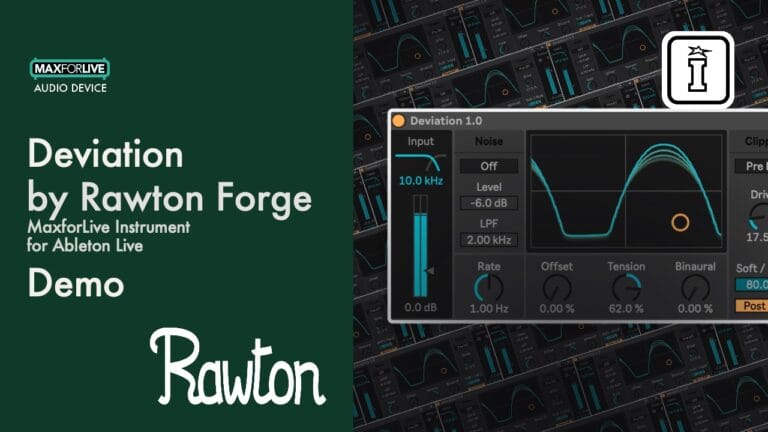
Deviation by Rawton Forge
SATURATION THAT TAKES SIDES.
Deviation by Rawton Forge is an asymmetric binaural waveshaper for Ableton Live — bending positive and negative half-cycles independently to generate even harmonics, genuine stereo width, and continuous stereo motion, all from the shape of the signal itself.
- Asymmetric waveshaping: Bounded homographic transfer function stretches waveforms around a movable pivot point
- Binaural stereo width: Per-channel deformation generates real stereo spread without wideners or tricks
- Quadrature LFO: Internal sine LFO modulates deformation in phase quadrature for continuous stereo motion
- Dynamic Offset: DC compensation linked to the signal envelope for clean, responsive processing
- Sidechained noise injection: Ring-mod noise fills waveform dips without touching the peaks
- ADAA soft clipper: Anti-Derivative Anti-Aliasing with adjustable knee — from gentle warmth to hard clip
- Magnitude-complementary crossover: Only the low band is processed; both bands recombine to a flat response
- Auto-Gain RMS matching: Honest A/B comparison at equal loudness, every time
USER GUIDE:
Deviation Userguide
Deviation by Rawton Forge
SATURATION THAT TAKES SIDES.
Deviation by Rawton Forge is an asymmetric binaural waveshaper for Ableton Live — bending positive and negative half-cycles independently to generate even harmonics, genuine stereo width, and continuous stereo motion, all from the shape of the signal itself.
- Asymmetric waveshaping: Bounded homographic transfer function stretches waveforms around a movable pivot point
- Binaural stereo width: Per-channel deformation generates real stereo spread without wideners or tricks
- Quadrature LFO: Internal sine LFO modulates deformation in phase quadrature for continuous stereo motion
- Dynamic Offset: DC compensation linked to the signal envelope for clean, responsive processing
- Sidechained noise injection: Ring-mod noise fills waveform dips without touching the peaks
- ADAA soft clipper: Anti-Derivative Anti-Aliasing with adjustable knee — from gentle warmth to hard clip
- Magnitude-complementary crossover: Only the low band is processed; both bands recombine to a flat response
- Auto-Gain RMS matching: Honest A/B comparison at equal loudness, every time
USER GUIDE:
Deviation Userguide
Additional information
| MaxforLive | Audio Effects |
|---|---|
| OS | Mac, Windows |
| Ableton Live Compatibility | Ableton Live 11 Standard with MaxforLive, Ableton Live 11 Suite, Ableton Live 12 Standard with MaxforLive, Ableton Live 12 Suite |
| Min. Requirements | Ableton Live 11 Suite or Ableton Live 11 Standard with Max for Live add-on |
PRICE: £16.50
Product reviews
No reviews yet. Be the first to review this product.
Deviation by Rawton Forge
Most saturation tools treat your waveform the same way above and below zero. Deviation doesn’t. Rawton Forge‘s asymmetric waveshaper bends positive and negative half-cycles independently — stretching the signal around a movable pivot point, generating even harmonics that conventional symmetric distortion simply can’t produce, and turning a clean sine into a pulse whose width tracks your input in real time.
But Deviation isn’t just about harmonic content — it’s about space. Applied independently per channel, the same asymmetric deformation becomes a source of genuine stereo width and motion. No artificial widening, no mid-side tricks. The stereo image emerges directly from the difference in waveform shape between left and right, making it one of the most organic-sounding approaches to stereo enhancement available in a Max for Live device. Combined with a phase-quadrature LFO that continuously modulates the deformation on each channel, Deviation keeps your sound alive and moving in a way that static processors simply can’t replicate.
Key Features
- Asymmetric waveshaping: A bounded homographic transfer function stretches waveforms around a movable pivot point, making positive and negative half-cycles unequal and generating rich even-harmonic content
- Binaural stereo width: Per-channel deformation with a dedicated Binaural control creates genuine stereo spread directly from signal shape — no artificial widening required
- Phase-quadrature LFO: Internal sine LFO modulates the deformation on each channel 90° out of phase, generating continuous, natural-feeling stereo motion
- Dynamic Offset control: Links DC compensation to the signal envelope for responsive, artefact-free operation across dynamic material
- Sidechained ring-mod noise injection: Fills the dips of the waveform with noise without touching the peaks — adding texture precisely where headroom allows
- ADAA soft clipper: Anti-Derivative Anti-Aliasing (ADAA-1) keeps the output clean at all sample rates, with an adjustable knee spanning gentle saturation through hard limiting
- Magnitude-complementary crossover: Adjustable cutoff frequency splits the signal into two bands — only the low band is processed, and both recombine to a mathematically flat frequency response
- Pre and Post DC blocking: Ensures symmetric clipping behaviour and a clean, DC-free output signal
- Auto-Gain RMS matching: Automatic level compensation keeps perceived loudness consistent for honest, equal-loudness A/B comparisons
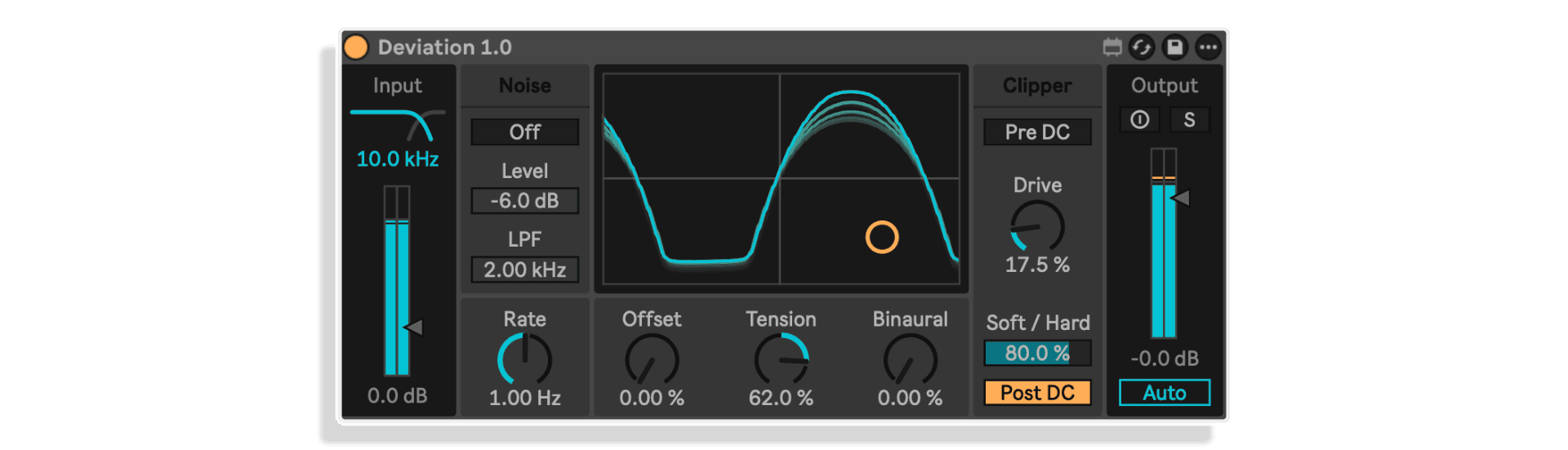
- Real-time Response display: Visual transfer function display with an integrated XY control point — Tension on X, Drive on Y — so you always know exactly what shape your signal is taking
How It Works
At the heart of Deviation is a homographic transfer function — a bounded, smooth curve that maps input amplitude to output amplitude in an inherently asymmetric way. Unlike a standard sigmoid or soft-clip curve, which treats positive and negative excursions identically, the homographic function can be shifted around a pivot point. This pivot controls where the waveform is compressed and where it is expanded, and adjusting it changes the ratio of positive-to-negative peak amplitude — the defining characteristic of even-harmonic distortion. The Tension and Drive controls shape this curve in real time, and the integrated XY pad on the response display lets you grab and drag the curve directly for an intuitive, visual approach to harmonic sculpting.
The Binaural section takes this deformation and applies it differently to the left and right channels. The degree of channel-to-channel difference is dialled in with the Binaural knob — at zero both channels are processed identically, as you increase it the channels diverge, pushing the stereo image wider in a way that feels physical and natural rather than processed. Engage the LFO and the deformation on each channel oscillates continuously in quadrature — one channel 90° behind the other — creating a slow, organic stereo sweep that breathes life into sustained sounds without ever feeling like a chorus or a pitch effect.
The crossover section means you don’t have to sacrifice high-frequency clarity for low-end character. Set the cutoff and Deviation processes only the low band — exactly where harmonic enhancement tends to add weight and presence — while the high band passes through untouched. The two bands recombine at a mathematically complementary crossover, guaranteeing a flat summed response regardless of where you set the frequency split. The result is a tool that can thicken a bass, add weight to a kick, or saturate a full mix bus without ever muddying the top end.
The Vibe — Who Is This For?
Deviation is built for producers who want saturation that does something genuinely different. If you’re working in techno, industrial, or experimental electronic music, the asymmetric waveshaping adds a brutal, one-sided harmonic aggression that symmetric clippers can’t match. For house and deep house producers, the low-band crossover and gentle soft clipper offer a transparent way to add warmth and presence to kick drums and bass lines without touching the mix above. Sound designers will find the noise injection and quadrature LFO combination uniquely useful for creating evolving, binaural textures from otherwise static sources. And for mixing engineers working in Ableton Live, the ADAA clipper with RMS-matched Auto-Gain provides a metering-honest, aliasing-free limiting stage that’s genuinely cleaner than most dedicated saturators at extreme settings.
Because it runs natively on Push 3 Standalone, Deviation is equally at home in the studio and on stage — bring it into a live performance rig and automate the Binaural and Drive parameters for real-time spectral and spatial movement that reacts to the energy of the room.
Technical Details
Deviation is a Max for Live Audio Effect compatible with Ableton Live 11 and Ableton Live 12. It requires Ableton Live Suite or Ableton Live Standard with the Max for Live add-on. Runs on Mac and Windows. Fully compatible with Push 3 Standalone.
Frequently Asked Questions
A: Most saturators apply a symmetric transfer function — the positive and negative halves of the waveform are treated identically, producing only odd harmonics. Deviation uses a homographic transfer function with a movable pivot point, making the two half-cycles unequal. This asymmetry generates even harmonics (2nd, 4th, 6th…) that a symmetric clipper physically cannot produce, resulting in a warmer, more analogue-flavoured character.
A: The Binaural control increases the difference in waveshaping deformation between the left and right channels. Because the harmonic content and waveform shape diverge between channels, the brain perceives the sound as wider — without any mid-side processing, delay-based widening, or pitch shifting. It’s genuine stereo width derived purely from the shape of the signal.
A: The internal sine LFO modulates the deformation amount on the left and right channels simultaneously, but with a 90° phase offset between them. This means as the left channel’s waveshaping reaches its peak, the right channel is halfway through its cycle — creating a continuous, slow rotation of the stereo image that sounds natural and organic rather than like a conventional chorus or tremolo effect.
A: ADAA stands for Anti-Derivative Anti-Aliasing. Standard waveshapers can introduce aliasing artefacts — unwanted high-frequency mirror images of the harmonics being generated — especially at high drive settings or on high-frequency source material. ADAA-1 mathematically suppresses these artefacts by computing the integral of the transfer function, resulting in a cleaner, more accurate output at all sample rates without the CPU overhead of heavy oversampling.
A: Deviation is designed to work well in both contexts. The magnitude-complementary crossover lets you restrict processing to the low band only, which is particularly useful on a mix bus where you want to add low-end weight without affecting the high-frequency detail. The Auto-Gain RMS matching ensures the output level stays consistent, making A/B comparison straightforward and preventing the louder-sounds-better bias during evaluation.
A: Asymmetric waveshaping can introduce a DC offset — a constant voltage shift in the output signal — because the positive and negative half-cycles are no longer balanced. The Dynamic Offset control links a DC compensation circuit to the signal envelope, so the correction tracks the signal dynamically rather than applying a fixed static correction. This prevents pumping artefacts on transient-heavy material and keeps the output centred regardless of input dynamics.
A: No — the noise injection uses a sidechained ring-modulation circuit that’s keyed to the amplitude of the input signal. Noise is added only when the waveform is near zero (in the dips), and suppressed when the waveform is at its peaks. This means you get textural complexity and analogue-style noise floor behaviour without the noise competing with the loudest parts of your signal.
A: Yes. Deviation is fully compatible with Push 3 Standalone, so you can use it in a hardware-only live performance setup without a connected computer. All controls are accessible directly from the Push 3 interface.
Important Information
## v1.2.0 – 29 May 2026
ADDED
– Push compatibility: device now reads the Live version on load and sets the encoder mapping to match. Button rows need Live 12.3+; older versions fall back to encoders only.
FIXED
– Crossover frequency wasn’t saved with the set. Now persists correctly.
– Disabled state: colored UI elements now grey out when the device is off.
v1.0.0 – Initial Release
Our Products are generally provided as Zip file downloads which in all cases will need to be extracted before use. For Max for Live Devices please place the extracted device in your User Library. For Ableton Live Packs please double click the extracted .alp file to install. For Ableton Live Projects please place in your projects folder.
END-USER LICENSE AGREEMENT FOR ISOTONIK STUDIOS SOFTWARE PRODUCTS.
PLEASE READ THE TERMS AND CONDITIONS OF THIS LICENSE AGREEMENT CAREFULLY BEFORE CONTINUING WITH THIS PROGRAM INSTALL.
This End-User License Agreement (referred to as “EULA”) is a legal agreement between an individual or a single entity (referred to as “LICENSEE”) and Isotonik Studios for the Isotonik Studios software product(s) which may include associated software components, media, printed materials, and “online” or electronic documentation (referred to as “SOFTWARE PRODUCT”). By installing, copying, or otherwise using the SOFTWARE PRODUCT, the LICENSEE agrees to be bound by the terms of this EULA.
This EULA represents the entire agreement concerning the program between the LICENSEE and Isotonik Studios and it supersedes any prior proposal, representation, or understanding between the parties. If the LICENSEE does not agree to the terms of this EULA, the LICENSEE should not install or use the SOFTWARE PRODUCT.
The SOFTWARE PRODUCT is protected by copyright laws and international copyright treaties, as well as other intellectual property laws and treaties. The SOFTWARE PRODUCT is licensed, not sold.
- GRANT OF LICENSE.
The SOFTWARE PRODUCT is licensed as follows:
(a) Installation and Use. Providing that the LICENSEE has paid any applicable license fees, Isotonik Studios grants the LICENSEE the right to install and use copies of the SOFTWARE PRODUCT on up to two computers in the LICENSEE’s possession that are running a validly licensed copy of the operating system for which the SOFTWARE PRODUCT was designed [e.g., Windows 10, macOS]. The computer(s) must be owned by the LICENSEE.
(b) Backup Copies. The LICENSEE may also make copies of the SOFTWARE PRODUCT as may be necessary for backup and archival purposes.
- DESCRIPTION OF OTHER RIGHTS AND LIMITATIONS.
(a) Maintenance of Copyright Notices. The LICENSEE must not remove or alter any copyright notices on any and all copies of the SOFTWARE PRODUCT.
(b) Distribution. The LICENSEE may not distribute registered copies of the SOFTWARE PRODUCT to third parties.
(c) Prohibition on Reverse Engineering, Decompilation, and Disassembly. The LICENSEE may not reverse engineer, decompile, or disassemble the SOFTWARE PRODUCT, except and only to the extent that such activity is expressly permitted by applicable law notwithstanding this limitation.
(d) Rental. The LICENSEE may not rent, lease, or lend the SOFTWARE PRODUCT.
(e) License transfer The LICENSEE may not transfer their license to the SOFTWARE PRODUCT to any third party. Any attempt to do so will be considered a violation of this EULA.
(f) Support Services. Isotonik Studios may provide the LICENSEE with support services related to the SOFTWARE PRODUCT for a period of 12 months following the date of purchase. Any supplemental software code provided to the LICENSEE as part of the Support Services shall be considered part of the SOFTWARE PRODUCT and subject to the terms and conditions of this EULA.
(g) Compliance with Applicable Laws. The LICENSEE must comply with all applicable laws regarding use of the SOFTWARE PRODUCT.
- TERMINATION Without prejudice to any other rights, Isotonik Studios may terminate this EULA if the LICENSEE fails to comply with the terms and conditions of this EULA. In such event, the LICENSEE must destroy all copies of the SOFTWARE PRODUCT in the LICENSEE’s possession.
- COPYRIGHT All title, including but not limited to copyrights, in and to the SOFTWARE PRODUCT and any copies thereof are owned by Isotonik Studios or its suppliers. All title and intellectual property rights in and to the content which may be accessed through use of the SOFTWARE PRODUCT is the property of the respective content owner and may be protected by applicable copyright or other intellectual property laws and treaties. This EULA grants the LICENSEE no rights to use such content. All rights not expressly granted are reserved by Isotonik Studios.
- NO WARRANTIES Isotonik Studios expressly disclaims any warranty for the SOFTWARE PRODUCT. The SOFTWARE PRODUCT is provided ‘As Is’ without any express or implied warranty of any kind, including but not limited to any warranties of merchantability, noninfringement, or fitness of a particular purpose. Isotonik Studios does not warrant or assume responsibility for the accuracy or completeness of any information, text, graphics, links or other items contained within the SOFTWARE PRODUCT. Isotonik Studios makes no warranties respecting any harm that may be caused by the transmission of a computer virus, worm, time bomb, logic bomb, or other such computer program. Isotonik Studios further expressly disclaims any warranty or representation to the LICENSEE or to any third party.
- LIMITATION OF LIABILITY In no event shall Isotonik Studios be liable for any damages (including, without limitation, lost profits, business interruption, or lost information) arising out of the LICENSEE’s use of or inability to use the SOFTWARE PRODUCT, even if Isotonik Studios has been advised of the possibility of such damages. In no event will Isotonik Studios be liable for loss of data or for indirect, special, incidental, consequential (including lost profit), or other damages based in contract, tort or otherwise. Isotonik Studios shall have no liability with respect to the content of the SOFTWARE PRODUCT or any part thereof, including but not limited to errors or omissions contained therein, libel, infringements of rights of publicity, privacy, trademark rights, business interruption, personal injury, loss of privacy, moral rights or the disclosure of confidential information.