
Birds by Alessandro aylesim Miracapillo
WHAT IF YOUR MELODY COULD WRITE ITSELF?
MAKE YOUR OWN TRIPLE PACK: Buy any three or more Aylesim products at the same time and get a 20% Discount (automatically applied at checkout)
Static sequences repeat. Birds evolves. This MaxforLive instrument generates 16-step melodic sequences and mutates them in real time — drifting away from the original idea and back again, creating melodies that breathe, shift, and surprise without losing their thread.
Inside you’ll find:
- Four generative styles — Stormo, Ostinato, Cantabile, and Puntillista — each producing distinct melodic character
- Eight pitch evolution algorithms including Chromatic, Gravity, Smooth, Drift, Interval, and Rotate
- Difference Limit control to set how far the sequence drifts from the original reference
- Independent gate evolution with Shuffle, Density, and Chaos controls for rhythmic mutation
- Generation tab with full control over density, note range, velocity range, and motif length
- Two clock modes — internal Steps or external MIDI Trigger for hardware and software sync
- Sequence Length from 1 to 16 steps
- Direct Ableton Live scale integration — diatonic or full chromatic mode
- Visual bird-on-wire interface showing every note state at a glance
A generative melody engine for composers, performers, and producers who want sequences that stay alive.
Requires Ableton Live and MaxforLive.
USER GUIDE: Birds Manual
Birds by Alessandro aylesim Miracapillo
WHAT IF YOUR MELODY COULD WRITE ITSELF?
MAKE YOUR OWN TRIPLE PACK: Buy any three or more Aylesim products at the same time and get a 20% Discount (automatically applied at checkout)
Static sequences repeat. Birds evolves. This MaxforLive instrument generates 16-step melodic sequences and mutates them in real time — drifting away from the original idea and back again, creating melodies that breathe, shift, and surprise without losing their thread.
Inside you’ll find:
- Four generative styles — Stormo, Ostinato, Cantabile, and Puntillista — each producing distinct melodic character
- Eight pitch evolution algorithms including Chromatic, Gravity, Smooth, Drift, Interval, and Rotate
- Difference Limit control to set how far the sequence drifts from the original reference
- Independent gate evolution with Shuffle, Density, and Chaos controls for rhythmic mutation
- Generation tab with full control over density, note range, velocity range, and motif length
- Two clock modes — internal Steps or external MIDI Trigger for hardware and software sync
- Sequence Length from 1 to 16 steps
- Direct Ableton Live scale integration — diatonic or full chromatic mode
- Visual bird-on-wire interface showing every note state at a glance
A generative melody engine for composers, performers, and producers who want sequences that stay alive.
Requires Ableton Live and MaxforLive.
USER GUIDE: Birds Manual

Product reviews
4.8 out of 5
4 reviews
How item rating is calculated
We show the average based on reviews. Only genuine reviews are displayed.
Sort by
July 5, 2026
This reviewer bought this product from our store.
Excellent device! It sparks creative ideas quickly and fits naturally into my workflow. Simple to use, inspiring, and a lot of fun. Highly recommended!
I recommend this product
April 11, 2026
This reviewer bought this product from our store.
Follow the Birds to the sky 8-)
BIrds delivers what it promises, and takes your idea to even better places
Melody variations are sensible niot just random
Getting spaces in between phrases could be better, maybe with a "null" bird for silence.
I recommend this product
March 26, 2026
This reviewer bought this product from our store.
Super inspiring generative sequencer
Love this sequencer, within minutes I had a full ambient track going with enough movement in the loop to keep it intersting
I recommend this product
March 29, 2026
This reviewer bought this product from our store.
Alfred Hitchcock returnnsssss
I love using "random" coming from some birds, a little... ummm... Alfred Hitchcock is here!
It made me smile at the last minute.
easy and crazy
nop
I recommend this product
Birds by Alessandro aylesim Miracapillo
Programming a melody takes time — and the results can feel fixed, predictable, finished. Birds by Aylesim approaches MIDI composition from the opposite direction. It generates 16-step melodic sequences and evolves them in real time, so the music you hear keeps moving without you having to rewrite a single note. A living sequence, not a static one.
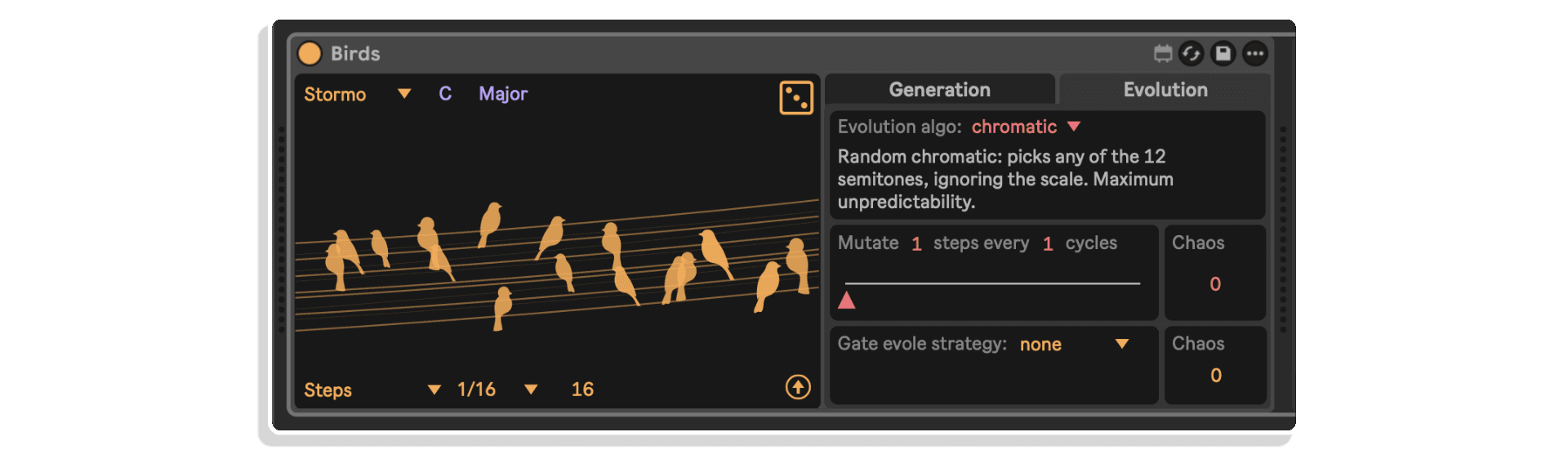
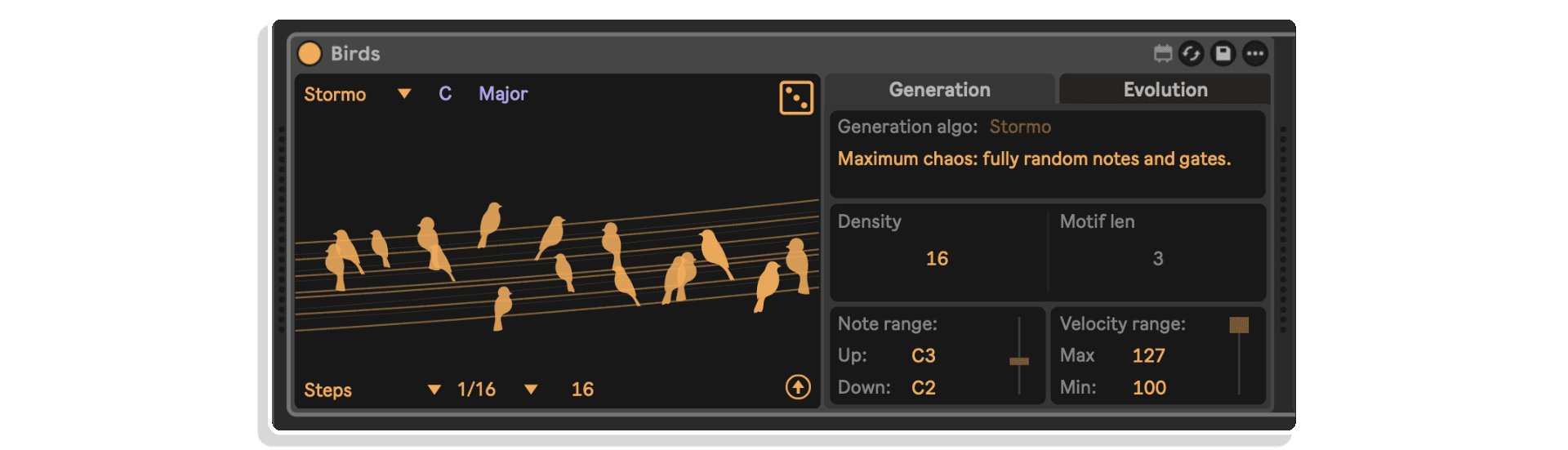
The interface makes the concept tangible. Birds sit on wires. Each bird is a note, its position on the wire is the pitch, and its horizontal position is the timing. As the sequence evolves, birds migrate between wires and you watch the melody change as it plays. Yellow birds are the original sequence. Red birds are evolved notes that have drifted from the original. Transparent birds are inactive steps. The picture tells you exactly where the sequence stands at any moment.
Four Generative Styles
Birds comes with four distinct algorithms for generating sequences, each producing a very different musical character. Choose your style from the dropdown before hitting the Random button, and a fresh melody is generated instantly.
- Stormo — Maximum chaos. Notes and gates are fully random with no memory between steps. Unpredictable, dense textures and rapid melodic movement.
- Ostinato — A short repeating motif with small variations. Near-constant gate activity with an accent on the first note of each repetition. Driving, repetitive patterns with internal momentum.
- Cantabile — Smooth, connected melody using small pitch steps and Euclidean rhythm. Soft dynamics and lyrical, flowing lines.
- Puntillista — Sparse notes with wide silences, favouring the tonic and dominant. Pointillistic, space-forward textures where every note lands with intention.
Birds reads the scale and root key directly from Ableton Live. With scale mode active, all generated notes stay diatonic. With scale mode off, the full chromatic range is available for atonal or experimental results.
The Evolution Engine
Every generated sequence becomes a reference point. The Evolution system mutates notes away from that reference — and back toward it — following a target divergence set by the Difference Limit. The sequence never drifts into total randomness. It orbits the original idea, creating variations that are always retrievable.
Eight pitch mutation algorithms give you precise control over how the melody changes over time:
- Chromatic — Random notes from all 12 chromatic pitches. Maximum unpredictability for atonal or experimental lines.
- Diatonic — Random notes drawn from the active scale. Stays in key while moving freely through any degree or octave.
- Stepwise — Notes move by 1-2 scale degrees up or down. Conjunct, vocal-like phrases with minimal leaps.
- Smooth — Each note moves toward the midpoint of its two neighbours. Gentle contours and gradual changes.
- Gravity — Notes are pulled toward the root. The farther they stray from the tonic, the stronger the pull.
- Drift — Small random steps with a gentle corrective pull when notes stray too far. Controlled randomness.
- Interval — Leaps from minor 2nd up to a 5th, biased toward larger intervals. Angular, disjunct melodic lines.
- Rotate — Copies a note from a nearby step, shifting the pattern gradually along the sequence. Motivic displacement and rhythmic variation.
The Chaos parameter adds independent random mutations at each step, operating outside the diverge/converge logic. Low values introduce occasional surprises. High values push the melody into unpredictable territory even when the Difference Limit is stable.
Generation Controls
The Generation tab shapes how new sequences are built before the Random button is pressed. Every parameter here feeds directly into the algorithm when you generate.
- Density (1-16) — Controls how many steps carry an active note. Behaviour varies by style: probability-based in Stormo, Euclidean in Cantabile, capped at 6 in Puntillista, minimum 12 in Ostinato.
- Motif Length (2-8) — Sets the repeating motif length for Ostinato. Shorter values produce tight loops; longer values build extended phrases before the motif restarts.
- Note Range — Note Down and Note Up define the pitch boundaries (MIDI 0-127). Narrow ranges favour stepwise motion; wide ranges allow larger melodic leaps.
- Velocity Range — Velocity Min and Velocity Max set the dynamic range for generated notes. Some styles use a narrow band for consistency; others exploit the full range for contrast.
Rhythm Evolution
Gate evolution works independently of pitch mutation. The Gate Evolve Strategy controls which steps are active as the sequence plays:
- None — Gates stay fixed. Only pitch changes over time.
- Shuffle — Active and inactive gates swap positions at a set probability. Density stays the same but accents shift.
- Density — The number of active gates is locked to the Gate Limit, but which steps are on or off changes at random. Fixed density, evolving pattern.
Gate Chaos independently flips individual gates at each step, adding or removing notes as the sequence runs. Low values keep the rhythm recognisable. High values produce increasingly irregular, unpredictable patterns.
Clock and Sequence Control
Birds advances through its sequence in two ways. In Steps mode, it follows Ableton’s transport at the selected rhythmic division (e.g. 1/16). In MIDI Trigger mode, each incoming MIDI note advances the sequence by one step — letting you drive Birds from an external sequencer, drum pad, or keyboard and sync it to hardware or other software.
Sequence Length sets how many of the 16 steps are active (1-16). Shorter lengths produce tight phrases that loop quickly. Longer lengths build extended melodic lines. Steps beyond the active length are greyed out in the interface.
Make Your Own Triple Pack
Buy any three or more Aylesim products at the same time and get a 20% discount, automatically applied at checkout.
Explore More from Aylesim
Frequently Asked Questions
A: Birds is a MaxforLive instrument that generates 16-step melodic sequences and evolves them in real time. Using four generative styles and eight pitch mutation algorithms, it creates melodies that drift away from an original reference and back again — producing living sequences that change without losing their musical coherence.
A: Yes. Birds is a MaxforLive device and requires both Ableton Live and MaxforLive to run.
A: MaxforLive is a platform that integrates the visual programming environment Max with Ableton Live, allowing users to create and use custom audio, MIDI, and control devices.
A: Yes. In MIDI Trigger mode, each incoming MIDI note advances the sequence by one step, letting you drive Birds from an external sequencer, drum pad, or keyboard.
A: You can explore the full Aylesim catalogue here: https://isotonikstudios.com/brand/aylesim/
Important Information
V1.0.0 – Initial Release – April 2026
Our Products are generally provided as Zip file downloads which in all cases will need to be extracted and saved to your hard drive prior to installation. Details on the different file type provided and what to do with them are below.
.alp Files – These are Ableton Live Packs and will either install directly into the Packs Section of the browser of Ableton Live or ask you to save them to your hard drive. For packs that install to the library, when you double click on them you will see a pop up window asking you to confirm that installation is ok as the files are described as “Legacy”. This is fine and you are ok to proceed, the packs are created using the format for an earlier version of Live and so remain compatible with the current version.
.amxd files – These are individual MaxforLive Devices and can be stored anywhere on your hard drive. We’d advise creating a folder for them and then adding that folder as a location within the Places section of Lives Browser.
END-USER LICENSE AGREEMENT FOR ISOTONIK STUDIOS SOFTWARE PRODUCTS.
PLEASE READ THE TERMS AND CONDITIONS OF THIS LICENSE AGREEMENT CAREFULLY BEFORE CONTINUING WITH THIS PROGRAM INSTALL.
This End-User License Agreement (referred to as “EULA”) is a legal agreement between an individual or a single entity (referred to as “LICENSEE”) and Isotonik Studios for the Isotonik Studios software product(s) which may include associated software components, media, printed materials, and “online” or electronic documentation (referred to as “SOFTWARE PRODUCT”). By installing, copying, or otherwise using the SOFTWARE PRODUCT, the LICENSEE agrees to be bound by the terms of this EULA.
This EULA represents the entire agreement concerning the program between the LICENSEE and Isotonik Studios and it supersedes any prior proposal, representation, or understanding between the parties. If the LICENSEE does not agree to the terms of this EULA, the LICENSEE should not install or use the SOFTWARE PRODUCT.
The SOFTWARE PRODUCT is protected by copyright laws and international copyright treaties, as well as other intellectual property laws and treaties. The SOFTWARE PRODUCT is licensed, not sold.
- GRANT OF LICENSE.
The SOFTWARE PRODUCT is licensed as follows:
(a) Installation and Use. Providing that the LICENSEE has paid any applicable license fees, Isotonik Studios grants the LICENSEE the right to install and use copies of the SOFTWARE PRODUCT on up to two computers in the LICENSEE’s possession that are running a validly licensed copy of the operating system for which the SOFTWARE PRODUCT was designed [e.g., Windows 10, macOS]. The computer(s) must be owned by the LICENSEE.
(b) Backup Copies. The LICENSEE may also make copies of the SOFTWARE PRODUCT as may be necessary for backup and archival purposes.
- DESCRIPTION OF OTHER RIGHTS AND LIMITATIONS.
(a) Maintenance of Copyright Notices. The LICENSEE must not remove or alter any copyright notices on any and all copies of the SOFTWARE PRODUCT.
(b) Distribution. The LICENSEE may not distribute registered copies of the SOFTWARE PRODUCT to third parties.
(c) Prohibition on Reverse Engineering, Decompilation, and Disassembly. The LICENSEE may not reverse engineer, decompile, or disassemble the SOFTWARE PRODUCT, except and only to the extent that such activity is expressly permitted by applicable law notwithstanding this limitation.
(d) Rental. The LICENSEE may not rent, lease, or lend the SOFTWARE PRODUCT.
(e) License transfer The LICENSEE may not transfer their license to the SOFTWARE PRODUCT to any third party. Any attempt to do so will be considered a violation of this EULA.
(f) Support Services. Isotonik Studios may provide the LICENSEE with support services related to the SOFTWARE PRODUCT for a period of 12 months following the date of purchase. Any supplemental software code provided to the LICENSEE as part of the Support Services shall be considered part of the SOFTWARE PRODUCT and subject to the terms and conditions of this EULA.
(g) Compliance with Applicable Laws. The LICENSEE must comply with all applicable laws regarding use of the SOFTWARE PRODUCT.
- TERMINATION Without prejudice to any other rights, Isotonik Studios may terminate this EULA if the LICENSEE fails to comply with the terms and conditions of this EULA. In such event, the LICENSEE must destroy all copies of the SOFTWARE PRODUCT in the LICENSEE’s possession.
- COPYRIGHT All title, including but not limited to copyrights, in and to the SOFTWARE PRODUCT and any copies thereof are owned by Isotonik Studios or its suppliers. All title and intellectual property rights in and to the content which may be accessed through use of the SOFTWARE PRODUCT is the property of the respective content owner and may be protected by applicable copyright or other intellectual property laws and treaties. This EULA grants the LICENSEE no rights to use such content. All rights not expressly granted are reserved by Isotonik Studios.
- NO WARRANTIES Isotonik Studios expressly disclaims any warranty for the SOFTWARE PRODUCT. The SOFTWARE PRODUCT is provided ‘As Is’ without any express or implied warranty of any kind, including but not limited to any warranties of merchantability, noninfringement, or fitness of a particular purpose. Isotonik Studios does not warrant or assume responsibility for the accuracy or completeness of any information, text, graphics, links or other items contained within the SOFTWARE PRODUCT. Isotonik Studios makes no warranties respecting any harm that may be caused by the transmission of a computer virus, worm, time bomb, logic bomb, or other such computer program. Isotonik Studios further expressly disclaims any warranty or representation to the LICENSEE or to any third party.
- LIMITATION OF LIABILITY In no event shall Isotonik Studios be liable for any damages (including, without limitation, lost profits, business interruption, or lost information) arising out of the LICENSEE’s use of or inability to use the SOFTWARE PRODUCT, even if Isotonik Studios has been advised of the possibility of such damages. In no event will Isotonik Studios be liable for loss of data or for indirect, special, incidental, consequential (including lost profit), or other damages based in contract, tort or otherwise. Isotonik Studios shall have no liability with respect to the content of the SOFTWARE PRODUCT or any part thereof, including but not limited to errors or omissions contained therein, libel, infringements of rights of publicity, privacy, trademark rights, business interruption, personal injury, loss of privacy, moral rights or the disclosure of confidential information.
More from Aylesim
Frequently Bought Together
 ★ Popular
 -37%
-37%Termite AudioClapp II by Termite AudioLive 11 & 12 · Max for Live Original price was: £19.00.£12.00Current price is: £12.00.