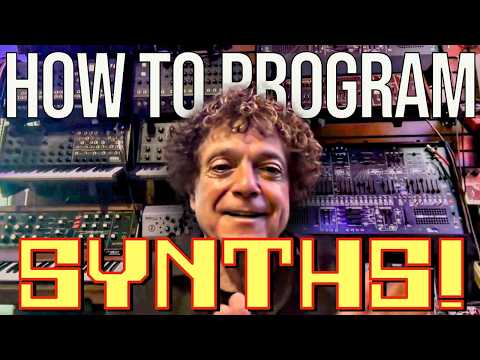
Legendary composer Anthony Marinelli breaks down how to reverse-engineer any sound using just four fundamental parameters: pitch, timbre, duration, and volume.
Anthony Marinelli has composed for Michael Jackson, Quincy Jones, and over 90 film scores. In this clip from the Music Production Podcast, he shares the deceptively simple framework he uses to break down and recreate any sound on a synthesiser, and it starts with just four things.
What It Does
Marinelli calls them the “big four”: pitch, timbre, duration, and volume. Together, these four parameters account for virtually every characteristic of a sound, whether you are trying to recreate a cricket, an orchestra, or anything in between. The approach is about training your ear to analyse a sound systematically before you touch a single knob.
He walks through the cricket example in detail. First you identify the pitch, high or low. Then you consider the timbre, is it fluty, bright like a string, does it pulse from dull to bright? Next comes duration, are the notes short and clipped or do they swell? Finally you address volume, how does the amplitude envelope behave over time? Only once you have answered those four questions do you start mapping them to synthesiser controls: pitch becomes frequency, timbre becomes waveform and filter cutoff slope (6 dB, 12 dB, or 24 dB per octave with or without resonance), duration becomes your envelope shape, and volume becomes amplitude modulation.
He also introduces a fifth layer that sits underneath the big four: irregularity. A real cricket does not sound like a machine because its pitch wobbles slightly as it rubs its legs together. On a synthesiser, you handle that by modulating the pitch with a noise generator, adding the organic unpredictability that separates a convincing sound from a mechanical one. Filtered noise layered beneath the tonal element completes the texture.
How to Use It
- Listen first, touch later. Before opening your synthesiser, close your eyes and isolate the target sound. Ask yourself: where does it sit in pitch? What is its tonal character?
- Map pitch to frequency. Get your oscillator into roughly the right register. If the pitch is wrong at the start, no amount of filter or envelope tweaking will fix it.
- Set timbre via waveform and filter. Choose a waveform that matches the tonal character, then use filter cutoff and slope to sculpt brightness. Add resonance if the sound has a peaked or nasal quality.
- Shape duration with the envelope. Decide whether notes are short and percussive or long and sustained, then dial in your attack, decay, sustain, and release accordingly.
- Control volume dynamics with the amplitude envelope. If the sound pulses or swells, automate or modulate the amplitude to match that rhythm.
- Add irregularity with noise modulation. Route a noise generator to pitch modulation at a low depth to introduce the slight instability found in real-world acoustic sources.
- Layer filtered noise for texture. If there is a non-pitched component (friction, breath, air), add a second noise source, filter it to match the spectral character, and blend it beneath the tonal layer.
Why It Matters
Marinelli draws a compelling analogy: a fluent Spanish speaker does not mentally translate from English, they simply know the word. The goal with synthesis is the same. Once pitch, timbre, duration, and volume become instinctive categories, you stop navigating a synthesiser by trial and error and start speaking its language directly. That shift from guessing to knowing is what separates producers who tweak presets from those who build sounds with real intention and expressive depth.