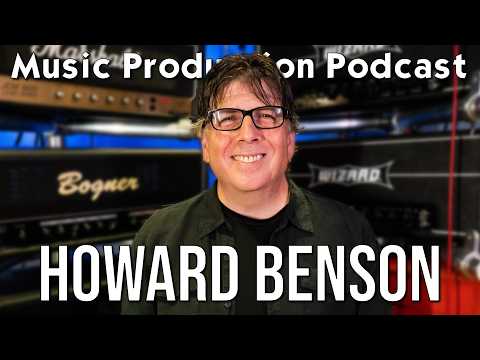
Grammy-winning producer Howard Benson shares how a focus on vocals, great songs, and a repeatable process turned 15 years of struggle into 15 platinum records.
Howard Benson has 15 platinum records, 10 gold records, and over 150 billion streams to his name. He has shaped the sound of modern rock through his work with My Chemical Romance, POD, The All-American Rejects, Daughtry, and many more. In this conversation with Brian Funk, Howard breaks down the mindset, process, and hard-won lessons behind a career that took 15 years to ignite and then never stopped burning.
What It Does
This episode is a masterclass in production philosophy. Howard traces the full arc of his career, from an aerospace engineer who got addicted to making records, through years of near-misses, to the moment ProTools and a chance mentorship with legendary producer Keith Olsen changed everything. The throughline is clear: process beats chaos, and songs beat sonics every time.
Howard is direct about where producers go wrong. Early in his career he was chasing guitar tones and drum sounds while the songs themselves were weak. It took his wife, a music publisher who signed Julia Michaels, telling him bluntly that his records sounded great but the songs were not good enough, to force a real shift. From that point he refused to enter the studio until the material was genuinely strong, turning down the first All-American Rejects record on those grounds alone. Six months later they came back with better songs and they made a hit together.
The vocal production approach Howard describes is equally distinctive. Rather than waiting for a fully tracked record, he starts cutting vocals against a solid demo as early as day three or four of a session. The performance is what he is after first. Tuning and pitch correction come later, once the guitars and bass are locked and there is a reference to tune against. The goal throughout is a vocal that works through a tiny speaker at a CVS pharmacy. If the melody and lyric land in that context, the production has done its job.
How to Use It
- Build a repeatable process before anything else. Howard credits Keith Olsen’s steady, structured approach to sessions as the single biggest shift in his career. Chaos in the room is the artist’s job; stability is the producer’s.
- Start with songs, not sounds. Do the pre-production work. Howard will negotiate arrangements over the phone for weeks before a session begins, and he will reject a project if the material is not ready.
- Get vocals down early. Cut lead vocals to a strong demo rather than waiting for a finished track. You are capturing a performance, not a polished take. Tuning can be addressed once the harmonic picture is complete.
- Separate the comping from the correction. Howard delivers a comped vocal that has the exact performance he wants, then hands it to his editor for gentle pitch correction once the bass and guitars are locked. The two stages are kept distinct on purpose.
- Know your role. Howard recognised he was a better record producer than mixer and brought in Chris Lord-Alge accordingly. Delegating what you are not strongest at tightens the whole process.
- Use data as a neutral referee. Streaming numbers, radio reaction, and listener data now give producers and artists an honest signal on whether a song is connecting. Howard uses that information to have conversations that would otherwise be purely subjective arguments.
Why It Matters
What Howard Benson describes is not a set of tricks or techniques. It is a production worldview built across 15 years of struggle and then refined through 15 platinum records. The core of it is straightforward: the song and the vocal are the record, everything else is in service of those two things. For any producer who wants to move beyond making records that sound impressive in the studio but disappear on release, this conversation is essential. The process Howard outlines is transferable regardless of genre, budget, or whether you are working in a professional facility or a home studio.